
Why this matters: The literature on African energy project finance centers largely on Western-supported investments. This creates a blind spot for decision makers in sub-Saharan Africa where China funds or builds approximately 20% of power plants. Unlike other international partners, China typically delivers power projects as integrated packages, with financing tied to state-backed engineering, procurement, and construction contractors. Some host countries, underprepared for this model, face delays, cost overruns, and lower-quality outcomes. This memo examines how Chinese energy project structures interact with gaps in African countries’ readiness, and how Ghana navigated them to achieve better results.
Three host-country preparedness gaps risk poor outcomes for Chinese-supported power projects
In sub-Saharan Africa, China funds or builds roughly one in five power generation projects. The scale and value of these projects are immense. According to a 2021 study, there were nearly 280 Chinese loan-financed energy projects launched across 40 African countries between 2000 and 2021. About half of those, worth almost $73 billion in loan commitments, remain unfinished. Ensuring the success of these outstanding and future projects remains a challenge because Chinese energy financing and contracting are not easy to navigate.
Many African countries are underprepared in three distinct ways:
- Lack of adequate expertise to handle bundled financing and contracting raises costs. Unlike most partners that separate finance from contractors, China delivers integrated packages of funding tied to state-backed engineering, procurement, and contracting firms. Many African countries lack the trained expertise needed to negotiate favorable financing terms and conditions in a bundled model. The integration of Chinese lenders and contractors, often tied to state-backed firms, can also limit host-country leverage to enforce robust milestone-based payments.
- Uncompetitive power procurement and weak cost benchmarking lead to expensive deals. Chinese firms often negotiate the terms for power projects directly with the host government or utility. While direct negotiation offers flexibility, costs can be padded, overstated, or inflated during negotiations. This shifts more work and risk onto host governments, which must benchmark prices, assess value for money, and negotiate risk allocation, often during supply constraints and with few alternative financiers.
- Limited project oversight results in delays and poor quality. Many African government entities overseeing projects are under-resourced, lacking relevant large-scale project management experience or sufficient personnel to supervise implementation effectively. This contributes to project delays, cost overruns, and lower-than-agreed-upon project quality.
Ghana got better results
Between 2013 and 2020, Ghana delivered five Chinese-supported power projects (solar, hydro, and gas) with a combined capacity of over 1 gigawatt (GW). These projects were delivered at reasonable cost, on relatively strong timelines, and with fewer quality problems than similar Chinese-supported projects elsewhere in the region.
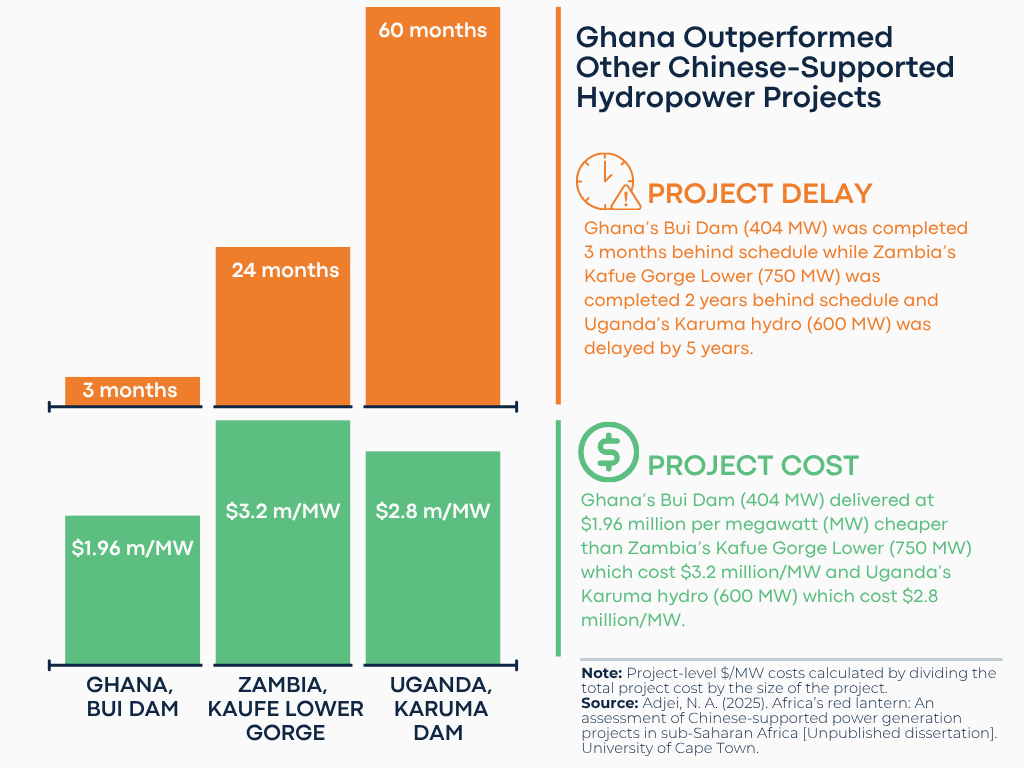
The Bui Dam is a strong example. It was delivered at a cost of $1.96 million per megawatt (MW), well below the regional hydro average ($2.8 million/MW) and lower than comparable projects in Zambia ($3.2 million/MW) and Uganda ($2.8 million/MW). Although these projects were larger than Bui, their delays cannot be explained by size alone. Bui (404 MW) was completed in five years, just three months behind schedule. This was significantly faster than Zambia’s Kafue Gorge Lower (750 MW), which took seven years and finished two years later than Bui. And it had fewer quality problems than Uganda’s Karuma plant (600 MW), which faced cracking dam walls and a five-year delay.
Four things Ghana did to ensure low-cost, timely, and high-quality projects
Other African countries can learn from Ghana’s example. Four specific actions made a difference:
- Set cost benchmarks to improve project cost negotiations. Ghana backed its generation ambitions with clear price signals through its solar feed-in tariff, which established a baseline of about $0.19/kWh. This reduced prolonged price negotiations and created a bankable pathway for two Chinese-supported solar plants, BXC (20 MW) and Meinergy (20 MW).
- Used competitive tendering to lower costs. Ghana used a competitive tendering process in 2018 to deliver the Bui floating solar project (50 MW) in 2020 at the lowest tariff of $0.10/kWh at the time it was commissioned. Firms competed on price, helping keep tariffs closer to actual costs and market rates. This also reduced the risk of price inflation that often arises when competitive procurement is bypassed and projects are directly negotiated.
- Staffed negotiation with experts to ensure flexibility and lower cost. For the Bui hydropower project, Ghana’s team negotiated lower funding requirements, longer repayment period on concessional loans, and linked part of the repayment to cocoa exports to ease debt service pressure while supporting trade. These terms reduced fiscal strain and lifetime financing costs, thereby improving power affordability. This was made possible by an experienced host team leading these direct negotiations.
- Invested in construction oversight to ensure timely and high-quality delivery. Ghana addressed quality disputes early on during Bui Dam construction to protect long-term performance, even when this required short-term work suspensions. For Bui Solar, Ghanaian engineers (including those from Bui Dam) were present alongside Chinese contractors, maintaining continuity of work during COVID-19, gaining hands-on experience, and learning from Chinese contractors. This approach kept the project on schedule despite global COVID-19 disruptions.
A roadmap for cheaper, faster, higher-quality African energy projects with China
Ghana’s experience shows Chinese-supported power plants are not simply ‘built by China.’ The host government, which often owns the asset and carries the debt, must also drive the terms, standards, and delivery.
To reduce the cost of Chinese-supported power projects, African policymakers should follow Ghana’s example:
- Establish clear, enforceable cost-relevant policies; and
- Make transparent, competitive procurement the default for all energy projects.
Donors and other partners can support African governments building capabilities for:
- Specialized financial negotiation expertise; and
- Stronger project implementation oversight to improve project timelines and quality.
Endnotes
- Adjei, N. A. (2025). Africa’s red lantern: An assessment of Chinese-supported power generation projects in sub-Saharan Africa [Unpublished doctoral dissertation]. University of Cape Town.
- Adjei, N A. (2025, July 8). Inside China’s power play: Understanding the institutions behind Africa’s energy projects. The China-Global South Project. https://chinaglobalsouth.com/analysis/china-power-projects-africa-energy-investment/
- Chiyemura, F. (2019). The winds of change in Africa-China relations? Contextualising African agency in Ethiopia-China engagement in wind energy infrastructure financing and development. The Open University. https://oro.open.ac.uk/68225/14/Frangton%20Chiyemura%20PhD%20Thesis.pdf
- Eberhard, A., Gratwick, K., Morella, E., & Antmann, P. (2016). Independent power projects in Sub-Saharan Africa: Lessons from five key countries. World Bank. https://doi.org/10.1596/978-1-4648-0800-5
- Foster, V., Islam, R., Chen, Y. and Calabrese, L. (2025) China’s infrastructure finance in Africa: impacts and lessons. ODI Working Paper. London: ODI www.odi.org/en/publications/chinas-infrastructure-finance-in-africa-impacts-and-lessons/
- Hensengerth, O. (2011). Interaction of Chinese institutions with host governments in dam construction: The Bui dam in Ghana. In Evolution of dam policies: Evidence from the big hydropower states (pp. 229–271). Springer Berlin Heidelberg.
- Jenkins, G. P., Baurzhan, S., & Olasehinde-Williams, G. O. (2018). Evaluation of the economic performance of hydropower developments supported by the World Bank Group 1975 to 2015. https://cri-world.com/publications/qed_dp_405.pdf
- Kiyonga, D. (2021, July 24). Defects delay Karuma, Isimba hydropower dams. Monitor. https://www.monitor.co.ug/uganda/news/national/defects-delay-karuma-isimba-hydropower-dams-3485006
- Kruger, W., Nygaard, I., & Kitzing, L. (2021). Counteracting market concentration in renewable energy auctions: Lessons learned from South Africa. Energy Policy, 148, 111995.
- Lema, R., Bhamidipati, P. L., Gregersen, C., Hansen, U. E., & Kirchherr, J. (2021). China’s investments in renewable energy in Africa: Creating co-benefits or just cashing-in?. World Development, 141, 105365.
- Ngundu, M. (2025). Success and failure of Chinese energy infrastructure projects in Africa.https://www.megatrends-afrika.de/assets/afrika/publications/MTA_working_paper/MTA_WP19_Ngundu_Energy_Infrastructure.pdf