Electricity demand across ASEAN is projected to more than triple by 2050, rising to about 4,000 terawatt-hours (TWh). ASEAN includes some of Asia’s fastest growing economies, including Cambodia, the Philippines, and Vietnam. Nuclear power, including small modular reactors (SMRs), potentially offers a low-carbon solution to support industrialization and rising living standards. A few nuclear startups have already begun to look into the ASEAN market.
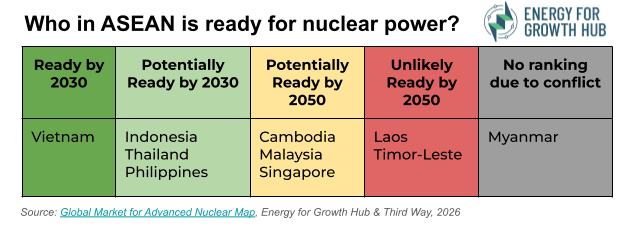
Based on the latest Global Market for Advanced Nuclear map from the Energy for Growth Hub and Third Way, here’s where each ASEAN member stands on nuclear readiness:
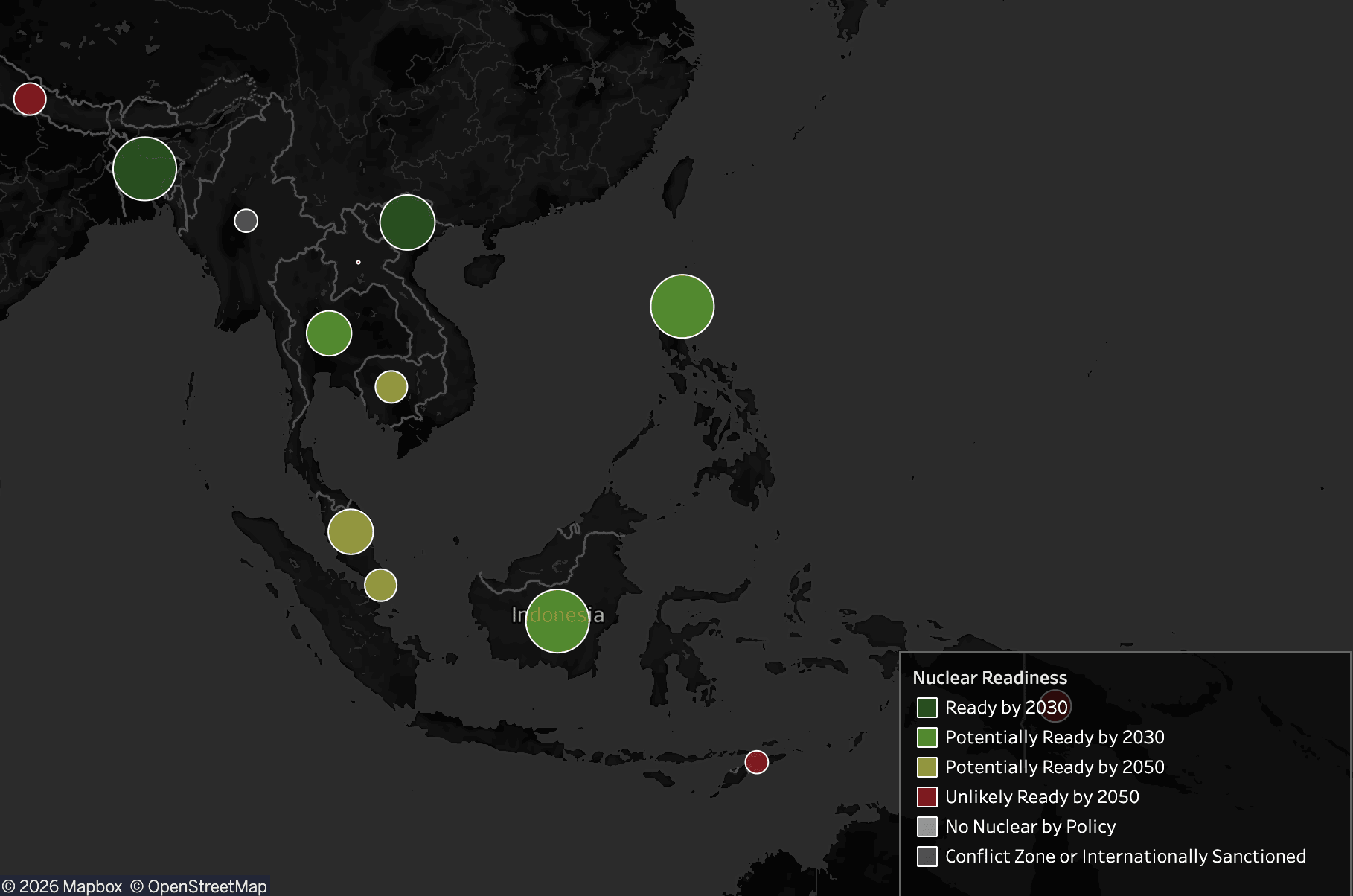
Ready by 2030 (green)
Owned, operating, or actively under construction.
1. Vietnam
- Vietnam plans to commission two nuclear power plants, Ninh Thuan 1 and Ninh Thuan 2, between 2030 and 2035, with a total capacity of 4–6.4 gigawatts (GW).
- In August 2026, the parliament approved plans to build the two-reactor, 2.4 GW Ninh Thuan 1 plant with Rosatom, following a March 2026 nuclear construction agreement. Japan, previously expected to develop the second plant, withdrew in December 2025.
- Vietnam enacted its Atomic Energy Law in 2025 and is currently in Phase 2 of the International Atomic Energy Agency (IAEA) milestones process.
Potentially ready by 2030 (light green)
Strong technical capability and close to ready for signing a vendor agreement.
2. Indonesia
- Indonesia plans to add 10 GW of nuclear power by 2040, and bring its first plant online between 2032 and 2034. It aims for up to 12% of nuclear in its energy mix by 2060, with an installed capacity of 35–42 GW.
- Indonesia is open to collaborating with various countries, including the United States, Russia, China, and South Korea, to develop nuclear power. In May 2026, Rosatom officials met with the Indonesian president to offer support for the country’s nuclear power program. In March 2025, Indonesia hosted a conference on SMRs with Japan and the US under the FIRST program.
3. Thailand
- Thailand’s draft power plan proposes bringing two 300 megawatt (MW) SMRs online by 2037.
- In June 2026, the US Department of Energy streamlined civil nuclear exports to Thailand by designating it as a Generally Authorized Destination, meaning certain nuclear technology and assistance can be exported to Thailand without prior specific DOE authorization.
- Thailand and South Korea hosted an SMR technology seminar in March 2026 on advanced nuclear, and, in 2025, signed an MoU on SMR technology transfer, feasibility, and training.
- Thailand signed a 123 agreement with the US in 2025.
4. The Philippines
- The Philippines aims to bring its first nuclear power plant online by 2032, with plans for 4.8 GW by 2050. In 2025, it established an independent nuclear regulator, and in 2026 the government finalized a streamlined licensing process, announcing it will begin accepting applications in 2026.
- In August 2026, a leading Philippine energy company signed a nuclear cooperation MoU with South Korea.
- In February 2026, the US announced several new initiatives to support the Philippines’ nuclear plans, including an SMR feasibility study with Meralco, the country’s largest utility. The Philippines signed a 123 nuclear agreement in 2024.
Potentially ready by 2050 (yellow)
Has indicated interest but still building capability and not yet close to signing a vendor agreement.
5. Cambodia
- Cambodia has signaled growing openness to nuclear power and continues to cooperate with the IAEA, but has no concrete plans or timeline for deploying a nuclear power plant.
6. Malaysia
- Malaysia currently hosts one nuclear research reactor.
- Malaysia formally included nuclear power in its national development plan in 2025 and is now assessing its nuclear policy and regulatory framework in accordance with the IAEA milestones process.
- In July 2025, Malaysia and the US signed an MoU to launch negotiations for a 123 agreement.
- In August 2025, a government-led pre-feasibility study concluded that nuclear power could be a technically viable long-term option.
- In December 2025, Malaysia amended its atomic energy law to strengthen nuclear safety, security, waste management, and decommissioning.
7. Singapore
*Developments since the March 2026 Global Nuclear Map was published warrant an update from Unlikely ready by 2050 to Potentially ready by 2050.
- Singapore expanded nuclear cooperation with the US, including agreements with Battelle and Idaho National Laboratory to study advanced reactors. The US also designated Singapore a Generally Authorized Destination. Singapore signed a 123 agreement with the US in 2024.
- In March 2026, Singapore signed a nuclear cooperation MoU with South Korea.
- In 2026, Singapore announced it will undergo an IAEA nuclear infrastructure review beginning in 2027.
- Singapore and China signed a nuclear cooperation MoU in August 2026.
Unlikely ready by 2050 (red)
Very low capacity or demonstrable progress.
8. Laos
- In June 2026, Laos and Russia signed a nuclear cooperation MoU.
9. Timor-Leste (ASEAN member as of October 2025)
- No announced plans to develop nuclear power and remains focused on expanding renewable energy.
No ranking due to conflict (grey)
On the World Bank’s list of Fragile and Conflict-affected States.
10. Myanmar
- In August 2026, Rosatom said initial site work for Myanmar’s first nuclear plant could begin in 2027. In March 2025, Rosatom agreed to build a 110 MW project featuring two 55 MW SMRs, with the possibility of expansion to 330 MW.