

Steep electricity price hikes in Ethiopia — What is going on?
In September 2024, Ethiopia initiated a Council of Ministers-approved, four-year long effort to raise electricity tariffs, with these consequences for customers:
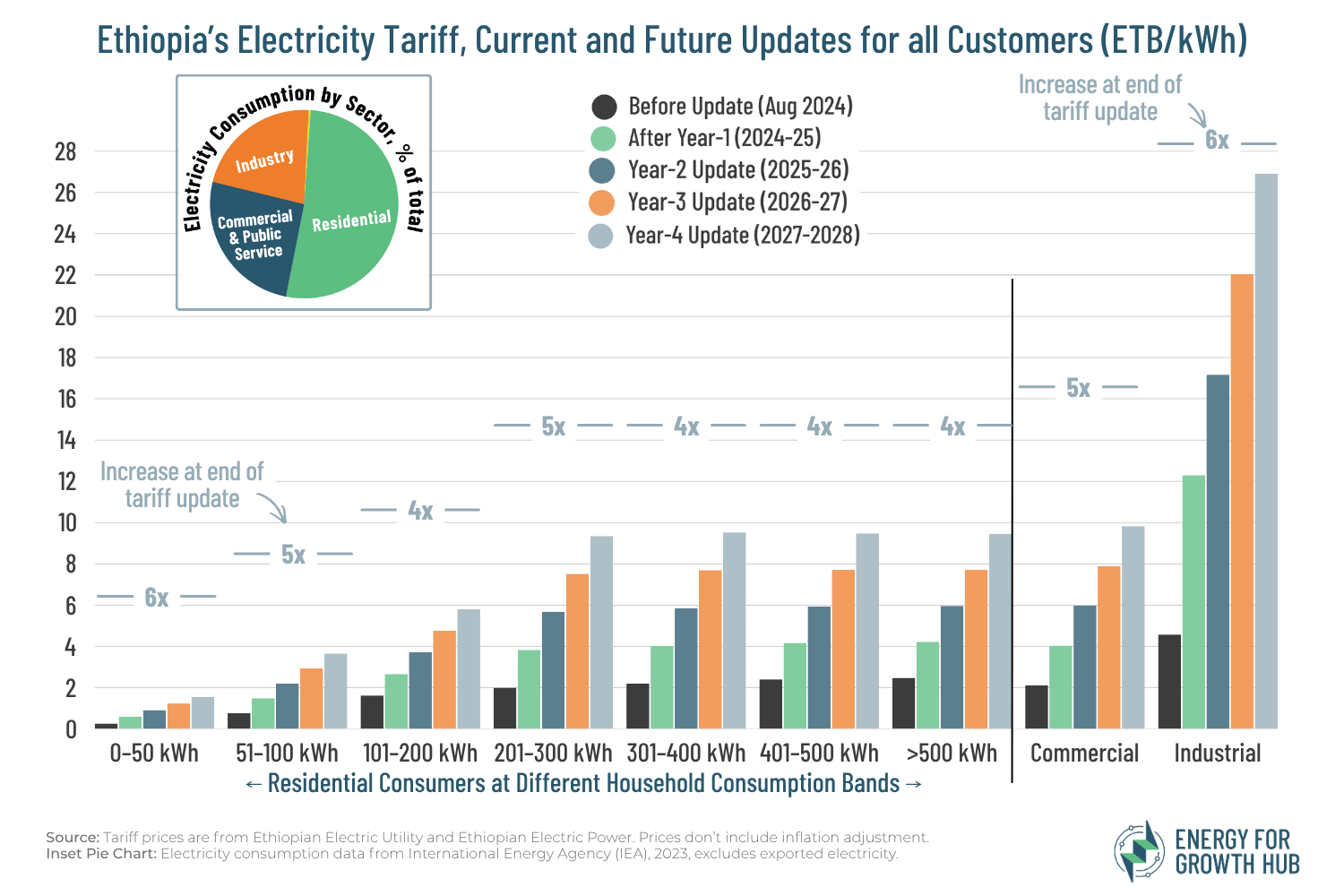
- Residential consumers will pay 4-6x more and lose progressive price structure, despite continued subsidies. Since the tariff adjustment began, rates for residential consumers have more than doubled. By the end of 2028, the three lowest household consumption bands, representing more than 70% of Ethiopian Electric Utility’s consumers, will pay four to six times more relative to before the reform, despite sustained cross-subsidies. The remaining four residential consumption bands will pay nearly identical rates after reform, eroding the old tariff’s progressive structure and straining poor households often on shared connections.
- Local businesses will pay 5x more for electricity. Commercial consumers represent approximately 10% of Ethiopian Electric Utility’s consumer base. Pre-reform, they paid less than those in the three highest-consuming residential consumer bands. After adjustments are complete, commercial tariffs will increase five times and slightly exceed those paid by the highest consuming households.
- Industrial consumers will pay 6x more for electricity, although FX-operating firms may be less affected. Large industrial users are predominantly served by the other state-owned utility, Ethiopian Electric Power. By the end of August 2026, their tariffs will have already quadrupled; two-years later, they will be paying six times the pre-reform levels. The impact is muted for firms that earn and transact in foreign currency given currency depreciation, but far more pronounced for local industries & businesses earning and operating in Ethiopian birr (ETB).
Why is Ethiopia raising electricity tariffs so dramatically now?
Three challenges converged to drive down utility revenue and prompt the current round of reform:
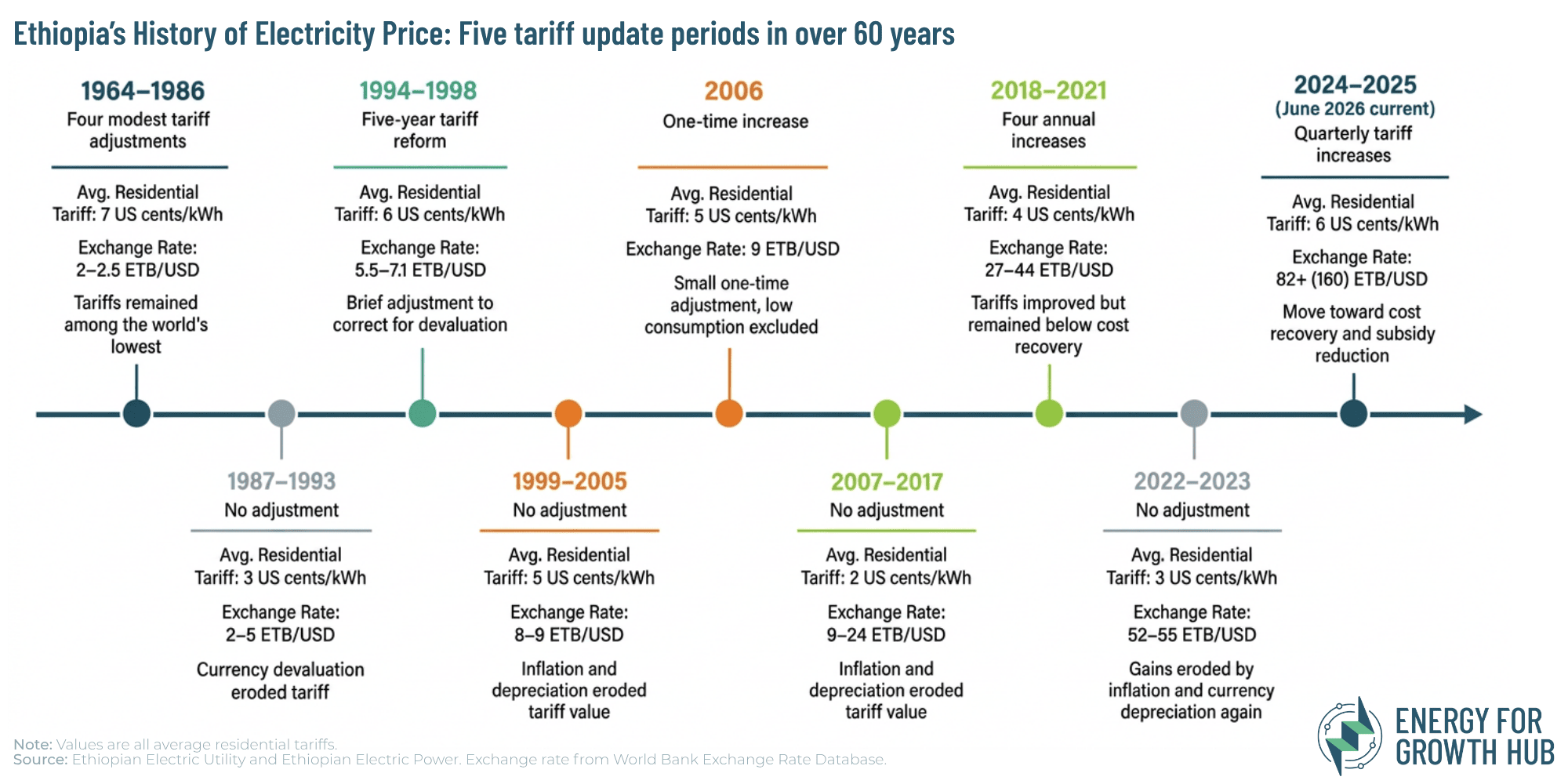
- Ethiopia’s electricity prices were chronically low and not cost reflective. Prior to the current tariff update, Ethiopia had only had four periods of electricity tariff adjustment in over 60 years. Before the last tariff reform in 2018, the average residential consumer paid 1.3 to 3.4 US cents/kilowatt-hour (kWh) — far below the estimated 9.2 US cents/kWh cost of generation, transmission, and distribution. Commercial and industrial tariffs remained below cost, unchanged since 2006 and among the lowest in the world.
- Ethiopia’s currency depreciation, inflation, and import dependence eroded tariff value. Between 2006 and 2022, the value of birr dropped from 9 ETB/USD to 52 ETB/USD. With only a few modest adjustments, the residential tariff fell from 6 cents/kWh to 3 US cents/kWh and commercial tariffs effectively dropped from 8 US cents/kWh to nearly 3 US cents/kwh. At the same time, the cost of providing electricity continued to rise. Ethiopia imports nearly 60% of the materials needed for the power sector. Post-COVID inflation and a currency float in 2024 further weakened the birr, raising the cost of transformers, switchgear, meters, conductors, spares, and contractor services and placing even more pressure on the government and utility.
- Ethiopia’s debt crisis forced long-delayed utility finance reforms. Decades of weakened utility cash flow increased reliance on government support and borrowing. The pressure intensified after Ethiopia missed a Eurobond payment in 2021, culminating in debt restructuring under the G20 Common Framework and an International Monetary Fund stabilization program in 2024. As part of this arrangement, the government has converted accumulated utility debt into equity, committed to quarterly tariff increases to achieve full cost recovery, and set a target to eliminate electricity subsidies by 2027/28.
Half-way through the reform, is it working? Yes — in two important ways.
In June 2026, the eighth of 16 planned quarterly increases in electricity prices began. Combined with the 2018-2021 tariff increase and other utility and sector reforms, the update shows two wins:
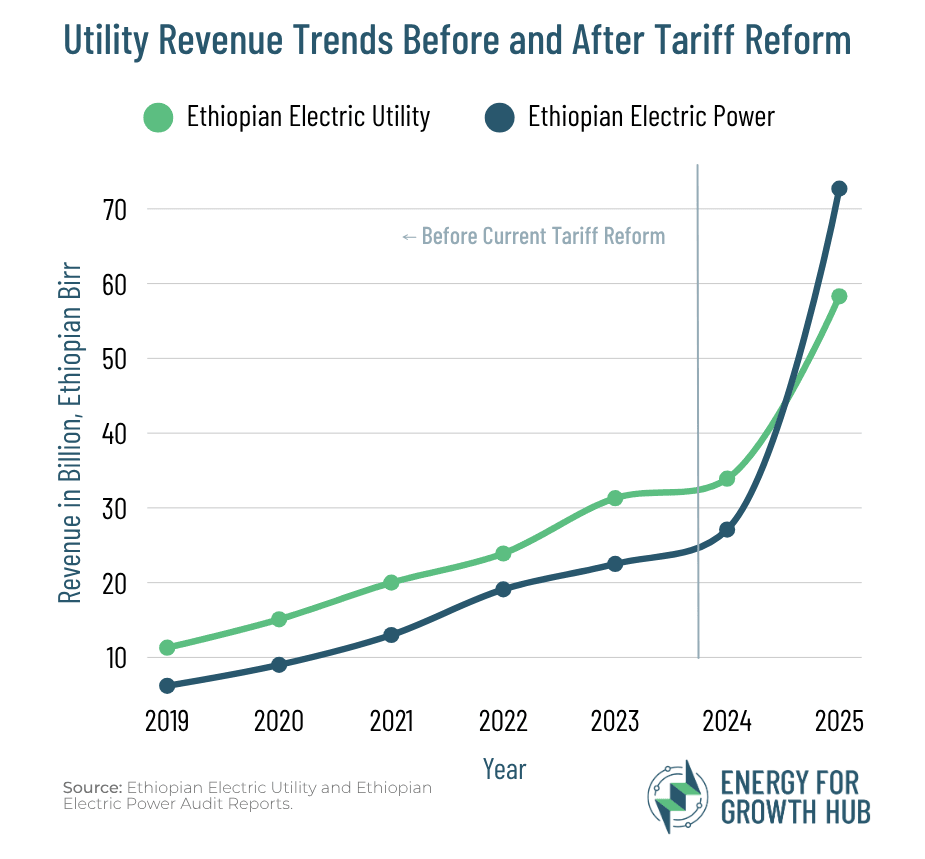
- Boosted utility revenue and positive operational margin. Ethiopian Electric Utility and Ethiopian Electric Power revenues have increased 5x and 12x, respectively, between 2019 and 2025. Prior to 2018, the utilities operated at negative operating profit margins. Post-reform, Ethiopian Electric Utility achieved net-operational profit in 2019 and Ethiopian Electric Power recorded its first operating profit in 2024.
- Expanded customer base. Between 2018 and mid-2026, Ethiopian Electric Utility roughly doubled its active customer base from an estimated 3 million to over 5.6 million connections. It also connected 103 new towns and villages, bringing electricity to more than 31,000 additional households and social institutions. This growth was driven by both boosted revenue and a strategic push to expand grid coverage and deploy decentralized solar hybrid mini-grids in remote rural communities.
Is the reform sustainable ? Not yet. Five risks still threaten long-term success.
Although tariff reforms are improving utility finances and meeting short-term policy objectives, five key risks could erode wins:
- Cost Structure Risk: New tariffs, still below costs, may trigger additional price hikes. Current adjustments will still keep Ethiopia’s electricity prices below the overall cost of generation, distribution, and delivery. Without cost reduction measures like reducing import dependence and technical and commercial losses, future big tariff increases will be imminent.
- Revenue Risk: Tariff increases alone cannot sustain utility finances. Ethiopia has underutilized non-tariff revenue generating opportunities, including monetizing surplus generation, improving electricity export pricing, and attracting large, reliably-paying industrial consumers. Strategies that grow revenue streams can protect consumers from drastic price increases while strengthening utilities.
- Reliability Risk: Higher tariffs may not translate into better power quality. Financial reforms alone are not sufficient. Commercial and industrial consumers need utilities to translate their revenue gains into increased power reliability for economic productivity. To deliver, policymakers need to enact additional governance reforms that link tariffs and utility incentives and oversight to service quality improvements.
- Affordability Risk: High electricity costs could weaken demand and cause public outcry. Wage growth, even in most urban parts of Ethiopia, lags behind the cost of living. No matter how technically justified the tariff increase may be, households will struggle to absorb the rise in electricity bills and knock-on effects on local goods and services. Utilities should closely monitor consumer’s willingness to pay, changes in consumption patterns, and the adoption of alternatives such as rooftop solar that could reduce electricity sales and utility revenue.
- Access Expansion Risk: New connections remain financially difficult to sustain. Ethiopian Electricity Utility has a mandate to expand access from 44% to 75% by the end of the tariff adjustments program. Yet, each new connection could cost between $100 and $1,000 while prospective customers have limited ability to pay. Without more financially sustainable approaches to new connections or low-cost electrification strategies, current tariff increases are not sufficient to close the cost-gap or reach the access target.
Conclusion
Ethiopia’s steepest electricity price increases are helping raise utility revenue and expanding connections. To maintain the gains and avoid unsustainable price hikes, policymakers must take note of and address five major risks: high cost of service, low non-tariff revenue, poor power quality, backlash over unaffordability, and high cost of new connections.
Appendix
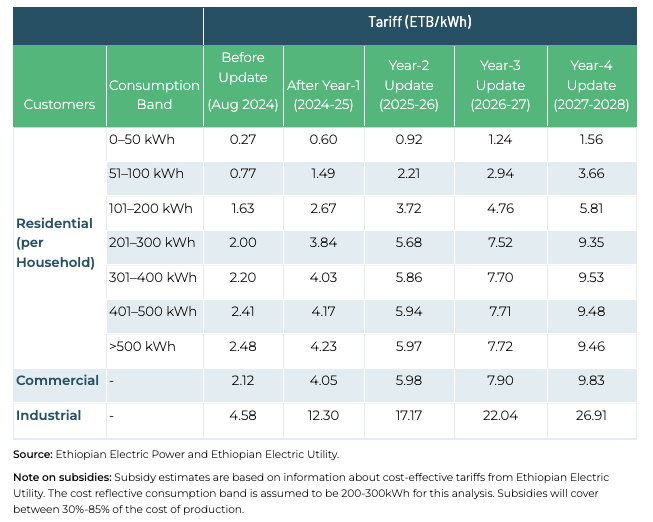
Ethiopia’s electricity price before the tariff reform, current price, and planned price increases by year. Actual adjustments happen quarterly.
Endnotes
- Ayele, Y., & Tesfaye, M. (2025). “Electricity price hikes are not enough: Getting reliable power in Ethiopia requires 5 key governance reforms.” Energy for Growth Hub.
- Bogale, S. (2022). “With surplus power, Ethiopia exports more electricity to neighbours.” The Reporter Ethiopia.
- Cardenas, H., & Whittington, D. (2019). “Magnitude and distribution of electricity and water subsidies for households in Addis Ababa, Ethiopia.” (Policy Research Working Paper No. 9025). World Bank.
- EDF Generation and Engineering Division, & Scott Wilson. (2007). Eastern Nile Power Trade Program Study: Module M3: Energy sector profile & projections: Vol. 3: Ethiopia: Final main report. Eastern Nile Technical Regional Office
- Ethiopian Electric Utility. (2019). Audit report.
- Ethiopian Electric Utility. (2020). Audit report.
- Ethiopian Electric Utility. (2021). Audit report.
- Ethiopian Electric Utility. (2022). Audit report.
- Ethiopian Electric Utility. (2023). Audit report.
- Ethiopian Electric Utility. (2024). Audit report.
- Ethiopian Electric Utility. (2025). Audit report.
- Ethiopian Electric Power. (n.d.).Audit report.
- Fikru, K. (2024, September 7). “New year to start off with revised electricity tariffs.” The Reporter Ethiopia.
- Federal Democratic Republic of Ethiopia, Ministry of Water, Irrigation, and Energy. (2019). National electrification program 2.0: Integrated planning for universal access.
- International Renewable Energy Agency. (2019). Innovation landscape brief: Time-of-use tariffs. International Renewable Energy Agency.
- International Monetary Fund. (2026). “Inflation rate, average consumer prices: Ethiopia,” [Data set]. World Economic Outlook Database, April 2026.
- International Trade Administration. (2024, January 18). “Ethiopia Country Commercial Guide – Energy.” U.S. Department of Commerce.
- Miriri, D. (2026, February 4). “Key events in Ethiopia’s journey towards debt restructuring.” Reuters.
- Office of the Prime Minister, Federal Democratic Republic of Ethiopia, internal letter on the Council of Ministers’ decision regarding the electricity tariff increase proposal, Miazia 8, 2016 E.C. [April 16, 2024], Amharic, scanned copy on file with the author.
- World Bank. (2023, March). Technical assessment for the Additional Financing Ethiopia Electrification Program (P178895).
- World Bank. (2020). “Second Ethiopia growth and competitiveness programmatic development policy financing” (Report No. 146308-ET).
- World Bank. (n.d.). Official exchange rate (LCU per US$, period average) [Data set]. World Development Indicators.