
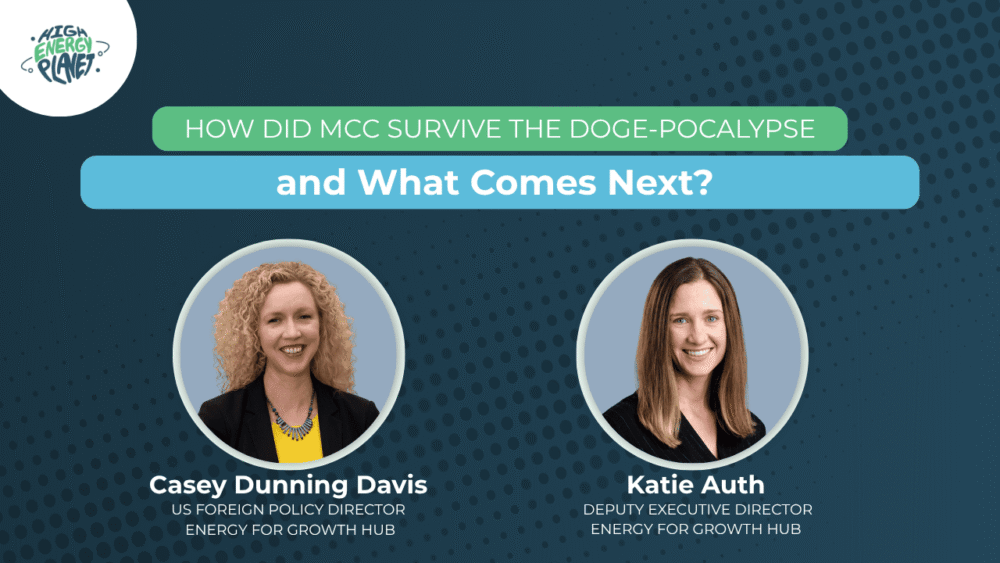
Energy for Growth Hub’s Casey Dunning Davis joins host Katie Auth to discuss how the Millennium Challenge Corporation (mostly) escaped being DOGEd, where it excels in international development, and where it falls short. Listen as Casey and Katie discuss how the agency’s mandate and portfolio are changing to match the political moment, and whether MCC could be the most powerful tool to strengthen electric utilities in emerging economies.
Casey Dunning Davis is the US Foreign Policy Director at the Energy for Growth Hub, where she leads work on advancing US policy for more impactful global energy investments. She previously spent nearly a decade as Director of Results and Learning at the Millennium Challenge Corporation. Before MCC, she was a senior policy analyst at the Center for Global Development, focusing on US development policy and aid effectiveness.
“I don’t know another donor agency that, as a matter of course, has this level of analytical firepower to understand where and in what to invest.”
– Casey Dunning Davis, Season 5 of High Energy Planet
Covered in This Episode
- MCC 101: Casey explains what makes the Millennium Challenge Corporation different from USAID and other development agencies: debt-free grants, a laser focus on economic growth, and compacts co-designed and co-funded with partner governments.
- How MCC Survived: Casey describes the fear inside MCC as USAID was dismantled, and why its hyper-selectivity and ability to account for every dollar helped it stay standing.
- Energy Takes Over: Katie and Casey look at how MCC’s portfolio has shifted under the Trump administration, with energy now accounting for over half of all funding.
- Why Utilities Matter: Katie explains why failing utilities are the biggest barrier to functional power systems, and Casey makes the case that MCC’s large grants and up-front reform requirements give it unusual leverage.
- Lessons from Malawi and Ghana: Casey uses two case studies to show how MCC holds partner governments to their commitments and walks away when they don’t follow through.
- Liberia and the Case for Focus: Casey argues MCC should target two or three utility problems rather than try to fix everything.
- After the Compact: Casey shares what she no longer believes: that a single five-year compact can transform a sector on its own.
Resources
- Learn more about the Millennium Challenge Corporation (MCC)
- Casey cites Nepal as the largest country co-investment to date. Learn more about the Nepal Compact
- Casey discusses the Malawi Compact, which focused on the country’s transmission backbone and utility reform
- Katie and Casey discuss the Ghana Power Compact, and MCC’s decision to pull funding when Ghana ended its utility concession
- Learn more about MCC’s work in Liberia, and Casey’s suggestions for the new one now in development
- Casey mentions MCC’s newest energy compact. Learn more about the Côte d’Ivoire Regional Compact
- Catch up on all High Energy Planet episodes, including this season’s E1 with Adva Saldinger
Key Terms
- MCC = the Millennium Challenge Corporation, a US government agency that promotes democratic governance and economic growth in the world’s poorest countries through time-limited grants for core infrastructure and policy reforms.
- Compact = MCC’s main program type: a five-year grant, often hundreds of millions of dollars, co-designed, co-implemented, and co-funded with the partner government.
- Threshold program = a smaller MCC program, typically around $50 million over three to four years, focused only on policy and institutional reform.
- Constraints to growth analysis = the analysis MCC and a partner country jointly conduct to identify the biggest barriers to economic growth.
- Root cause analysis = the follow-on analysis that pinpoints which specific problem within a sector MCC’s money should target.
- DFC = the Development Finance Corporation, a US government agency mobilizing private capital to advance economic development in partner countries and support US foreign policy goals.
- World Bank Group = the largest and most influential multilateral development bank. It provides financial products to emerging economies.
- USAID = The US Agency for International Development, formerly the leading agency directing US development assistance. The Trump administration dismantled the agency in 2025.
- DOGE = the Department of Government Efficiency, the Trump administration initiative that drove cuts across federal agencies.
“ Utility reform is absolutely at the root of basically every barrier in the energy sector, in catalyzing cheaper clean energy, in fixing costs.”
– Katie Auth, Season 5 of High Energy Planet
Transcript
Katie Auth: Hi guys, and welcome to a new episode of High Energy Planet. My name is Katie Auth. I’m the Deputy Executive Director at the Energy for Growth Hub. We’re focusing this entire season of the podcast on US energy policy and climate policy in emerging markets, what the eff is happening, and what are some of the most exciting and creative ideas around where we go from here.
So last episode, I talked to Devex journalist Adva Saldinger about how the Trump administration is engaging with the US Development Finance Corporation and the World Bank. And today, we’re going to dig deep on another really important institution, which is the Millennium Challenge Corporation, or MCC.
The Millennium Challenge Corporation is a US development agency. It was founded by Congress in 2004 to promote democratic governance and economic development in the world’s poorest countries. It provides time-limited grant capital, sometimes as much as $500 million, for core infrastructure and policy reforms in specific countries that the US and its partner government jointly decide are the top priorities for catalyzing economic growth.
I’m really excited about this conversation because I happen to believe that MCC is the most undervalued and underappreciated US tool for improving people’s lives and powering economic growth around the world. I also think there’s a lot more that we could do with it. And I think that right now there’s a real political window to reimagine what the agency is and what it can be in a new era.
So my guest today is a colleague of mine at the Energy for Growth Hub, Casey Dunning Davis. Before she joined us about a year ago, she spent almost a decade at MCC as the Director of Results and Learning. So she has firsthand experience and a real depth of knowledge around the agency and what it means and its pros and cons.
So we’re going to talk about how MCC avoided getting DOGE’d, why it might be the best hope for helping countries strengthen their power utilities, and what changes she’s going to be pushing for in the future. She’s brilliant, she’s hilarious. She’s always fun to talk to about anything, not just MCC. So let’s do it.
Hey, Casey!
Casey Dunning Davis: Hi, Katie, it’s great to see you.
Katie: I am doing great. I’m happy to be on your podcast.
Meet Casey Dunning Davis, MCC’s “Ride or Die”
Katie: We brought you here because you worked at MCC for many, many years. And I actually happen to know that you were once awarded a “Ride or Die” award from MCC leadership because you were so loyal and devoted to the agency. And I also know that at the same time, you have major critiques and creative ideas about how the agency should evolve.
So before we dig into any of that, I wanted to start with a quick 101 for folks who may not know what the Millennium Challenge Corporation is. I want you to pretend that I am your mom, or your uncle at Thanksgiving who is not involved in US government. Tell me in one sentence: what is MCC?
Casey: MCC is a US government independent agency that invests in lower-income, well-governed countries.
What Makes MCC Different From USAID and DFC?
Katie: And what differentiates it from, say, what USAID did? Or, we talked in our last episode about DFC. What is the primary thing or things that makes MCC different?
Casey: Great question. So the first is that it’s all grant funding. So unlike DFC, where you’re often paying back the loan, this is debt-free money.
And unlike USAID, or like the former USAID, it is laser-focused on economic growth. And so that means that it’s often large infrastructure investments coupled with policy reforms. But they’re really focused on often a single sector that will unlock growth in a country. And it’s often different, based on the country context.
Katie: And it’s co-designed with the partner government?
Casey: Yes, and so I feel like country ownership has kind of gotten a bad rap here. But yes, it’s co-designed with the government, it’s co-implemented with the government, and co-funded with the government.
So unlike a lot of other ones, the country often invests a significant amount of its own money. So in the Nepal Compact, I think it’s the highest co-investment to date. But it was something like $500 million from MCC and over $100 million from the Nepal government, which is a significant amount of funds.
Compacts vs. Threshold Programs
Katie: And you just used the word “Compact.” So a Compact is basically what?
Casey: So MCC has two product lines, so to speak. So there’s the Compacts, which are hundreds of millions of dollars, and they have a strict five-year time clock. And there are the smaller threshold programs, which are often three to four years, often around the $50 million mark, and those are only focused on policy and institutional reforms. So the Compacts do those large capital infrastructure investments, whereas the thresholds are only reforms.
Katie: Awesome. And the last thing that I want to make sure listeners understand before we get into the details is in contrast to USAID, which was active in hundreds of markets around the world doing a whole bunch of different stuff, MCC is currently active in about how many countries?
Casey: It’s very small. It’s very small. So right now it’s around 13 to 15, based on kind of how you would define active. But on average, MCC selects two to three new partner countries every year. And so you can then game that out with a five-year time clock. But it’s super selective, super small.
And once the investment, the program, is over, MCC leaves. And so unlike a USAID mission or, of course, a State embassy, which is there in perpetuity, MCC does not have a continued country presence after the program is over.
Katie: Super helpful.
How MCC Avoided Getting DOGE’d
Katie: So you were at MCC when the second Trump administration came into office. You were at MCC as USAID was being forcibly dismantled. What were sort of the worst fears inside MCC’s headquarters about what could happen to the agency? What did people expect?
Casey: I mean, the worst fears were that the agency would also be dismantled because the kind of wholesale… I think you could use many words. I’ll say misunderstanding of the purpose of development. And so I think everyone at MCC, myself included, was scared that MCC would also be demolished.
Katie: Yeah, but obviously it didn’t.
Casey: It was not. Well, not obviously. I think those fears had very real antecedents. But no, MCC is still going strong.
Katie: So, I don’t know if you have a good sense of this. I know there were probably lots of factors. But what do you think were the primary factors that saved MCC from being destroyed like USAID was?
Casey: So this is a great question, and I think much has been thought and written, and I think rightly so will continue to be, because therein, hopefully, I think lies a larger truth for how we continue to do and hopefully expand US development activities.
But I think I’d point to two things. So the first was the hyper-selectivity in both country selection, in project selection. And so MCC could, for literally every dollar it was spending, explain why it was spending it, what the purpose was, and what the intended impact would be for both the country, and then also was able to say the benefit to the US.
And then that leads to, I think, the second big reason was that focus on economic growth. And so when you’re talking about sectors like energy that we work on, transportation, water and sanitation, but really energy and transportation, it was clear the benefit to the country, the benefit to the economy, but then also the benefit to private firms, both of the country but internationally, and then, of course, the US.
Did MCC Skate Under the Radar?
Katie: Yeah, that all makes sense. And obviously we didn’t talk about this in the opening, but MCC was started by a Republican administration. It was George W. Bush. It was sort of seen traditionally as the Republican vision of what foreign assistance could and should look like.
But I’m also curious. All of your rationale makes sense, but part of me is also like, do you really think that this White House even really knows that MCC exists, what it does? Part of me wonders whether they have skated under the radar in a way that USAID just wasn’t able to, because it became the poster child for everything that the administration thought was wrong about foreign assistance.
Casey: So, yes. So I think another critical differentiator between MCC and USAID is funding size. So MCC is roundabout $900 million annually, and USAID was $30 billion. So if you’re comparing target sizes here, it’s kind of night and day in that respect.
And also, let’s be clear that many programs at MCC were terminated as a part of the foreign assistance review. So it’s not like MCC came out unscathed. And by many, I mean almost a third, in some cases veering closer to half if you go by the program number.
But absolutely, MCC has always kept its head down. In part, that was kind of institutional makeup. So USAID was, as was often quoted, the premier development agency. And so MCC had no, kind of, or had a far lesser voice. And so in terms of institutional makeup in the US interagency, it had to keep its head down.
But then I think it also… It is doing its thing. It has the board, so it has a tip to the interagency. But I think it also just kept its head down because it kind of wanted to do its own thing and continue along and not have to kind of play ball.
Working With MCC From the Outside
Katie: Yeah. And you and I have talked about that piece of it a little bit, because when I was at USAID and I was trying to design interagency programs to foster investment in energy, it was often really difficult to work collaboratively with MCC. And not because the people there weren’t wonderful. They absolutely were. They were super smart. They were doing really, really cool things.
But MCC operated on its own timescale. They sort of went off into a corner with their country partners, developed a Compact, and then they’d come back to the rest of the interagency and be like, “This is what we’re doing.” And we’ll get into this more. I think that’s something that we could talk about. Is that a good thing? Is that a bad thing?
What Got Cut From MCC’s Portfolio
Katie: But I wanted to pick up on your point about how so many Compacts were actually canceled by the Trump administration. Can you give us a sense of what changed? If you look at MCC’s portfolio pre-Trump 2 versus now, what are the biggest differentiators?
Casey: I think it honestly came down to, first and foremost, the sector. And so the sectors that had a natural alignment to America First, and by and large that was, like I said, energy and transport. To the point where I was running some numbers in anticipation of this conversation, and what I found even shocked me.
So prior to this administration, energy was a quarter to a third of MCC’s kind of total portfolio at any given time. Right now, it’s over half. Over half of all funding is going to energy, like 54%. The next is transportation programs. That’s 44%. That’s basically the entire portfolio.
And so you can see the connections with the road or with grid expansion, how that could align with America First, and then also strategic priority countries. And so I think not only in what country programs were maintained, but also MCC has been selecting new countries at the same pace in this administration, and those are in the Indo-Pacific and Latin America largely.
Katie: Yeah. Is it fair to say, just to put a finer point on your—
Casey: You can push away.
Katie: No, no, not pushing. So if energy and roads/transport are basically the two areas of focus, those are clearly both infrastructure-heavy, sort of areas of hard investment. And it’s my understanding that a lot of the stuff that got canceled was softer infrastructure. It was education. It was a lot of investment in healthcare, I don’t know. Can you give us just a quick sense of what got pulled back?
Casey: Sure. So there was a Compact in Timor-Leste that was kind of almost all through the development process. It was largely focused on water and sanitation and education. That got pulled back. And then, as you said, a number of programs that were focused on education, focused on healthcare and ag. So in Lesotho, there was a Compact that was ready to go.
But then I should note also, there were energy programs that were also pulled back. So a threshold program in Mauritania. There was a Compact that was likely to be focused on energy that also got pulled back. I don’t want to say the country.
Katie: Do you have a sense of what drove… Maybe this is where you’re going. What drove those decisions to end those energy Compacts?
Casey: I think it was the region was not a priority. And so that’s where you see the selection in Latin America and in the Indo-Pacific, again, almost exclusively shows the administration’s priority regions.
Why Failing Utilities Hold Back Energy Investment
Katie: Yeah. All right, let’s dig deep. We’ve done an MCC 101. I want to turn to the energy sector in particular, and I’m going to focus us really nerdily on a specific aspect of what MCC does, which is strengthening power utilities. And so, before listeners go to sleep, I’m going to explain why this is super important. Wake up! Wake up, people! Utilities! This is important!
Okay, so number one, just giving listeners a sense of the fact that failing utilities are absolutely the primary barrier to energy investment in many emerging economies. They’re heavily indebted. In some cases, they’re losing more money with every new house they connect to the electricity grid. And these are the entities that private sector investors have to count on to get repaid at the end of the day. So it makes the entire energy system much more risky and much more difficult to finance.
Number two, it’s incredibly difficult to try to solve that problem. Many, many institutions have tried. But governments don’t want to raise the price of electricity often, because they don’t want to make voters mad. So utilities go deeper into debt, then they can’t take care of their infrastructure, so the quality of service goes down, makes people even less willing to pay for electricity.
And utilities are heavily political. They are not neat little technical organizations. They are an agent of politics, and they are embedded in their local political system.
Can MCC Fix a Broken Utility?
Katie: And so given all of that, I’ve thought for a long time, especially after my experience at USAID, that basically, if the US government wants to tackle this problem, we should use MCC, or basically we shouldn’t try at all.
Because USAID did a lot of technical assistance with utilities. USAID provided trainings. It would pay for advisors to go in and embed in utility teams. It would help strengthen internal policies. But all of that was just playing around the edges of a really sort of deep, foundational problem. And we made some progress, but I actually think it was almost lunacy to think that that type of scattered assistance could solve something as complex as the utility problem.
And then, so MCC was my big hope. And then I dig into some of the big Compacts that MCC has done focused on utility reform, and did they achieve anything? I’m not sure. So I don’t want to be, but I’m pretty jaded now about the ability of any foreign entity to fundamentally reform a utility in another country. And I would love you to make me less jaded.
But I want to start off just by understanding from you, what specific tools does MCC have that make it potentially more effective than USAID was in strengthening utilities?
Casey: So I will endeavor to make you less jaded. But I will not disabuse you of a healthy skepticism of anyone outside of the country itself having kind of a complete utility overhaul, because of the politics, as you exactly noted.
The Power of Half a Billion Dollars
Casey: So I think the biggest thing that MCC brings to bear in utility reform in doing a power sector investment is a whole lot of money. So when you are saying, “Here is half a billion dollars,” which if you look at some of the most recent energy Compacts, that’s about where we’re at in Senegal, in Sierra Leone, in Nepal, it’s hard to then look at that and say, “Okay, I’m not going to make these reforms.”
Because the way MCC is set up, there are often certain reforms that have to happen, sometimes even before a single dollar is disbursed to the country, to make those reforms. And so when an administration in a partner country is asked to do these very politically difficult reforms, I think it helps to be able to tell her or his people, “I have to do it. Otherwise, we lose half a billion dollars in investment, in debt-free investment into the power sector.” So I think that’s the biggest thing.
Katie: Yeah. Just to quickly interrupt there, when you say investment, I think one of the things to stress for people is DFC makes huge investments, but it’s investments into private assets. This is money that actually goes to state entities, like a utility. And USAID could not do that, did not do that. So this is quite different. It’s very direct government to government.
Casey: Quite different, and also to your point, there’s nothing like it. It’s public infrastructure that MCC is contributing to. And I also, like you, am hard-pressed to understand where else that might come from unless it’s another bilateral donor, quite frankly, who I don’t see investing these significant sums of money upfront as well.
So when MCC and the partner country sign on the dotted line for this, that money is then obligated in full. So again, unlike with USAID and the annual appropriations process, where you’re like, “Is it going to come? Is it not? We don’t know,” there’s a level of continuity and reliability. So when you start to invest in that transmission line, you know you’re going to have the funds there in year four to actually finish. And again, the public infrastructure that will then be owned by the government.
Katie: Right. And public infrastructure, as we talk about all the time, is so especially crucial in the power sector, where the private sector has nothing to come in and do until you have sort of basic grid systems and a utility that’s functional. So this is absolutely crucial.
Lessons From the Malawi Power Compact
Katie: Is there a good example of a specific country we could use as a case study of where MCC has tried to come in and partner with a country to turn around a utility?
Casey: Sure, there’s a lot, because for about ten years now, MCC’s de facto policy has been, “We will not do large infrastructure without the associated policy reform.” Which, again, fair, because, as everyone recognizes, you have to have a functioning utility to then operate and maintain this infrastructure.
So I love the example of Malawi. And so in the Malawi Power Compact, which was really, I think, the first time MCC had eschewed a focus on household access and really focused on the transmission backbone of the country. So it’s the super unsexy stuff that’s hard to sell politically, but is absolutely critical to a functioning energy system.
So it focused on largely transmission and then utility reform. So it had a couple really big wins around establishing an independent regulator and helping to make that work, and a lot of utility planning.
But I think a lesson MCC has learned is that whereas, when the five-year clock started, it broke ground on the large infrastructure and public works fairly immediately, the utility reform side came a little bit later. And so one of the big takeaways is that, for instance, it introduced a whole new data management system for the utility. It came about halfway through the Compact.
One of the big findings was that this should have happened honestly in the development period. So before the Compact had started that five-year clock, the utility reform should have begun. One of the—
Katie: So almost treating it as a condition precedent?
Casey: Correct. And starting the active work. So not just the utility should pass a law or do something different, but that the work begins. Because for much of these change management reforms, it takes time to have the personnel understand, to implement the systems.
And so I think whereas MCC is hyper-focused on finishing the large infrastructure works on time and on budget, that same urgency should be applied to the reforms as well.
Katie: Yeah. And you’re basically hinging all of the money that the partner government will want to flow, you’re making that dependent on clear advancements in utility operation.
Casey: Yes.
What Happened in Ghana
Katie: What about… ‘Cause I know this is a couple of years old now, but I was at USAID when MCC’s Compact in Ghana sort of fell apart because they were unable to work with Ghana to follow through on the utility reform component of the Compact. Can you say a little bit about, not necessarily the details of what happened, but what does that teach us about the challenges that MCC runs into in these situations?
Casey: Yes, and I love this example. I’m so glad you brought it up, because it’s also an example where MCC’s posture is that the agency can’t want it more than the government. And so it was built into the Compact. There was going to be a management kind of services contract that would run the utility. Everyone had agreed to it.
But when it was time to have that happen, and if memory serves, there was also a change in administration, which is also something I’d love to get into. Because we think about, oh, the change in administration on the US side, how does that impact priorities? The same thing is happening in our partner countries as well. And so thinking about that.
But basically, in the Compact with Ghana, it was written that around $300 million of the $500-plus million Compact was contingent upon this utility reform. And if it didn’t happen, the money would go away. It was a big question to me if that would actually happen, because that was kind of a huge… It was the Compact.
But sure enough, the utility reform didn’t happen. And so MCC pulled back that entire tranche of funding. And I think, to the agency’s credit, it kind of showed the seriousness with which it is approaching all of its work. It’s not charity. It’s not a given. And so it, I think, then set the agency up for future reforms in other countries to say, “Here are the lines. You’ve agreed to them. And if you don’t hold up your end, we’re out.”
Katie: That’s important to stress, ’cause I think listening to this, people who aren’t necessarily familiar with MCC might hear that, and it sounds like the US is putting demands on these countries. But these are, in fact, reforms that the partner government has fully helped to design and has signed onto, right?
Casey: Yes, and even ratified. So the most recent energy Compact is with Côte d’Ivoire. It’s a regional investment in the West African Power Pool.
Katie: Yeah, that one’s cool.
Casey: It’s super cool. And just earlier, in early August, the Council of Ministers ratified the Compact. And so it shows the kind of national adoption of the Compact and—
Katie: Sorry, what does it mean to ratify the Compact?
Casey: A Compact has the force of a treaty for the US. And so I think what it’s kind of showing is that it is a similar status in the country. And I think it’s already kind of been signed, but it’s a signal from the country of kind of the national support of the aims of the agreement, which I think is really interesting.
The Liberia Compact and Utility Reform
Katie: So Casey, I want to talk about another country, Liberia, because even though you’re no longer at MCC, you and another Energy for Growth colleague have been looking closely at the Liberia Compact in development, which also includes a big utility reform component. Can you talk a little bit about how that Compact is shaping up? And specifically, what is the Compact hoping to achieve on the utility side?
Casey: So it’s still in development, so we don’t exactly know the kind of specific contours of it. But we do know that MCC and the Liberian government have selected energy. And as I mentioned previously, with every infrastructure there will be a utility component. And so it’s still too early to say exactly what that would be.
But I would draw a lesson from past utility reform efforts, in that I think MCC rightly attempted to kind of transform, to reform the utility. And that encompasses so many things.
Katie: You mean in the first Liberia Compact?
Casey: In the first Liberia Compact, they also were supporting a management services contract that then ended a year after the Compact ended. And the Liberia Electricity Corporation was basically just reverted back to as it was.
But I mean, if you look across MCC’s experience with utility reform work, there is a tendency to kind of reform everything. And so I would, recognizing that the level of dysfunction in these utilities is often quite deep… Having MCC have two or three aspects of the utility that it goes deep in and reforms, as opposed to this holistic, “Now we’ll have cost-reflective tariff, and we’ll have good management, and it’ll be depoliticized.”
And so I would hope to kind of see that level of high precision, because it’s applied to the infrastructure, right? The Compact will not cover generation, transmission, distribution, rural, urban. It simply can’t, because there’s not enough money and not enough time. And so they get hyper-specific and selective. And so how do we apply that same level of selectivity to utility reforms as well?
How MCC Diagnoses What a Utility Needs
Katie: Yeah, I think that’s maybe the most daunting thing about trying to partner with countries to address utility reform, because it touches absolutely every aspect of power sector operations, and you can get lost in the number of places you could intervene, the number of things that need investment. It’s endless. And so—
Casey: Absolutely.
Katie: I know that MCC has a robust methodology for assessing constraints across the power sector writ large. How do they actually go into a country and diagnose specific issues within a utility that they might want to address? Is there an existing methodology for doing that?
Casey: Yes. Yes, and this is where we’re going to get really nerdy. So, as a part of the constraints to growth analysis process and this diagnostic process, which, again, I don’t know another agency that as a matter of course has this level of analytical firepower to kind of understand where and in what to invest. So the American taxpayer should be excited about that.
But once the sector is decided via a constraints to growth analysis, and so this is going to unlock the most binding constraint to economic growth, then what MCC undertakes is what’s called the root cause analysis. And basically, this analysis is saying, “Okay, it’s the energy sector. But the energy sector is quite large, and there are many things.” And so then it runs all these diagnostic tests to understand what aspect is the thing that, if grant dollars might be applied, could hopefully unlock all the other ones.
And so you could envision a world where, okay, it’s the energy sector. And then when you start to understand the root causes, you see, all right, there’s actually a healthy amount of independent private interest in generation, and our national connection rates are fairly good, but it’s the grid that is… It’s crumbling. It’s not where it needs to be. So let’s focus our dollars in this public infrastructure, or something similar.
But it’s this root cause analysis process that, again, is in partnership with the country, which I can’t emphasize enough, if we actually want these investments to be durable. It helps MCC and the country understand exactly what the issue is in a given sector.
Katie: Okay, you’ve made me slightly less jaded, I think.
Casey: Great.
Front-Loading Reform and Breaking Out of the Silo
Katie: No, I’m joking, mostly because I still do basically hold to my position that if the US is going to do this at all, and I think we should, because utility reform is absolutely at the root of basically every barrier in the energy sector, in catalyzing cheaper clean energy, in fixing costs. But if we’re going to do it, we should use MCC to do it.
And it sounds like you’re saying, if we do it with MCC, to be super specific, to focus on fixing a few highest-priority issues in the utility, not feeling pressure to try to fix everything simultaneously, to put the utility reform component upfront.
For listeners, I just hit my microphone and almost knocked it off the table, so Casey is laughing at me.
Casey: A gentle smile.
Katie: So to front-load the requirements for concrete steps towards utility reform before the rest of the money flows. Is there one other thing that you would tell MCC to do?
Casey: Yes. Think about these power sector investments and what other US agencies can bring to bear. So is DFC operating in the given country, and are they doing deals with the private sector in energy? How can you think about that, to help have an offtaker readily identified for the new power?
I think MCC operates in a bit of a silo, and so doing a better job… And again, that’s a two-way street, right? DFC would also have to then engage in the dialogue, and same with State Department and others. So I think, given that MCC comes in for the five years and leaves, how could MCC better utilize the US interagency to kind of exponentially increase the impact of its investments, which already have great impact?
Should MCC Join the Foreign Policy Conversation?
Katie: So this was a perfect segue, by the way, to my final section, which was going to be about how you want to see MCC evolve, especially in a post-Trump era. So—
Casey: Okay.
Katie: But what you’re saying there is not… That is actually a very hotly contested proposition, because you’re saying that MCC should be more involved in the interagency process. It should be more closely tied to the foreign policy goals that the US wants to achieve more broadly. It should be…
And I think to a lot of pure development practitioners and people who have been with MCC for decades, that sounds really dangerous, because it sounds like diluting what MCC was always so rightly proud of, which was this adherence to a methodology and, “We’re going to tackle real development challenges regardless of US politics.” Why are you advocating that MCC take itself out of its silo? What’s the benefit to MCC of that?
Casey: I think it will only increase the impact. So look, if we think about development, the way I would define it, that’s humanitarian work, that’s health. Those are things MCC has never and should never do. It is focused on economic growth, and that is a focus that should be maintained and, quite frankly, doubled down on. I think MCC should get more funding to do more of this work.
And I think I would like to see MCC use its voice for that purpose. And so as the kind of reordering of US development policy has been happening and continues to be ongoing, you see State Department leading all these new activities, DFC with a more than tripled cap. I think MCC has a voice and a place here, and I’d like to see it be used more, be listened to more, because I think it has much to contribute.
We talk a lot about how to kind of expand markets and how the project pipeline for deals for DFC sometimes isn’t there. MCC is the one who’s creating the markets. And so having them as a voice and bringing that to bear, I think, will only increase US standing and US impact in these partner countries.
Do I think MCC should be the development voice? Absolutely not, because I don’t want to see it kind of doing the sectors that I had just mentioned, which have completely different processes and focus. But I do think we’re at a point where MCC is a player in the US interagency and in US development policy, and so should act like such.
Katie: Yeah. I mean, I also think there’s a huge benefit for the rest of the sort of US foreign policy and statecraft ecosystem in having one of the voices be at the table, a voice that is incredibly data-driven, very tightly focused on economic development outcomes. And it doesn’t mean that that perspective is going to dominate the conversation, or that that’s going to be the voice that drives ultimate decision-making.
Casey: Correct.
Katie: But you want that at the table. And I fear that if MCC sort of remains siloed and just focuses, turns inward, we’ll lose that really important voice in the bigger conversation.
Casey: Yes. I agree.
“Wait, What Is MCC?”
Katie: Yeah. So, and I just want to… You and I laugh about this all the time. It is shocking how often you talk to people, even who have spent their careers in the foreign policy ecosystem, who know US government, and they’re still like, “Wait, what is MCC?” It’s very striking.
Casey: Very striking, and it takes naught but two minutes. When you explain, you’re like… Oh God, I’m speaking on behalf of it. And then they are like, “Oh, oh, goodness, this is great. We should be doing more of that.”
Katie: Right.
Casey: And so the value proposition, I mean, I’m a little biased, but to me is clear. But I think it’s been borne out because MCC still exists when so much else of US development work does not. And so I think it then hearkens back to there is still this bipartisan support. There is an understanding that US development dollars can do good for a country and be good for the US, whether it’s in energy security or helping to kind of expand markets for US private firms.
It doesn’t have to be a zero-sum game for development policy. And so I am perfectly happy with understanding the returns to a country and the returns to America of a given MCC Compact, because I know of MCC’s data-driven model to get to that impact. And I think it could be used in more places around the world.
The Closing Question: What Do You No Longer Believe Is True?
Katie: I think that’s an awesome place to end. We follow the Ezra Klein model here, which is that we ask the same question to every guest at the end.
Casey: Oh, goodness. Okay.
Katie: So I want to ask you, what’s one thing that you once believed about global economic development or about energy that you no longer think is true?
Casey: It’s long been debunked, but I think especially at the beginning of MCC… So prior to joining MCC, I was doing a lot of thinking and writing about it, and this notion that a five-year Compact would be transformational, and we would come in and do these things, done and dusted, sector’s transformed, it’s growing, let’s — on to the next thing.
And so I think this kind of notion of continual engagement, if the US is kind of serious about engaging in long-term development, continual engagement of the full US toolkit. And so it’s not continual MCC engagement. It might be more than one Compact, but it’s not continual. But then we’re thinking about, okay, what comes next? Is it DFC? Is it the Trade and Development Agency?
And so this kind of sense of, it’s never going to be one and done. And so you can prioritize, and that… But if we’re serious about development, what’s the kind of long-term strategic vision here? And being a bit more serious about that, I think, is where I’m at right now.
Balancing Quick Wins With Long-Term Impact
Katie: I think that’s such a good point, and it makes me think about… You and I are in all of these conversations that are happening now across DC about sort of what comes next in development policy and how do we rebuild, and all of these… People come at this from a bunch of different perspectives. But one of the common refrains from people is that we should learn from the Trump administration, which came in hot and did a bunch of things that went quickly.
And there’s this perception that the American public doesn’t have the stamina to put up with things that take a long time, and that you have to go in and do stuff super quickly, and that you have a couple years, and then you’re done. And I think there’s definitely elements of truth to that. But how do we do that and also recognize that true economic transformation takes decades? And we’re kidding ourselves if we think we’re going to be able to do anything in a year or two years or five years, right? And how do you sort of balance short-term gains that are visible and compelling to people with longer-term impact?
Casey: Right, which is totally doable. We just need to focus on that storytelling… not even storytelling, aspect of impact more.
Katie: Yeah. Let’s leave it there. Casey, I love you. Thank you for coming on. This was awesome.
Casey: Absolutely. Thank you for having me. I love talking about MCC and development policy writ large.
Closing and Credits
Katie: And that’s it for today’s show. Thanks for listening. High Energy Planet is a production of the Energy for Growth Hub, a global think tank building a high-energy and resilient future for everybody. You can learn more at energyforgrowth.org. And if you like this podcast, tell a friend, rate and review us. We really appreciate it.
Stacy Raine is our producer, and Jillian Mock is our senior producer. Thanks to both of them, and we’ll see you next time.