
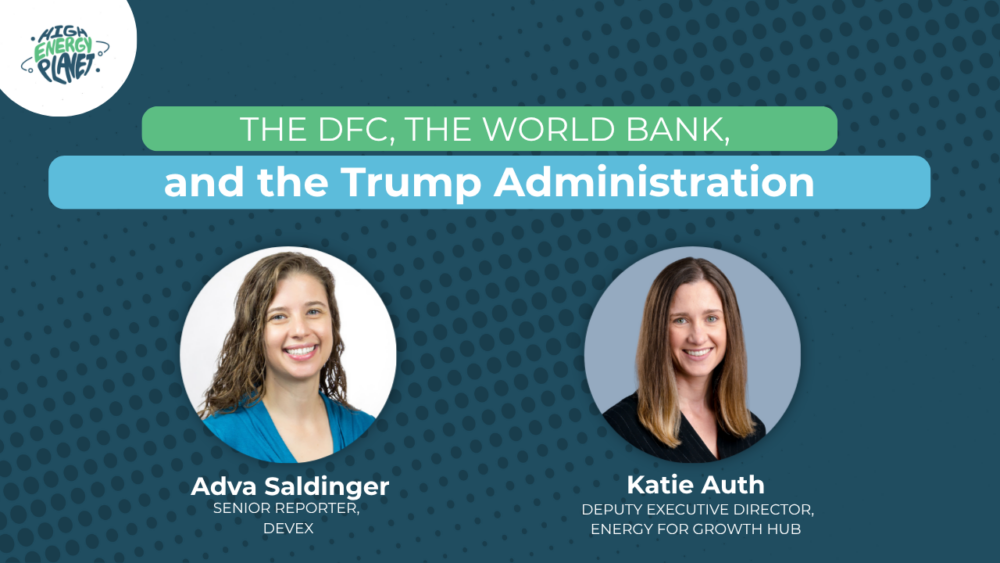
International development reporter Adva Saldinger joins host Katie Auth for the first episode of season 5 to discuss how the Trump administration is reshaping the world of development finance for energy and climate. Adva explains the rising prominence (and shifting mandate) of the US Development Finance Corporation (DFC) — and the questions being raised about its speed, credibility, and accountability. She and Katie also dig into how the World Bank is navigating pressure from the US, including a compromise over its climate strategy.
Adva Saldinger is a Senior Reporter at Devex where she covers development finance and U.S. foreign aid policy. Adva authors the weekly Devex Invested newsletter that focuses on the role of business and finance in addressing global challenges. A journalist with nearly two decades of experience, she has worked at several newspapers in the U.S. and lived in both Ghana and South Africa.
“I think if you want a deal to get through, you need to pretty clearly be able to link it to a benefit to the US economy and be able to articulate that pretty well.”
– Adva Saldinger, Season 5 of High Energy Planet
Covered in This Episode
- [00:05:00] A Reshuffled Landscape: Katie asks Adva how her beat has changed since the start of the second Trump administration, and Adva explains that with USAID gone, the Development Finance Corporation and the Millennium Challenge Corporation have become the central players in US development policy — though a clear, unified policy vision still hasn’t emerged.
- [00:09:00] DFC’s Pivot to Fewer, Bigger Deals: Katie and Adva dig into why DFC, following a congressional reauthorization that more than tripled its investment cap to over $200 billion, is now chasing fewer, larger, more strategic deals in energy, infrastructure, and critical minerals.
- [00:14:00] Congress, the Board, and the Cost of Speed: Katie and Adva unpack Congressional pushback on transparency and accountability, reports of Commerce Secretary Howard Lutnick blocking deals at the board level, and whether DFC’s faster timelines means cutting corners on due diligence.
- [00:22:00] The I Squared Capital Blueprint: Adva walks Katie through DFC’s $1.5 billion natural gas deal in South and Southeast Asia, and what it reveals about what it now takes to get a deal approved: a clear, articulable benefit to the US economy.
- [00:30:00] Treasury’s World Bank Wish List: Katie and Adva talk through Secretary Bessent’s asks of the World Bank and how World Bank President Ajay Banga has managed the pressure from the Bank’s largest shareholder.
- [00:42:00] The Climate Compromise, and What’s Next: Adva and Katie discuss how the World Bank kept its Climate Action Plan but dropped its 45% climate target, and consider a possible future where DFC drives US strategy while the World Bank is responsible for the traditional development mission.
Resources
- Follow Adva Saldinger’s reporting at Devex
- Read more about DFC’s congressional reauthorization: DFC gets a long-awaited glow-up.
- Adva referenced Ben Black’s congressional testimony: Ben Black, CEO of DFC, July 15, 2026.
- Read about DFC’s $1.5 billion energy platform with I Squared Capital, the largest project the agency has undertaken.
- Adva referenced the World Bank ending its ban on financing for nuclear energy. Two other banks have now followed suit: World Bank, Asian & Inter-American Development Banks Lift Longstanding Bans on Nuclear Energy.
- Adva mentioned an op-ed from four World Bank executive directors. Read it here: The World Bank is moving to climate action that counts, focusing on results.
Key Terms
- DFC = the Development Finance Corporation (DFC), a US government agency that mobilizes private capital to advance economic development in partner countries and forward US foreign policy.
- World Bank Group = the largest and most influential multilateral development bank. The bank provides financial products to emerging economies.
- USAID = The US Agency for International Development, formerly the leading agency directing US development aid. The Trump administration largely dismantled the agency in 2025.
- IDA = the International Development Association (IDA), a part of the World Bank that provides lending services to lower income countries.
- IBRD = the International Bank for Reconstruction and Development, a part of the World Bank that provides lending services to middle-income and credit-worthy low-income economies.
- MCC = the Millennium Challenge Corporation, a US government agency that promotes democratic governance and economic growth in the world’s poorest countries through time-limited grants for core infrastructure and policy reforms.
If you enjoyed this episode, please rate, review, and share it with your energy nerd friends.
Transcript
Katie Auth: Hey guys, welcome back to a new season of High Energy Planet, a podcast about energy for economic development around the world. We’re super excited to be back after a long hiatus.
I’m Katie Auth. I’m the Deputy Executive Director at The Hub, and I want to start by saying that my former co-host, who hosted this show with me for many seasons, Rose Mutiso, has left to found her own organization, all about centering African leadership in science and technology. So it’s sad for me and for this podcast, but awesome for the world, and we wish her the best. You should check out her new work.
This Season: Making Sense of US Energy and Climate Policy in Emerging Economies
We’re focusing this entire season of High Energy Planet on the confusing mess that is US energy and climate policy in emerging economies. What’s happening today, and then also, where do we go from here? Where is this going to lead us? What are the new, most exciting ideas that are likely to shape the future of this space?
I think this is important because US policy and decision-making still has huge influence over energy markets and where money goes. It’s upended a lot of traditional relationships between countries and the ways in which development capital and private capital end up getting deployed: which projects get funded, which countries end up seeing influxes of capital, and how it shapes geopolitical relationships in foreign policy.
In the face of all that, because of how fast the news moves and how quickly the players and the issues are changing, it’s maybe never been harder to figure out what’s actually going on. That’s why I wanted to start the season by bringing on a reporter who covers this every day.
Introducing Devex Reporter Adva Saldinger
Adva Saldinger is a senior reporter at Devex, a media platform focused on international development. Adva covers development finance and U.S. foreign assistance policy, and she has more than ten years of experience as a journalist. She has lived across the US, and in Ghana, South Africa, and elsewhere.
She’s not an energy specialist per se, and she doesn’t focus her reporting on energy in particular. But she’s going to give us a really good landscape of who’s who, where these institutions are going, and the most exciting stories that she’s tracking as a journalist.
We’re going to talk about how the Trump administration is engaging with two of the most important development finance institutions today: the Development Finance Corporation and the World Bank.
The Development Finance Corporation is a US agency. It was founded in 2018 to catalyze private investment in lower-income economies, and it has this dual mandate to advance both development outcomes and US foreign policy goals, which will come up later — we’ll discuss it. This double mandate is a little tricky.
In the last year, DFC has had its investment cap more than doubled by the US Congress. It’s gained more flexibility to invest in higher-income markets, and it’s really assumed a new level of prominence and attention under the second Trump administration, especially now that USAID is gone. It’s sort of the only development game in town when it comes to US policy, and there are a lot of people asking the DFC to do a lot of different things.
The second institution we’re going to talk about is the World Bank. The US has considerable influence over all of the major MDBs, the multilateral development banks, like the World Bank, and the World Bank is probably the biggest and most influential.
When Trump first came into office the second time around, there were all of these rumors flying around Washington that the US was going to pull out of the World Bank and it was going to have to relocate. It really triggered a sort of panic within the development community. None of that has happened. In fact, the Trump administration and the World Bank have found areas of alignment, especially in the energy sector, but also in development more broadly, and we’re going to talk about some of those surprising issues.
I rely on Adva’s reporting at Devex. I read her all the time, and you should too. She’s also just an incredibly smart and funny and kind person to know, and a friend to have. So I’m delighted to have her on the show, and you guys are going to learn a lot from her.
Katie Auth: Hey Adva, so nice to have you here.
Adva Saldinger: It’s so great to be with you. Thanks for having me.
Katie Auth: Awesome. So, I wanted to bring you on because this is the first episode of the season, and we’re really going to be digging into all things US development and climate and energy policy.
There’s a lot going on, and I think a lot of people — even those of us who are close to the action, or who live in DC — continually struggle to keep up with what exactly is going on: what’s being funded, what’s changing, who are the players that we should be watching. So I thought I’d bring you on to ground us all in what you’re seeing as a reporter.
Obviously, almost everything about US development policy has been upended since Trump came into office in January 2025. I’d love to hear from you as a development reporter covering these institutions: what’s the biggest thing that has changed about your day-to-day job since that inauguration day?
How Adva’s Beat Has Changed Since the Administration Change
Adva Saldinger: Yeah, you know, I think part of it is the institutions you cover, right? Someone who used to cover USAID — that institution is gone. So now we have a new constellation of actors and players that are more important in this US development landscape.
And I think the other thing that’s been a real challenge is that the initial policy was kind of “stop work, review everything, shut a lot of it down.” We really don’t have any sweeping policy announcement where we understand if there is a vision, or what the vision is, of US foreign assistance today. We’re starting to see around the edges things that we think or believe are important to this administration.
But we’ve also seen different poles of power within the administration. In the early days, there was the significance of DOGE, which often moved really fast. And you do see tension, I think, sometimes between the Office of Management and Budget at the White House and the State Department on certain decision-making, or even sometimes people within State have different perspectives. So I think one of the things that’s been a challenge is trying to figure out what is the policy direction, what is important. Some of the things they said at the beginning that they really didn’t want to do — in terms of funneling money through the UN — we’ve seen them do, because it’s the only way to move money.
DFC and MCC Become Bigger Pillars
A big part of it for me personally is that it’s interesting, because I used to cover what were, in the past, considered some of the smaller players in the development landscape: the US Development Finance Corporation and the Millennium Challenge Corporation. Those are now, I think, much more important pillars, now that USAID doesn’t exist and the State Department is figuring out where it’s going.
We do know that they want a more commercial approach to development. We’ve seen a very transactional, commercial focus on critical minerals and AI, so we are starting to see some of that. But the landscape, and the way it’s being talked about, has changed.
And then, my focus has been a lot more on the DFC, which I know we’re going to talk about more today, because it is now potentially a very important piece of the development landscape of the US government.
What Does the White House Want From DFC?
Katie Auth: Yeah, so I do want to dig into the Development Finance Corporation specifically, because, especially now that USAID is gone, DFC is really by far the biggest, highest-profile development institution that the US government has.
I think it’s caught in a bunch of different currents. You have bipartisan support for taking the DFC in a more strategic foreign policy direction, rather than just focusing on pure development. And then you also have the administration, I think, looking to DFC to do a lot of different things, and to be a lot of different things, in different contexts.
So I want to wrap our heads around that. From everyone you’ve talked to in the administration, what do you think this White House actually wants to achieve with DFC?
Adva Saldinger: I think that’s a little bit hard to know right now. I think maybe also what Congress wants and what the White House wants could be different.
Ben Black, who’s the CEO of the DFC — it took about a year to get him in there, so in that period, things were kind of in a holding pattern. Now I think we’re starting to see what the direction is that they want to go in.
It’s important to say that in December, the DFC was reauthorized by Congress. And, you sort of alluded to this, there’s this bipartisan support for it to do more than just be a development institution — for it to also be a strategic tool for the US government. But really importantly, the investment cap of the agency grew from $60 billion to over $200 billion with the reauthorization. So it has the potential to be a lot bigger.
What the DFC has said, and what they’ve told me, is that they really want to be an institution that does fewer, larger transactions. They want to focus on energy, infrastructure, and critical minerals, and they’re open to investing anywhere in the world.
Katie Auth: And what is the rationale that they give you for that shift to fewer, larger deals? Is it a speed issue?
Adva Saldinger: I think that they think the larger deals are more strategic, that you can have more impact. At least on the Hill, a lot of the support comes from: how can the DFC help counter China? Especially if you’re looking at infrastructure and energy deals in middle-income and upper-middle-income countries, you might need to put a large amount of money in to feel like you have more control, or some sort of greater leverage.
I do think there’s a sense, that I’m getting in some conversations, that they want to use the DFC and money that the DFC might give to private actors as leverage with governments as well, which I think it’s a little bit tricky but I’ve heard that that is something we’re maybe starting to see.
Katie Auth: You mean leverage to achieve other foreign policy goals?
Adva Saldinger: Yes.
Does DFC Still Care About Development Impact?
Katie Auth: Just to interrupt on your point about bigger, fewer deals being more strategic — I think the counterargument from development practitioners is: well, that by default means you’re going to be operating mostly in larger, richer markets. It really tilts the scales away from smaller projects that might have more of a catalytic development impact.
I know we hear folks like Ben Black and the leadership at DFC still talk about the importance of development, and the fact that you can do both development and strategic foreign policy. But do you get the sense that they really do care about DFC’s development impact, or how are they thinking about that in their strategy and implementation?
Adva Saldinger: I think that there are certainly people at the agency who still care about development impact. I actually put that question to them. I said, look, you can do fewer, larger deals — that’s actually a very small percentage of what the agency has done in the past. What about missing out on deals in small countries, or smaller transactions that might have outsized development impacts?
They kind of said, well, we still think we can find development impacts. With infrastructure projects, even in low-income or small countries, you can put in a lot of money. I think it raises questions around additionality, especially in higher-income countries. Could this money come from elsewhere? How much money does DFC need to put in to actually catalyze the private capital to come in behind it? So I think there are questions.
They have explicitly also told me that DFC is not a traditional DFI anymore — that they don’t see it as a traditional development finance institution.
Katie Auth: What does that mean?
Adva Saldinger: That they consider themselves somewhere between a DFI and a sovereign wealth fund. I don’t know exactly how they interpret that, or what that means to them. From what I’ve heard, they’re telling me we’re still following our impact assessments, we’re following these guidelines. But I am hearing concerns, both from people who are watching the agency and people at the agency, about how closely they’re hewing to some of those impact guidelines.
We’re starting to hear pushback in Congress, really asking, well, where is the development impact? One thing I wanted to point out is Ben Black testified in Congress in July, and he talked about how the DFC has completely rebuilt its pipeline. It’s got 340 potential deals in the pipeline, worth $78 billion. The top three countries in that pipeline were Argentina, Mexico, and Brazil.
He talked about how they’re focusing on regions that are vital to US economic security, and he listed a number of regions. Sub-Saharan Africa was not on that list — there were no sub-Saharan African countries in the list of top countries in this new pipeline. I think that will raise questions, and especially if you see a change in Congress in the midterm elections, there will be more questions and oversight about the development mandate, but also concerns about transparency and ethics.
One of the things we saw at that hearing is a lot of concerns about whether people tied to the Trump administration would benefit from DFC transactions.
Bipartisan Concerns, or Mostly Democratic?
Katie Auth: Yeah, and I think a lot of that stuff has come out more explicitly in relation to other agencies, but people are looking at DFC very closely. I’m curious — you talk about how questions are starting to get raised by Congress. Is that only coming from the Democratic side, or are you seeing a bipartisan concern about DFC’s impact and mandate?
Adva Saldinger: I think, so far, it’s probably mainly from the Democratic side. Judging from that last hearing, and from some of the things I’m hearing from folks I’m talking to, I think it’s primarily from the Democratic side. But I will say that I think, in the background, there are Republicans who are also telling the agency, “Hey, you need to pay attention to this, because you could lose Congress on this, especially if Congress flips.”
I think that people outside of the agency, and maybe people at the agency too, understand that this is part of the legislative mandate — that this is a development agency. It’s in the name. So how does that change? I think that’s interesting. Katie Auth: And recognizing that in a couple of years, or at some point, the political context is going to shift back, and the agency will be under new pressure to demonstrate a different set of objectives.
The Reputational Risk of Canceled Deals
Adva Saldinger: One of the things I’m hearing is also that the DFC risks some reputational damage in this period. I think people have already told me some of that has happened because they canceled a bunch of deals from the previous administration. I had someone joke to me that DFC offers political risk insurance against the risk that other governments will renege on a policy priority, but that what people actually need is political risk insurance from the US, from US political decisions.
So that’s a bit tongue-in-cheek, something a source told me, but I think there are some fundamental questions about how DFC is approaching things, and also, from a risk perspective, what risk they’re taking. Are they still adhering to all the environmental and social governance policies and standards that have existed to date? And if they don’t, or if they change them, does that open the US government up to risk down the road? And then what happens? Who has to pay for that?
Katie Auth: I remember I wrote a couple of things early on, when USAID was first being shuttered, and USAID had all of these contracts that were being just dropped. It looked like there was a risk that the same thing would happen at DFC.
My argument at the time was basically that the credibility and trust that private developers and government partners had long been able to place in the US government — as an entity that would, by and large, stick to its commitments, follow through, and make payments — if we lose that, we don’t really have, at the moment, a ton of other stuff to put on the table that’s appealing. Our development finance is not particularly fast. It’s often a huge pain to actually get it if you’re a project developer. We’re not particularly cheap — it’s not like we’re offering super concessional financing.
So the halo effect of having the US government be part of your deal, and the credibility and trust that it brings, is a huge part of what made us an appealing partner. If you lose that, I think we’re in real trouble.
Adva Saldinger: Look, I don’t necessarily think that’s lost yet, but I do think it has taken a hit, in part because deals that were very far down the pipeline — that even had board approval — were canceled at the DFC. If you’re a private company, why would you invest eighteen months to two years, and incur a lot of costs by that point, especially if you get to board approval?
Katie Auth: That’s a long time.
Adva Saldinger: So I’m hearing some people say, well, I’m not recommending that clients pursue that.
Howard Lutnick and the DFC Board
I think the DFC is trying to — I think there were some early issues at the board. I reported some about this: Commerce Secretary Howard Lutnick killing deals at the board meetings, which is generally unusual. The process is normally that you’ve worked out any issues before you get to the board meeting.
I think that’s calmed down a bit, from my understanding. I think the DFC has put in some processes so that senior leadership and the political leadership are doing a review earlier in the process, to try to ensure that deals could go through.
Actually, Ben Black said that they’ve sped things up by ten weeks — they’ve reduced the investment timeline by ten weeks. People have long said DFC is too slow, so I think a lot of people would say that’s good. I think the question is: how are you doing that? Is all the due diligence still being done? They’ve set up a special team to accelerate things, and brought in some new people to work on that team. So I think we’ll see. In some ways, it’s too early to know how some of these things will play out.
Katie Auth: I wanted to quickly double back on the Howard Lutnick point, because you’ve done a lot of reporting on this, and I was certainly hearing stories about these board meetings. One of the things he was reported to have said was, basically, the DFC — or the board — won’t approve any project that doesn’t directly contribute to US reindustrialization. I was curious whether you have a sense of whether that has calmed down and been dealt with. How did that get resolved? Is that still a tension within the cabinet and the DFC board that’s getting played out, or is that largely resolved now?
A Benefit to the US Economy: The New Test for DFC Deals
Adva Saldinger: I don’t have enough sourcing to really tell you how that has been resolved, but my understanding is that it is better. He’s maybe been told, “Hey, we need to get some of these deals through.”
I do think one thing that has emerged is: while the DFC doesn’t have an explicit US nexus — they don’t have to invest in a US company — in this administration, I think if you want a deal to get through, you need to pretty clearly be able to link it to a benefit to the US economy, and be able to articulate that pretty well. I think those transactions are going to succeed more.
Inside DFC’s Largest-Ever Deal: $1.5 Billion for Natural Gas
One example is actually one I wanted to talk to you about, because in June, the DFC board approved the single largest transaction that the DFC has ever done: a $1.5 billion investment in a platform that would do natural gas infrastructure in South and Southeast Asia. The platform would be created by I Squared Capital, which has gotten investment before from DFC and from OPIC before that.
I think they looked at the landscape and said, hey, look, this will help US natural gas exporters into these markets, but also help some of our previous investments in these markets that need more natural gas for their pipelines. But I was curious your thoughts on that, because I’m certainly not an energy expert, and I think it’s also a transaction that we probably would not have seen in the Biden administration, for example. I’m curious your thoughts on that transaction.
Katie Auth: Yeah. I don’t know the ins and outs of that particular transaction, but I think, A, it’s a great example of the point you made earlier about DFC really tilting towards massive infrastructure projects.
On the LNG side, I’m someone who happens to believe that there are good-faith opportunities to couple positive development outcomes with US commercial opportunities, whether it’s in the LNG sector or anywhere else. I actually think that finding spaces to invest in that type of co-benefit project is the way to make foreign assistance and development finance politically durable in the US.
So I’m not against that, but I do think it’s happening in a context where a lot of people in the energy-for-development space are looking across the portfolio and saying, “Okay, DFC’s energy portfolio is largely LNG.” The Department of Energy has made its international portfolio almost entirely about LPG, liquefied petroleum gas, for cooking. So there’s a sense that it’s become almost entirely about gas.
My push would be: if this administration is serious about wanting to do an “all of the above” energy strategy, which has been their language from the get-go, I want to see evidence that they’re also taking seriously projects in clean tech — wind, solar, renewables, geothermal — outside of advanced nuclear, which they’re very supportive of, and some geothermal. I’m not seeing evidence of that.
I’m curious if you are — whether clean energy projects get taken seriously at DFC. What happens if they knock on the agency’s door?
Adva Saldinger: I couldn’t tell you definitively, but my sense is that they are not a priority. Does that mean maybe we would never see one? You can’t say no — there might be a project that… But I don’t think they’re a priority. I think that’s been pretty clear.
Katie Auth: I think, for people who have been tracking US global energy policy through administrations, the downside of having made energy technology so ideological is that you whipsaw. From the Biden administration, where, in my opinion, they were so anti-gas that they were turning down a lot of projects that actually would be hugely beneficial to energy-poor countries in Africa and Southeast Asia — to an administration that’s not even considering anything other than natural gas. That’s not going to be an environment that’s conducive to private sector partners being able to count on working with the US across the long time spans that are needed for these projects.
Looking ahead, post-Trump, no matter who or what party comes into office next, I would love to see a more stable approach to energy that isn’t so ideological. I know lots of people want that, but it’s a huge problem.
Adva Saldinger: It’s definitely something I’ve heard from others as well.
What to Watch for Next at DFC
Katie Auth: Adva, is there anything else on DFC that you want to touch on super quickly before we jump to the World Bank?
Adva Saldinger: Yeah, I was just going to say some of the things I’m watching are the standards, and, right now, we don’t have a lot of data about what the DFC has done between January and March. There are seven transactions that are publicly listed — a pretty small sample size to understand this new direction.
So one of the things I’ll be watching closely is, on the transparency side, what are they sharing? What do the deals look like that are getting done? What countries are they in? What types of deals are they? Are they tilting more toward the strategic side? And then, really looking at some of the accountability of the impact frameworks, and some of these questions around who’s benefiting from DFC deals — I think that’s important to watch moving forward.
Katie Auth: Yeah, and I think on the data piece, that’s a great point. I think even before President Trump came into office, there were always frustrations about the level of information that was provided publicly by DFC.
Adva Saldinger: There have always been lags — it’s always many months after you want it.
Katie Auth: Yeah, and it’s not just DFC, this is across the US government. But it’s interesting to see that, in the reauthorization, Congress actually did insert language that called for more transparency and more public data. I know CGD, the Center for Global Development, has done a bunch of good analysis on this. We’re going to be launching a DFC tracker where we look at the investments as they come out. So it’s great that there are people focused on this analysis, and I’m glad that you’re obviously a huge part of that too.
Adva Saldinger: And what’s difficult is also that there are a lot of investments that are announced, or have letters of interest, or any number of these things — the press releases you see that actually never come to fruition. So it’s really difficult to track the reality versus what’s publicly being put out there, and to really come up with a more concrete picture of what’s happening.
What Board Approval Actually Means
Katie Auth: Totally. And I do just want to stress, for people listening, that when the board makes an announcement that DFC has approved funding for a project, that does not mean the project is definitely going to be built. There’s still a lot of stuff that has to happen between that commitment and there actually being a hard piece of infrastructure in the ground.
Adva Saldinger: And even the disbursement of money from the DFC. There are still steps after board approval for the money to actually get out the door, to start building whatever it is, or supporting whatever it is.
Turning to the World Bank
Katie Auth: So I want to talk about the World Bank, because I know this is something you’ve also done a bunch of great reporting on. The US government sits on the board of all the major multilateral development banks, but I’m going to dig in on the World Bank — A, because it’s the biggest, highest-profile institution, and because some of the ways its relationship with the Trump administration have developed have been really interesting and surprising.
I’m sure you remember, at the beginning of the Trump administration, there were rumors flying around that the US was going to pull out of the World Bank entirely. Obviously, that has not happened. And if you look at what the Secretary of the Treasury, Scott Bessent, has said, he continues to say really positive things about the importance of the World Bank as a global actor.
Do you think — I think I know what the answer to this will be — but do you think there is a coherent vision within the Trump administration for what the World Bank should do, and what its relationship with the US should look like?
Bessent’s Vision: Back to Basics
Adva Saldinger: I think the answer to the first part of that question is yes. Bessent has pretty clearly articulated what the US wants from the World Bank, which is: go back to the basics, focus on your core development mission, move away from this mission creep on climate and other things.
I think the US has determined that its role as the majority shareholder in the World Bank — and I would say the International Monetary Fund, maybe even more so — is strategically important. So the US wants to maintain that power. We’re seeing that play out in some processes around shareholding.
They want the World Bank to do more on debt, to focus on country self-reliance, and to have an “all of the above” energy strategy — they pushed on nuclear, so the World Bank changed its nuclear energy policy. There have also been other requests around procurement — they want procurement to be more competitive, which, reading between the lines, really means they want more US companies winning World Bank contracts.
I think we’ve seen the Bank shift some of its policies toward what the US is asking. One of the big ones I mentioned is, after years of basically having a ban on nuclear energy, reversing that.
The Climate Action Plan Compromise
And then, earlier this year, there was a big, months-long debate about the World Bank’s climate change action plan, which we covered really closely. In the end, the World Bank did extend its climate change action plan indefinitely, but they dropped the 45% climate target — and that was something the US really didn’t want.
You saw the Bank changing some of its language on climate — talking about climate co-benefits, for example, as opposed to direct climate financing. I think there are differing opinions on the whole climate action plan debate. Some people think the Bank has mainstreamed its climate work, and so it’s okay to move forward in this way. It was kind of a compromise.
Understanding the Graduation Policy
And then another big thing the US has asked for: they’ve said, look, World Bank, you need to implement your graduation policy.
Katie Auth: Can you explain what that is?
Adva Saldinger: As countries develop and move up the income levels, at some point they’re supposed to essentially phase out — they become too wealthy to receive World Bank financing. This happens across World Bank financing generally: the poorest countries are eligible for IDA funds, and then you graduate to hybrid IDA, IBRD, which dictates the loan terms and so on. But in this case, the US is most focused on that higher end — particularly China, which they think should no longer receive any World Bank funds. We’re actually seeing some movement in that direction.
We’ve also seen that they want the Bank to focus more on critical minerals, and we’ve seen the Bank leaning into that. So we have seen the Bank being responsive. But Bessent has been pretty clear, and a lot of that messaging has been consistent over time.
A Jobs Agenda and a Focus on Low-Income Countries
But as you said at the beginning, a lot of what I was reporting on was people who were terrified that the US would pull out, that the World Bank would have to leave DC. All these scenarios — that really didn’t come to pass. I think part of it is that decision was made at Treasury. I think Bessent looked at it and said, this is important.
One of the things that’s fascinating is that quite a number of the things they’re asking for are actually things that Treasury has asked for before, including in the Biden administration. Some of this isn’t new.
Katie Auth: Well, and I think if you go through the list of stuff you just laid out — recognize that China should be treated differently, open up technical assistance and support for advanced nuclear — there’s a list of things that actually don’t sound crazy to most people across the political spectrum. I would say that the Treasury agenda is not necessarily a crazy MAGA… As you’re saying, this is stuff that a lot of administrations have asked for in the past.
Adva Saldinger: Yeah, and I think that’s important to point out. There have also been interesting things they’ve called for. I think one of the things — the World Bank has really leaned into a jobs agenda, and I think that ties very closely to what the administration wants. Ajay Banga, the president of the World Bank, comes from the private sector, and I think he really believes in jobs as a driver of growth. But I think that’s also a way for the Bank to signal, hey, we’re going back to the basics, we’re focusing on economic development.
But we’ve also seen, for example, Treasury call out IFC, the World Bank’s private sector arm, for not doing enough in low-income countries —
Katie Auth: I know, I saw that!
Adva Saldinger: — which is something the US actually basically required of them the last time they gave them more capital. So some of the people I’ve talked to are pushing, in this context, for a real focus on low-income countries and real development, which is also interesting because it’s sometimes counter to what we’re seeing on the bilateral side. But it’s interesting that we’re seeing it at the World Bank.
The Role of Multilateral Development Banks
Katie Auth: So this is exactly what I wanted to talk to you about, because this is what I think is so interesting about the vision that Secretary Bessent has laid out. As I understand it, and as people within Treasury have confirmed to me, it’s basically arguing that bilateral agencies like the DFC should be about strategic US foreign policy, about advancing US interests — and that the World Bank should be about pure, traditional development, putting even more money into low-income, high-risk markets, as the US has been pushing for — and that the US would continue to contribute to development via the World Bank and the other MDBs.
What do you think about a world in which bilateral agencies were explicitly about US strategic interest, and we did development via multilateral organizations?
Adva Saldinger: I mean, it’s interesting, right? Is it good or bad? I don’t think I’m in a place to make that judgment. But I would point out that it’s not just the US. We’re seeing this in other countries that are pulling back their bilateral assistance and looking to the World Bank, or other MDBs, as one of the main vehicles for their development work.
One of the things I wrote recently is that these MDBs are playing an outsized role in development challenges — a much greater role than they have in the past — because there’s so much focus on them, and because so much of the bilateral capital is going away. Maybe there are efficiencies in that. I think it depends on how these institutions operate, what programs they do, and whether you start to see any of the MDBs, via their board members, trying to influence things in one direction or the other that would benefit their own strategic interests more.
So I think there are a lot of questions, but I agree with you that this may be part of the way things are moving, at least right now, in the US.
Stretching Capital: IDA Leverage and MIGA
And some people have argued, over time, that IDA is actually strategically the best investment you could make in the world’s poorest countries. For every dollar that’s given to IDA, they go to the capital markets and raise money — it’s like four to one, or something like that, which is far more leverage than most other giving.
The other thing to note is that paid-in capital to the World Bank, including to IBRD, stretches much farther. Or look at guarantee agencies like MIGA, which is still operating essentially on the initial $300-and-something million dollars it was given many years ago — it’s never had a capital increase. It gets some money through trust funds and other vehicles. The Bank does know how to stretch its resources, and shareholders have pushed it really hard to do more of that.
But I think there are real questions about where that money is going. If you’re going to try to stretch that capital more, are you providing fewer grants and more loans? What does that mean for indebted countries, for the world’s poorest countries? How competitive are World Bank loans on a pricing basis at that point? And if you get close to commercial loans, it might be easier to just take a commercial loan, because there are a lot fewer requirements on it. So I think there’s a lot of questions in that debate.
Katie Auth: Yeah, I think that’s right. I think this is a much more nuanced vision of development than the caricature the Trump administration is often portrayed as — like, “DOGE shut down USAID, development assistance is a fraud.” That’s not really what we’re seeing in how the administration and the Treasury are thinking about the World Bank, which I think a lot of people aren’t necessarily aware of.
Can the World Bank Move Fast Enough?
And then the other thing I wanted to mention is, we talked about how DFC has been criticized for being slow and bureaucratic — that was also one of the big critiques of USAID. If the World Bank and the MDBs are going to play an increasingly central role in all of this — you think you’ve seen bureaucracy at USAID, wait till you get to the World Bank. There are so many ways we will have to think about reforming those policies and getting speed, scale, and agility, if they’re actually going to be effective.
Adva Saldinger: No one’s ever accused the World Bank of being fast. But I will say that one of the big things Ajay Banga said when he came in was that there’s way too much red tape, and so he’s made it a priority to speed things up. The World Bank has sped up some parts of its processes over the last couple of years. So I think, to some extent, they’re trying. But I think you’re right, that you’d probably need to see more of an emphasis on that, and also on country responsiveness. I think there’s a lot of conversations there.
How Ajay Banga Has Managed the Relationship
One of the things I did want to say is that, in this relationship, I actually think Ajay Banga — who was appointed, obviously, by the Biden administration — has pretty deftly managed this relationship, including sometimes receiving outside criticism, and criticism from within the Bank, for some of his decisions.
Katie Auth: What do you think was particularly deft?
Adva Saldinger: I just think he managed to find a way to engage with them, talk to them, and pivot things in a way that — arguably, he may believe in — but also, I think, very clearly speak to and align with what his largest shareholder was looking for.
Balancing Shareholders on Climate
One of the interesting things, just to go back to the climate action plan really quick, is that part of what a president of the World Bank has to think about is safeguarding the institution across US political cycles, which are going to come and go, and, as we said earlier, there’s going to be a whipsaw.
Katie Auth: In that discussion about the World Bank ultimately agreeing to drop the climate finance target but keeping its Climate Action Plan in place — are they doing enough to satisfy the Trump administration, while keeping their climate plans on the books, knowing that it’s very possible that in a couple of years they’ll have a much different administration in place, and they’ll have to again prove how pro-climate they are?
Adva Saldinger: I think so. But I think part of it was really also other shareholders — this didn’t happen in a vacuum. You saw other shareholders saying, we believe climate is very important to us and we don’t want the World Bank to back away from climate. So I think part of it was balancing different shareholders’ demands on the institution.
We had an op-ed from the executive directors representing France, the UK, and an ED who represents Asia Pacific, written for Devex, which I thought was really interesting, because these are some of the strong, vocal climate supporters, and they actually praised the extension of the climate plan. They said, look, the Bank has mainstreamed climate, we don’t necessarily need this separate target. It was important for that period of time to mainstream it and get the Bank thinking about it, but the important thing is that we’ve extended the climate action plan, and there are commitments to learn and improve over time.
So I did think it was interesting that some of those champions were very vocally supportive of the outcome. I think it was really a place where they had to figure out a compromise that wouldn’t displease anyone too much, but that would also keep the path open to other shareholders, and to the US position changing down the line.
The Closing Question: What Do You No Longer Believe Is True About Development Policy?
Katie Auth: Yeah, definitely. We have one final question that we’re going to ask a version of to every guest we bring on this season. The question for you is: what’s one thing that you once believed about development policy that you no longer believe is true?
Adva Saldinger: I feel like that’s a hard question.
Katie Auth: That’s why I’m asking it.
Localization: The Gap Between Belief and Practice
Adva Saldinger: I think I am far more skeptical of the gap between rhetoric and reality on a number of things — maybe that’s broad, but I think it’s on a number of things.
Part of this strikes me because I think so much of what the development community talked about in the last few years is, for example, localization and local agency. I was just talking to a local cooperative group in Haiti that’s trying to get the Inter-American Development Bank to structure an agricultural program according to the needs they’ve identified in a survey of farmers in the area where the program will operate. So I think that often there’s so much rhetoric around, especially, that type of issue, and the reality is that the systems just aren’t changing fast enough to respond to that.
Katie Auth: Yeah. I think localization has been an area where you really see this tension between the people inside aid agencies who truly do want — they believe in local leadership, they believe in local design of programming. In my experience, they understand the valid critiques of international aid policy that’s driven from places like DC. And then you have the structures and the incentives of the agencies in which they work, which, sometimes for valid reasons and sometimes for stupid reasons, don’t allow real moves in that direction. But we can keep pushing.
Adva Saldinger: Yeah, and I think there are so many other examples too, especially in the private-sector investment space, where I feel like there’s so much blown-up rhetoric that just doesn’t match the actual pools of capital that are out there. So I think that’s something I’m paying a lot of attention to.
Why We Need Reporters
Katie Auth: It’s also a core reason why we need reporters — who can call agencies out on the data and really check them, regardless of which administration is in power. We need people to connect those dots and double-check and confirm, and I’m just so grateful for all the work you do, Adva and Devex, and the whole team you guys have. It’s been awesome to have you on the podcast. Thanks so much for joining us and talking about DFC and the World Bank. I learned a lot, and I look forward to following all your work as we move through this year. Thanks so much.
Adva Saldinger: Thanks so much, Katie. It’s great to be with you.
Closing and Credits
Katie Auth: And that’s it for today’s show. Thanks so much for joining us. High Energy Planet is a production of the Energy for Growth Hub, which matches policymakers with evidence-based pathways to a high-energy future for everyone. You can find out more at energyforgrowth.org. And if you liked today’s episode, please be sure to rate and review the podcast, and maybe tell a friend about us. Stacy Raine is our producer, and Jillian Mock is our senior producer. Join us next time for more High Energy Planet. Thanks, bye.