
African governments are setting net-zero targets under harsh realities and with an incomplete view of trade-offs
Despite contributing just 2–3% of global emissions, African countries are increasingly being drawn into setting net-zero emissions targets by changes in the rules of global finance, trade, and development. Extraterritorial policies like Europe’s carbon border measures are turning climate policy into a trade barrier with material economic consequences for African economies. And climate finance increasingly requires net-zero commitments, pushing governments to adopt time-bound targets to unlock funding.
For example, South Africa has submitted a 2050 low-emissions strategy to the UNFCCC, Nigeria’s Energy Transition Plan targets net zero by 2060, and countries such as Namibia, Togo, and Zimbabwe are attempting to link net-zero goals and economic development planning.
This target-setting is happening under harsh development realities and major knowledge gaps.
- African countries must pursue climate goals alongside urgent energy, food security, and development needs. More than 600 million people still lack electricity access, and clean energy financing costs remain two to three times higher than in advanced economies. At the same time, governments must expand food production, reduce poverty, and sustain economic growth amid rising food insecurity, population pressures, high input costs, and worsening climate impacts on development.
- African countries lack clear evidence on what different net-zero timelines would require in practice, from energy system transformation and land-use change to food prices, water demand, financing, and institutional capacity. This evidence gap persists because existing net-zero studies rarely examine the cross-sectoral and implementation consequences of alternative timelines.
We used integrated systems-level modeling to look at the real-world implications of net-zero pathways
Debates over African targets for net-zero emissions are often disconnected from energy, agriculture, and water planning, obscuring the real trade-offs. To address this, the team at Clean Air Task Force used the Global Change Analysis Model (GCAM), a widely used integrated assessment model, to compare business-as-usual against African net-zero pathways for 2050, 2070, and 2100 across regional blocs. Integrated assessment models are useful for decision-making because they show how choices in one sector affect outcomes in others, making visible trade-offs that single-sector studies often miss. In this study, GCAM helps reveal how various net-zero timelines could reshape energy investment needs, land-use pressures, food prices, and water demand. While the results are regional and continental — not country-specific forecasts — they offer a systems-level view that can inform national policymaking.
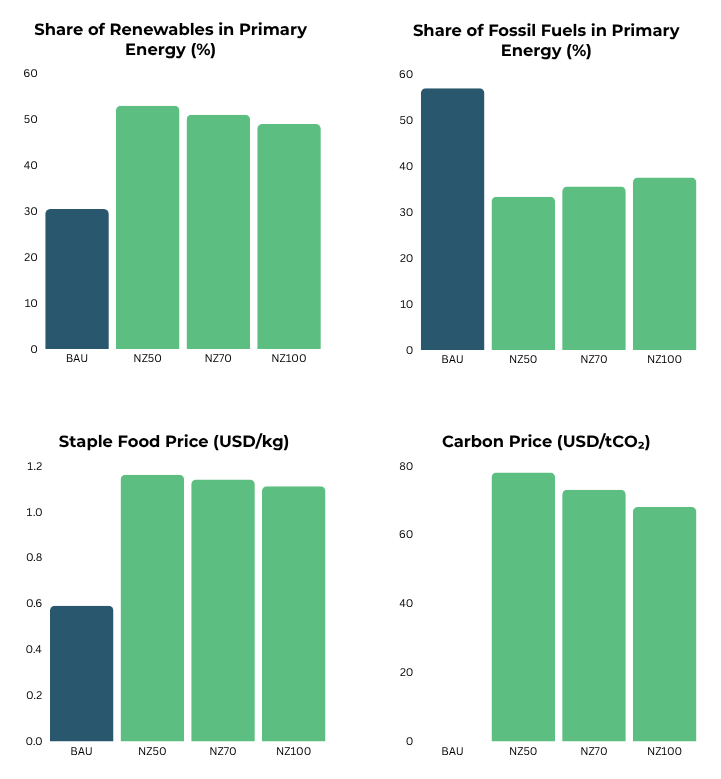
FIGURE 1: Average modeled outcomes for Africa under business-as-usual (BAU) and alternative net-zero timeline scenarios. Each bar represents the average value of the indicator over the full modeling period. NZ50, NZ70, and NZ100 denote scenarios in which net-zero emissions are achieved in 2050, 2070, and 2100, respectively. Source: Dioha M O, Ampah J D, and Odarno L (2025). https://doi.org/10.1088/1748-9326/ae0053.
Five Key Findings and their Policy Implications
Although the model reveals important regional differences, five broad lessons apply to African countries that have adopted — or are considering — net-zero targets.
- Net-zero targets determine how fast and how costly energy transitions will be. In our model, all net-zero pathways reach the same structural endpoint in 2100: increased renewables, increased food prices, and average annual carbon prices of $70 to $80 per ton across the century, converging near $125 to $130 by 2100. What differs is the pace and cost of getting there. Faster transitions require higher implicit costs because there’s less time for infrastructure turnover and technology cost reductions, and earlier targets force economies to face high carbon prices sooner and sustain them over more years. The cumulative burden of an earlier timeline is therefore far larger than the modest annual price gap suggests. For perspective, $70 to $80 per ton is roughly the EU’s carbon market price, meaning every pathway ultimately implies European-level carbon prices in a region where average income is about $1,700 per person compared to about $47,000 in the EU.
- This means: African governments should treat net-zero timelines not as diplomatic badges, but as decisions with real implications for the cost, pace, and feasibility of transition. Countries with net-zero goals should stop treating the target year as the strategy and start stress-testing it against food, land, water, and financing constraints. A viable pathway that achieves net-zero emissions in the 2060s, 2070s, or even 2100, with hard interim milestones, can be more valuable than a headline 2050 pledge with no delivery architecture.
- All net-zero pathways require large-scale renewables. Under the business-as-usual scenario, renewables provide just a third of Africa’s primary energy needs over the century. All net-zero scenarios raise that to over half, increasing renewables’ share in the primary energy supply mix up to 1.7-fold.
- This means: African governments must prioritize renewable build-out regardless of net-zero timeline. Each country should leverage its renewable resources to increase renewable capacity.
- Food price pressures will be most severe in West Africa and under faster net-zero timelines. Across all net-zero pathways, food prices nearly double compared to the business-as-usual scenario. The rise is not uniform: under the scenario that achieves net-zero in 2050, Western Africa sees the steepest increase, with prices rising from $0.64/kg to $1.45/kg, an increase of about 127%, while Northern Africa sees the smallest increase, from $0.51/kg to $0.59/kg, an increase of about 16%. These increases stem mainly from land competition: net-zero pathways price land-based emissions and expand bioenergy and afforestation for carbon removal, which squeezes cropland and raises land costs. Faster timelines amplify the effect. Note that the model assumes productivity grows only in line with historical trends.
- This means: African governments, especially in West Africa, must pair net-zero commitments with investments in agricultural productivity. Net-zero targets — particularly faster 2050 pathways — will be politically difficult to sustain if crop yield, food systems, storage, trade logistics, and land governance do not improve in parallel.
- Conflict between energy, water, and agriculture will intensify with emerging net-zero technologies. Achieving net-zero emissions reduces average water use for food crops by about 14%–15% compared to business as usual. Still, that gain is partly offset by new water demand from emerging technologies needed for low-carbon fuel and electricity (for example, bioenergy with carbon capture and storage). This technology also creates a land-use trade-off because expanding biomass production for carbon removal can compete with cropland, afforestation, and other land uses, intensifying pressure on food production and land management.
- This means: African governments should establish land and water safeguards regardless of their net-zero timeline. Expanding low-carbon fuels and electricity systems will likely increase pressure on land and water resources, making it critical for governments to strengthen protections for community consent, prioritize non-food feedstocks, and avoid overreliance on land-intensive carbon removal.
- Net-zero timelines are also about who pays the cost of transition. Earlier action shifts more of the burden onto today’s food consumers and rural communities exposed to land competition, and requires governments to mobilize limited capital quickly. This matters because the transition is unfolding in a context where nearly two in five Africans still lack access to electricity, and average income in Sub-Saharan Africa is only about $1,700 per person. These realities make the timing and distribution of transition costs central to whether net-zero pathways are politically and socially feasible. Delayed action shifts more of the burden onto future generations, economies exposed to higher cumulative emissions, and workers in fossil fuel-dependent sectors, where a slower transition today could mean a more abrupt and disruptive adjustment later.
- This means: African governments need to consider not just timelines, but how to distribute costs across political cycles. Policies that are affordable in the long run can still fail if near-term costs fall too heavily on households, farmers, workers, or public budgets before benefits become visible. A more robust approach is to pair net-zero timelines with phased financing, social protection, worker-transition support, and institutions that can sustain climate policy beyond a single election cycle.
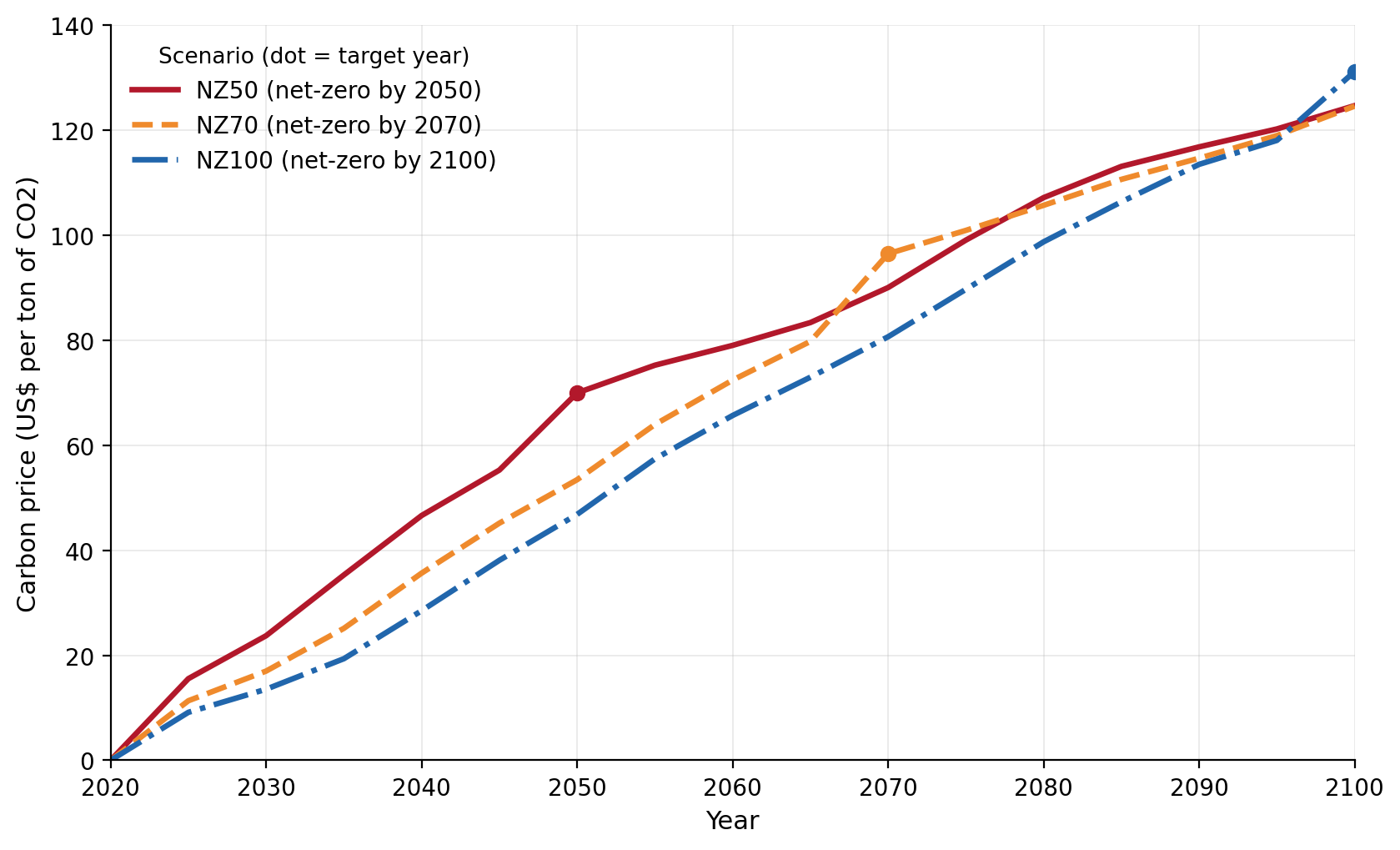
FIGURE 2: Carbon price trajectories for Africa under three net-zero timelines (NZ50, NZ70, NZ100 = net-zero by 2050, 2070, and 2100; dots mark target years). All pathways converge by 2100, but earlier timelines face high prices sooner and longer. Source: Authors' calculations.
Conclusion
While timeline decisions determine the pace, cost, and distribution of transition burdens, they do not change the direction of travel. Earlier timelines require faster investment and stronger safeguards, while delayed timelines reduce near-term pressure but increase cumulative emissions and the risk of a more disruptive transition later. In all cases, African governments face the same no-regret priorities: expanding renewable energy, investing in more productive agriculture, strengthening water- and land-use efficiency, and adopting integrated planning across energy, agriculture, water, and food systems. These interconnected sectors cannot be decarbonized effectively in isolation.