
Five ways the disruptions are damaging African economies
- Fuel import bills are forcing governments to choose between raising prices and expanding subsidies. When global oil prices rise, fuel import costs increase because African countries are price takers in global markets with no ability to negotiate lower rates. Governments must either raise pump prices (politically costly) or expand subsidies (fiscally costly).
-
- As of March, Egypt’s pound has lost 7% of its value since the start of the war as Suez Canal revenue declined due to decreased traffic, creating a feedback loop where currency depreciation makes fuel imports even more expensive.
-
- In April, Zambia suspended fuel taxes for three months, forfeiting $200 million in revenue at a time when the country is restructuring debt and trying to reduce its budget deficit.
The test will be whether governments can maintain these subsidies beyond a few months, or if fiscal reality forces politically painful price adjustments that could trigger unrest.
- Oil exporters are losing despite higher crude prices because they lack refining capacity. Countries that produce crude oil but lack domestic refining must export crude and reimport refined products at global prices. Higher crude revenues don’t offset the cost of importing fuel.
-
- Nigeria exports crude, but imports refined products. Lagos business owners report that fuel costs have doubled or tripled, limiting operations despite the country being an oil producer.
-
- Angola is expanding refining capacity through the $6 billion Lobito Oil Refinery (200,000 barrels per day), with Zambia in partnership talks to reduce its dependence on imported refined products. The crisis may accelerate a broader shift toward domestic refining across the continent, a move that could reduce vulnerability to external shocks, though financing and execution remain major hurdles.
- Fertilizer supplies have collapsed, threatening food security. Fertilizer shipments through the Strait dropped 92% from February to March. Gulf states supply up to 25% of Africa’s nitrogen fertilizers, with East and Southern Africa most exposed.
-
- When fertilizer becomes scarce or expensive, food prices increase, hitting Africa hard since households in many of the biggest economies on the continent spend nearly half their income on food.
-
- Rice supplies are also at risk. Asian countries are major rice exporters, and higher fertilizer prices due to reduced Gulf shipments threaten to lower supply and increase prices for African importers.
- The Strait disruptions are cutting off industrial inputs, disrupting manufacturing and mining. Shipments of industrial raw materials through the Strait fell 93% in March. This includes sulphur for mineral processing, limestone for cement, and gypsum for construction.
-
- Zambia and the Democratic Republic of Congo rely on imported sulphur for copper processing. Domestic production covers only 15-20% of mining sector requirements.
-
- Iron ore exports dropped 65%, and steel shipments fell 93%, disrupting construction and manufacturing across Nigeria, Egypt, Kenya, and Tanzania. For economies trying to industrialize and diversify away from commodity exports, losing access to basic industrial inputs at this scale sets back progress.
- Higher fuel costs are pushing power systems toward crisis. Diesel and heavy fuel oil are widely used for backup generation, peaking capacity, and self-generation by firms facing unreliable grids. Even where oil’s share in total generation is modest, these sources often set the marginal cost of electricity.
-
- When fuel prices rise, utilities face higher operating costs. Governments will now choose between tariff increases, subsidies, or delayed payments.
-
- The result is typically higher electricity prices, financial stress in utilities, and deteriorating service reliability. Watch for utilities rationing power or accumulating arrears — both are early warning signs that the fiscal shock is becoming a larger crisis.
Two ways some countries are benefiting in the short term
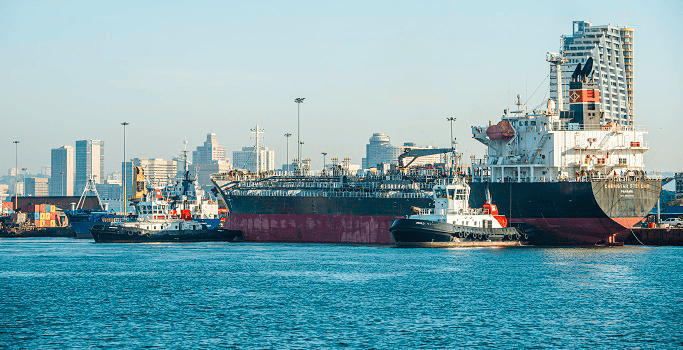
Shipping companies avoiding the Strait of Hormuz and the Red Sea are rerouting vessels around the Cape of Good Hope, creating a surge in traffic for African ports.
- Rerouted shipping is increasing traffic at African ports. Shipping companies are rerouting vessels around the Cape of Good Hope. Kenya’s Lamu Port received 74 vessels since January, about a third of all ships serviced since opening in 2021. South Africa’s Port of Cape Town recorded a 112% rise in vessel traffic. But increased traffic doesn’t automatically translate into revenue.
- Offshore services and bunkering hubs are capturing increased business. Companies providing crew changes, spare parts delivery, and medical evacuations are seeing increased demand as vessels seek to reduce downtime without making unnecessary port calls. Smaller ports are also capturing more of the bunkering business. Mauritius saw bunker calls rise 42% in March, with fuel demand up 58%. Namibia’s Walvis Bay and Togo’s Port of Lomé are positioning themselves as strategic alternatives.
This represents a potential growth opportunity for African maritime industries, though it is unclear whether the shift will outlast the crisis or fade once Middle East tensions ease.
What this means for African economies
African economies face higher costs for energy, food, and industrial inputs while losing revenue from suspended taxes and reduced trade flows. Higher import bills widen trade gaps while weaker currencies make imports even more expensive, creating a cycle where the initial shock gets worse. For countries emerging from debt restructuring, revenue losses undermine deficit reduction and threaten debt sustainability, while structural dependence on imported fuel, fertilizer, and industrial inputs constrains the growth needed to service debt and create jobs.