
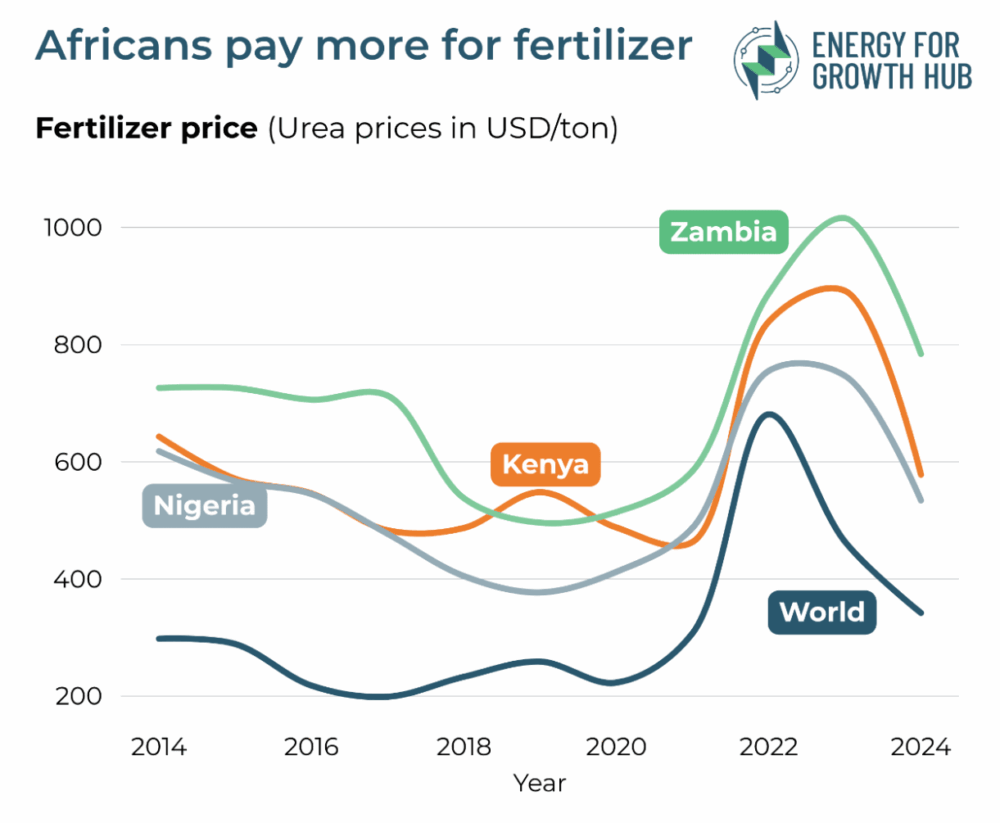
Fertilizer in Africa remains both unaffordable and scarce, trapping millions of people in a cycle of high food costs and widespread food insecurity. Given the continent’s unrealized renewable potential, some advocate that producing hydrogen, a key fertilizer ingredient, using renewable electricity could make fertilizer cheaper and more locally available.
But the short and long answer is no, for three main reasons. Before getting to those, it’s worth setting the stage.
Africa’s food shortage demands more fertilizer, fast!
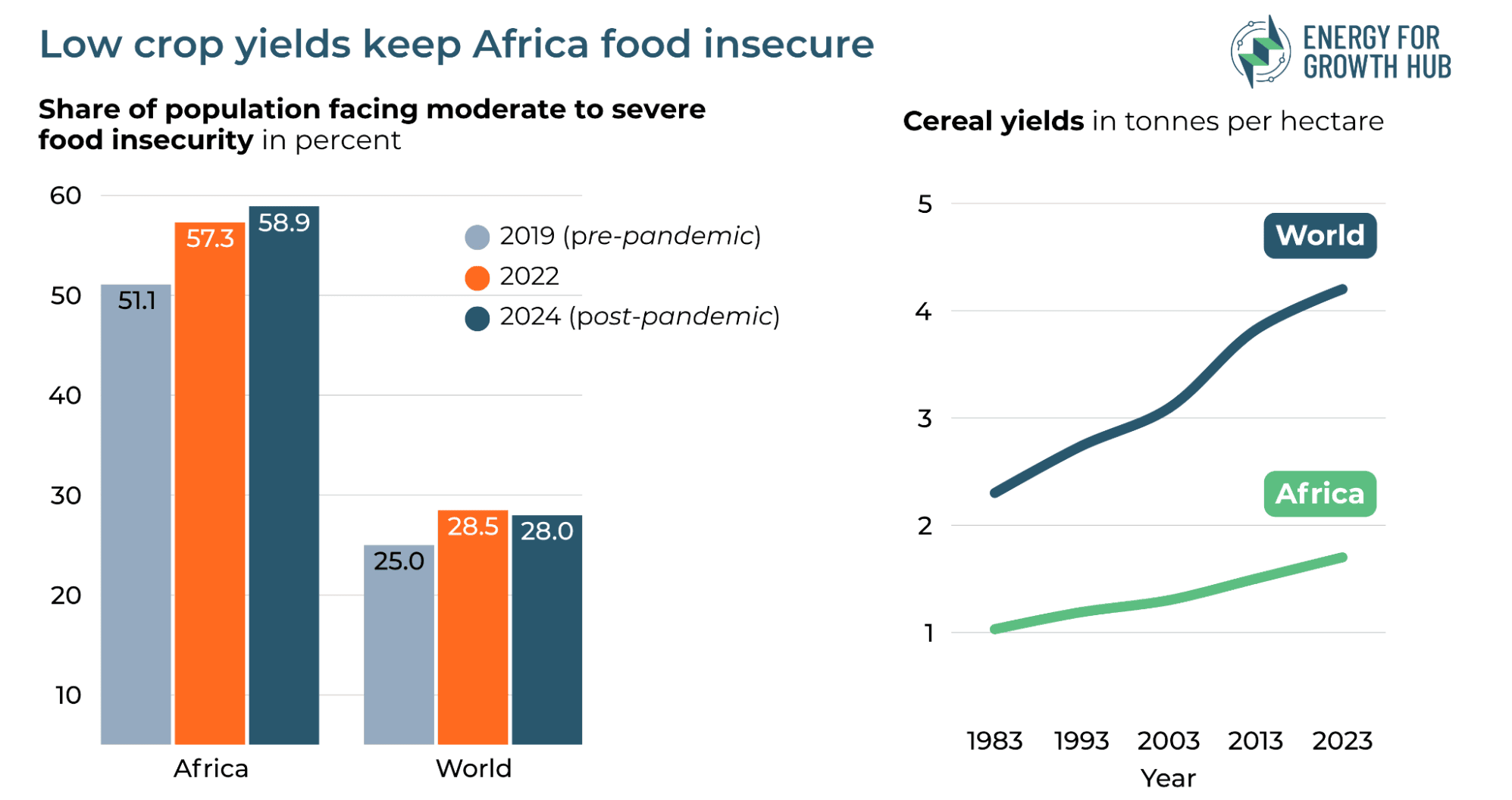
Africa is the only region where food insecurity has continually worsened since the COVID-19 pandemic, even as the rest of the world recovers. Crop yield growth has remained stubbornly low for decades, leaving average yield in Africa far below the global level. Closing this gap, without expanding harvested land, requires increased fertilizer use.
 Source: Food and Agriculture Organization of the United Nations, Our World in Data and Statista.
But fertilizer is too expensive and scarce in Africa
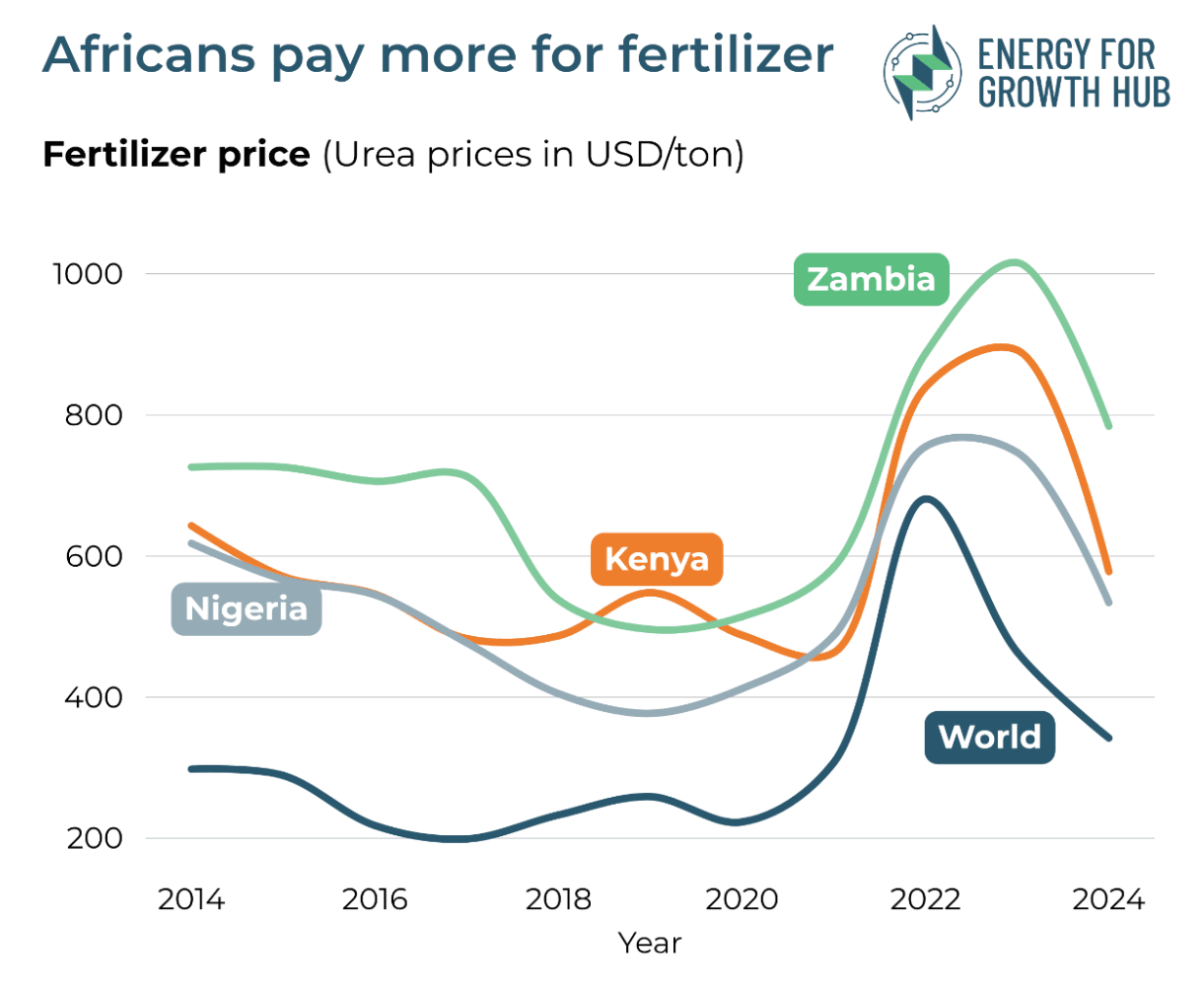
Across much of Africa, fertilizer use is far below local targets and global levels. Only eight countries have met the African Union’s 2015 goal of consuming 50 kilograms of fertilizer per hectare of cropland, which is still less than half of the global average. Sub-Saharan Africa, despite its large population, makes up only 3% of the world’s fertilizer consumption. As a result, even African nations that produce fertilizer domestically, such as Nigeria, prioritize shipments to higher-demand markets abroad. African farmers therefore face a double burden: low fertilizer availability and prices that remain well above the global average.
Source: Food and Agriculture Organization of the United Nations, Our World in Data and Statista. FAOSTAT: Fertilizers by Nutrient(2023).
Some are, understandably, looking to green hydrogen, a building block of fertilizer
Hydrogen is a key ingredient in ammonia, the main component for fertilizer production. Conventionally, ammonia is made from natural gas, which has confined its production to gas-rich regions around the world. But the ability to split water using renewable electricity to make hydrogen (green or renewable hydrogen) has inspired a new vision of decentralized, low-cost, green ammonia and green fertilizer production—even in countries with no natural gas at all. With Africa’s under-tapped potential for low-cost renewables like wind and solar, renewable and hydrogen advocates assert that green ammonia production using green hydrogen is a solution for Africa’s fertilizer security. As a result, a majority of the green hydrogen projects proposed in Africa plan to produce green ammonia. Some countries, like Kenya, are pursuing green ammonia production as a key national strategy for fertilizer security.
But green hydrogen won’t make African fertilizer cheaper or plentiful
These prevailing assumptions, although well-intentioned, won’t deliver within the timeline and scale needed to respond to Africa’s current food crisis. Here are three reasons why:
Reason 1: Green hydrogen needs cheap and abundant power—Africa doesn’t have it yet.
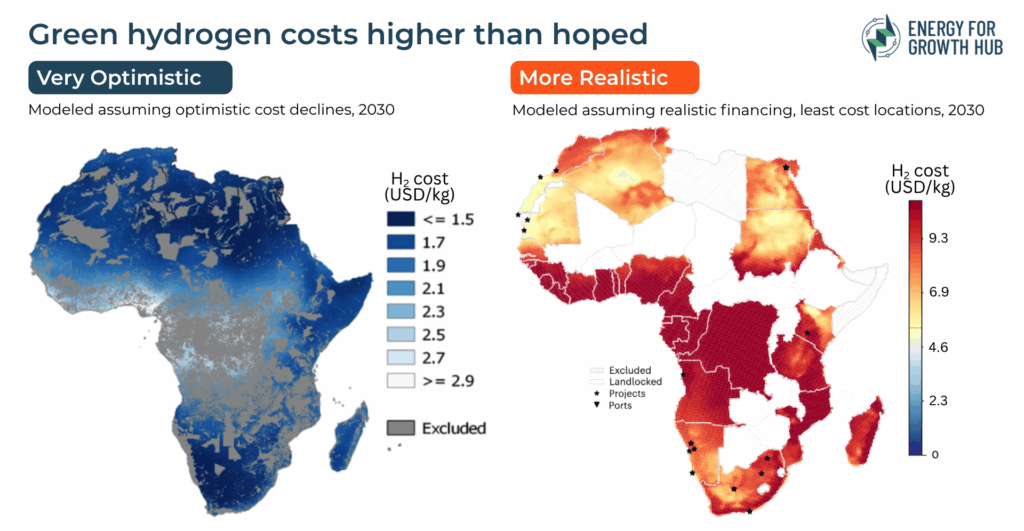
Optimistic projections suggest that green hydrogen production costs could fall well below $2/kg by 2030. Achieving that, however, would require renewable electricity to be priced at less than 2 cents/kWh. Current large-scale solar and wind projects in Africa are closer to 5–7 cents/kWh, thrice the cost of what is needed. Historically, green hydrogen production in Zimbabwe and Egypt thrived on abundant hydropower at 1–2 cents/kWh—a reality that no longer holds, as today’s renewables face high capital costs, financing hurdles, and risk premiums. A recent European modeling study with more realistic financing assumptions found that green hydrogen production costs in Africa are still 3-10 times above global targets, largely due to the high cost of electrolyzers and the vast amounts of power required to split water. Making cheap green hydrogen is a prerequisite for green fertilizer production, and neither green hydrogen innovation nor Africa’s grid is there yet.
Source: International Energy Agency, Africa Energy Outlook 2022 (left); Egli and colleagues. Nat Energy 10, 750–761 (2025) (right)
Reason 2: Green hydrogen alone can’t make African fertilizer green or cheap.
Beyond ammonia, fertilizer production depends on additional inputs. For example, making urea, the most widely used fertilizer in Africa, requires CO₂, which would have to be captured from fossil sources or cleaner alternatives, like biomass or direct air capture. These options add both complexity and cost. Green technology advocates argue that greener production pathways could be financed through climate funds, which remain limited at best. By contrast, fossil-fuel-based fertilizer production captures CO₂ as part of the reforming process that produces ammonia, giving it a built-in technological and cost advantage. Recent estimates from the Breakthrough Institute show that producing “green” urea—even under the most optimistic hydrogen production scenarios—could double fertilizer costs. Similarly, a World Resources Institute study found that producing “green” diammonium phosphate (DAP) in Kenya would remain more expensive than current fertilizer. With imported fertilizer already prohibitively expensive, greening production won’t make fertilizer more affordable or available in Africa.
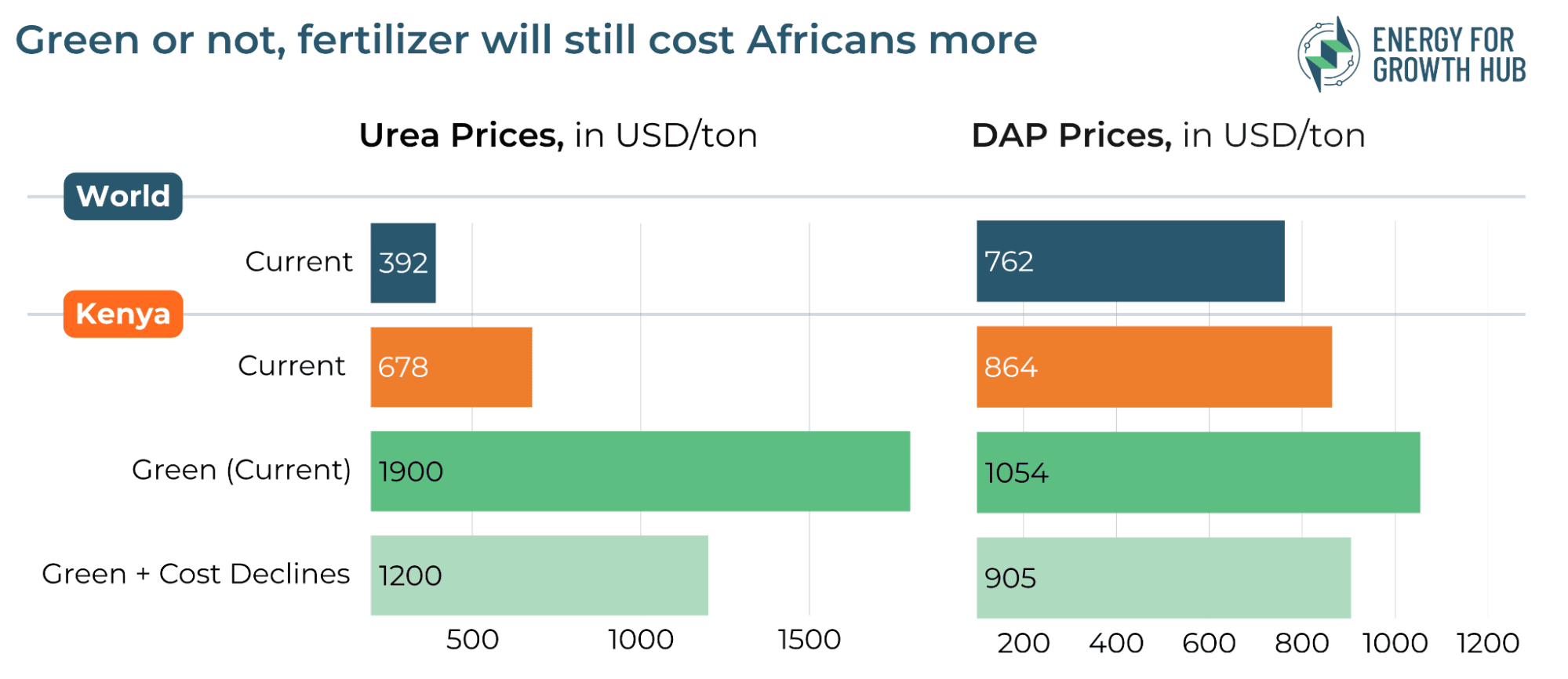
Source: Breakthrough Institute (2025) (left); Source: World Resources Institute (2025) (right)
Reason 3: Green hydrogen can’t fix Africa’s broken fertilizer supply chains.
In most African countries, fertilizer markets are heavily subsidized yet riddled with inefficiencies and corruption. The World Resource Institute’s study of Kenya’s fertilizer market found that roughly 40% of subsidized fertilizer leaks to non-target groups, is resold at higher prices, and rarely reaches farmers who need it most. Similarly, a 2024 Sustain Africa study covering five African countries found that weak private-sector participation, high interest rates, inflation, and currency depreciation have created a fragile local market ecosystem. Limited importers, high diesel costs, and inefficient distribution networks drive local fertilizer prices further above global averages. Addressing these deep structural and logistical barriers would require green hydrogen to be far cheaper than the global target of $1–2 per kilogram—an unrealistic prospect in the near term and uncertain one in the long term.
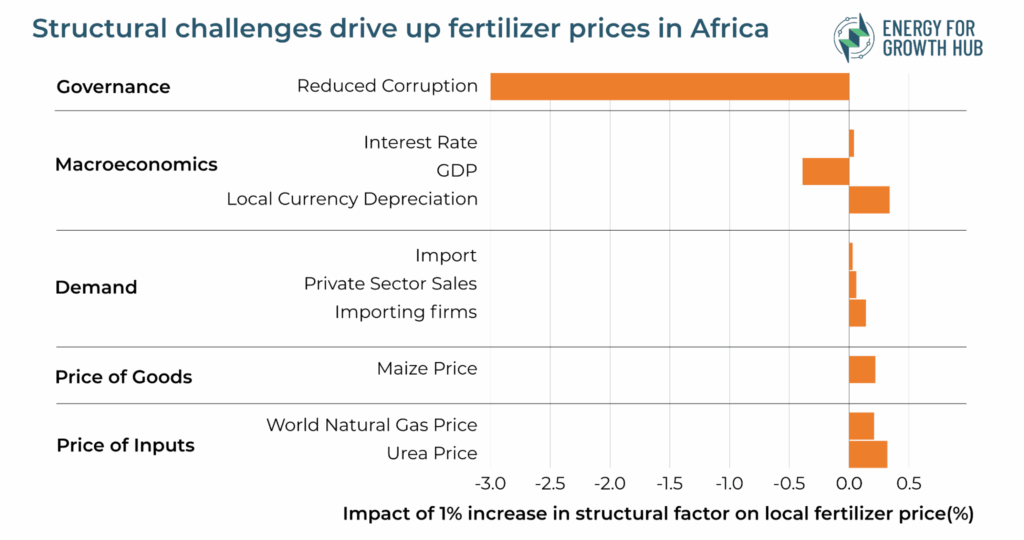
Source: Causes and Consequences of the 2021/22 Fertilizer Price Spike on sub-Saharan Africa. Sustain Africa (2024)
TLDR: Green hydrogen is the wrong solution to Africa’s food insecurity
Green hydrogen is an inadequate and costly response to Africa’s urgent food security challenge. The continent lacks the cheap energy, low-cost clean inputs, and efficient fertilizer markets needed to make large-scale investment in green hydrogen viable—or to build an affordable, resilient fertilizer market across Africa. Instead of fueling the green hydrogen hype, policymakers should focus on addressing the root causes of food insecurity by: (1) investing in non-green fertilizer production where the ingredients are accessible; (2) implementing policy solutions that improve fertilizer import, sale, and distribution challenges; and (3) expanding access to affordable and reliable electricity.