
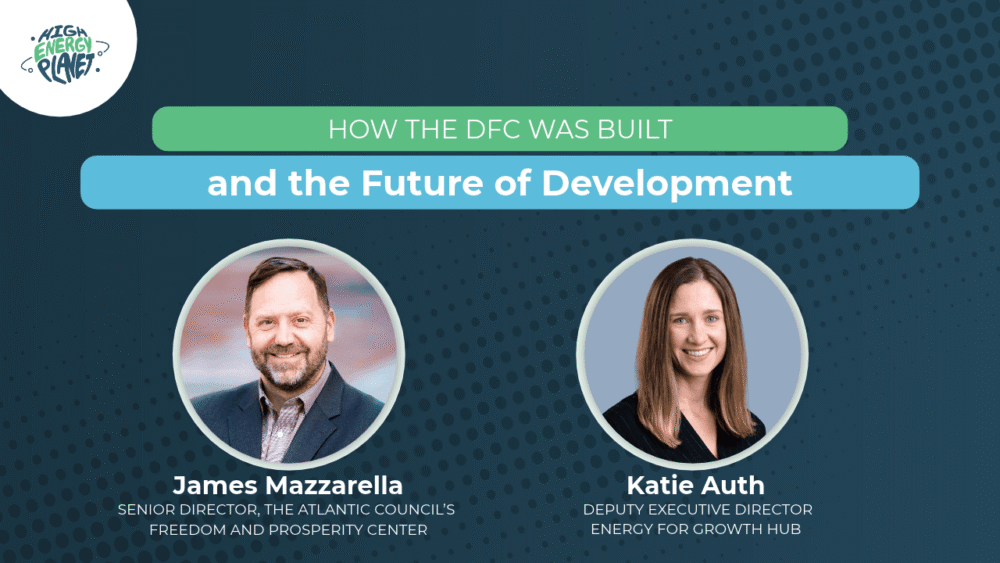
James (Jim) Mazzarella of the Atlantic Council joins host Katie Auth to discuss how he created the US Development Finance Corporation (DFC) and what US foreign aid needs now. Drawing on his years at the Millennium Challenge Corporation (MCC) and the White House National Security Council (NSC), James explains why he sold the DFC as a national security tool, and the risks that framing carries. Listen as Katie and James discuss how 9/11 inspired the work they both do today, why Congress stayed quiet as USAID was dismantled, and what the future of US development policy can look like.
James Mazzarella is senior director of the Atlantic Council’s Freedom and Prosperity Center. From 2017 to 2019, he served at the White House as senior director for global economics and development, and was a primary architect of the US International Development Finance Corporation. He previously served as deputy vice president of congressional and public affairs at the Millennium Challenge Corporation, ran New York State’s Office of Federal Affairs, and was chief of staff to Congresswoman Susan Molinari.
“ I feel like we’re a great nation, and we can do great things, but I do get frustrated, like everybody else, when we try to do great things, and it’s not achieved, or money gets wasted.”
– James Mazzarella, Season 5 of High Energy Planet
Covered in This Episode
- From Staten Island to MCC: James shares how 9/11 brought him from New York politics into development, and how he talked his way into a brand-new MCC.
- Opposition or Frustration? James sees isolationism on both sides, but argues most Americans are frustrated by a lack of results, not opposed to aid.
- The Blueprint for the DFC: How a paper co-written by the Hub’s own Todd Moss helped shape the DFC, and why development is “usually the last” priority.
- The Risks of the National Security Pitch: Why “national security is often in the eye of the beholder,” and what shifting priorities cost long-term projects.
- Inside the NSC, Then and Now: James compares the NSC’s traditional convening role with today’s de-powered version, and suggests how the next administration should size it.
- Congress and Trust: Why lawmakers stayed quiet as USAID was dismantled, and what earmarks reveal about their trust in aid agencies.
- Partners, Not Fixers: James makes the case for partnering with countries that want to change, because “we can’t want it more than them.”
Resources
- Learn more about James’ work at the Atlantic Council’s Freedom and Prosperity Center
- Read the 2015 Center for Global Development paper by Ben Leo and Todd Moss that James used as his blueprint for the DFC
- Learn more about the Development Finance Corporation (DFC)
- Learn more about the Millennium Challenge Corporation (MCC)
- James points to the Lobito Corridor in Angola and Zambia as a different US model. Read about DFC’s investments along the Lobito Corridor
- James mentions DFC and MCC partnering on energy in Sierra Leone. Learn more about the Sierra Leone Compact
- Catch up on all High Energy Planet episodes, including this season’s E1 with Adva Saldinger and E2 with Casey Dunning Davis
Key Terms
- DFC = the Development Finance Corporation, a US government agency mobilizing private capital to advance economic development in partner countries and support US foreign policy goals.
- MCC = the Millennium Challenge Corporation, a US government agency that promotes democratic governance and economic growth in the world’s poorest countries through time-limited grants for core infrastructure and policy reforms.
- NSC = the National Security Council, the White House body that coordinates foreign policy and national security across federal agencies.
- OPIC = the Overseas Private Investment Corporation, the US development finance agency replaced by the DFC in 2019.
- Earmark = a requirement from Congress that funds be spent on a specific purpose or program.
- USAID = The US Agency for International Development, formerly the leading agency directing US development assistance. The Trump administration dismantled the agency in 2025.
“On some level, it’s the reality of any institution made up of people that are acting on the incentives that are there. … There’s no incentive for people to ramp down assistance.”
– Katie Auth, Season 5 of High Energy Planet
Transcript
Katie Auth: Hi everybody. I’m Katie Auth with the Energy for Growth Hub. Welcome to a new episode of our podcast, High Energy Planet.
In the last two episodes, we talked about what’s happening at two major US development agencies, the Millennium Challenge Corporation and the Development Finance Corporation.
My guest today, his name is James, or Jim, Mazzarella. He worked at MCC in its very earliest days, and he was one of the architects of creating the DFC. So he has immense expertise and insight into both of those agencies. He’s also worked very deeply with the Hill and with congressional offices. He’s now the senior director of the Freedom and Prosperity Center at the Atlantic Council.
We’re going to talk about how 9/11 pushed him from New York state politics into global development, why he created the DFC and where it’s fallen short of what he originally intended, and then how the US can lead in the future with a little bit more humility and realism.
Thanks for joining, and let’s get into it.
Meeting During the Power Africa Days
Katie: Hey, Jim. Welcome to High Energy Planet. Thanks for coming on.
James Mazzarella: Thanks for having me on. It’s great to see you.
Katie: I have to preface this conversation by saying that I spent many years being very intimidated by you. I was working at USAID at Power Africa, and you were at the NSC, and we would have to go brief you. You had a reputation as the tough guy who was going to ask us really hard questions, and we would have to defend ourselves.
And then I’ve gotten to know you in the years since, and I’ve learned that you’re secretly the most thoughtful, kindest person in this space, so that’s a funny thing.
James: Well, I’m not… Thank you. I don’t know if I’m that kind. But I like to think I’m thoughtful. I like to take both sides of a story.
Sometimes I got a little frustrated with the Power Africa folks. They did great things, and I really admired the program, but sometimes they took credit for stuff that other agencies did, which they should have, because they were coordinating everybody. But I’m somebody who comes from a tradition of: you have to give credit where credit’s due.
Katie: Yeah. You were by no means the only person frustrated with us about that at times.
From Staten Island to Southeast Asia
Katie: So we brought you on, and I wanted to start by talking about how you got involved in development in the first place. When I learned more about your background, I realized that you didn’t start your career in foreign policy. You were actually in New York state politics. You worked on the Hill, and then you were working for New York Governor Pataki for many years, and then you jumped to MCC. So I’m curious what drove that shift, and why did you enter the development space?
James: Yes. It’s a very circuitous career path that I’ve had. But it’s been a great one, and I wouldn’t trade it for anything.
I did always have an interest in international relations, and I went to school for that at Michigan State. My first job, before I worked on the Hill, was actually in public relations and communications, working for the Bosnians and the Croatians and the Kosovars, as each one was fighting for their independence from Yugoslavia. Very intense work.
Through that process is when I met Susan Molinari, who turned out to be an amazing person. She was my congresswoman from Staten Island, New York, and I ended up working for her. Working for Susan is really how I got into it. I was really not interested in Republican politics or being on the Hill as a Republican necessarily, but I was really committed to her and helping her achieve her goals. So I became her press secretary for a while, and then I was her chief of staff.
That was great, but then she left Congress and became a television news anchor for a while. So I took that opportunity to take some time, and I went backpacking in Southeast Asia for a number of months.
I didn’t really understand, but I saw a significant amount of poverty, and I saw some development projects that the Australians were doing that were really impactful. A bridge here, a telecom deal there. They were infrastructure. They were working on some infrastructure projects. Even at the time, I realized the way we did development through USAID, with much more short-term, one- or two-year processes, wasn’t creating the sustainable growth that you could see with the Australians.
Katie: Meaning infrastructure versus more technical assistance? What’s the difference that you saw?
James: Yeah. So this is in the ’90s. Australia built a bridge between Laos and Thailand that was critical. It was a very small bridge, but it was a huge lifeline between the two countries, helping the Laotians have access to economic growth and a rail line that was on the Thailand side.
The US wasn’t doing infrastructure like that. And they used to do infrastructure. They did amazing water programs in the ’70s in Jordan and other places.
9/11 and the Road to MCC
James: Then I happened to get a job with the governor of New York. While I was there, September 11th happened.
My job for the governor was basically the state-federal liaison. So a lot of what I had to do was coordinate the congressional delegation, work with the administration, and get the resources New York needed from the federal government to rebuild and recover from the attacks of 9/11.
I spent a number of years doing that. When I was ready to go, I could’ve gone a couple of different ways with my career path, and I was exploring those different ways. But my stretch goal was MCC. MCC had just been stood up, and for me, the Millennium Challenge Corporation was representing development the way I saw being done that was so impactful.
I made a stretch goal, even though I don’t think I was qualified. Could I get into MCC? I was looking at a whole bunch of different job options. This is when I really —
Katie: And just for context, for people who don’t know, President George W. Bush launched MCC in what?
James: The legislation passed in 2004.
Katie: So it’s a brand-new agency.
James: So it was a brand-new agency. Nobody knew if it was going to stick around. I don’t think there was a lot of competition for jobs. I talked my way into it. I did congressional relations for them, and that’s really where I learned about development.
At MCC, we’re supposed to be reducing poverty. How do you reduce poverty? The best way is actually by creating economic growth, according to the economists. What are all the best practices of foreign assistance happening at that time? They put them into one agency, and they created a bipartisan consensus to move this forward.
Isolationism on Both Sides of the Aisle
Katie: I wanted to talk about the bipartisan nature of MCC, but first I just wanted to say: for so many people of a certain age, I think 9/11 was the impetus for getting into this kind of work. For me, I was in 10th grade when 9/11 happened, and I watched the Iraq War happen. I was desperate to be part of a better vision of US foreign policy. I was like, “It has to be better than this.” It’s just interesting to think about how that event triggered so many people to think differently about foreign policy.
So you go to MCC. It’s launched by a Republican president. There’s very strong bipartisan consensus around it. And to some extent there has remained bipartisan support for MCC to this day. But you must have watched the Republican consensus on development shift over time. What has that looked like for you, to watch that consensus fracture?
James: Well, I feel like I’m in a bubble now, and so I still know tons of Republicans who are very concerned about development and effective development.
And there’s a whole host of not just Republicans, but Democrats. It seems like there’s an isolationist way on both sides of the political spectrum that is not just opposed to development, but opposed to foreign interventions at all. They just don’t believe that the US should be a leader.
I grew up in Michigan, and much of my family doesn’t quite believe in global leadership or soft power or foreign aid. And now, when I sit down and explain to them when it’s effective, here’s how it can be effective, and this money’s not wasted, they do become much more appreciative and thoughtful about it and agree that it’s money well spent.
But they are very frustrated by the general perception that it’s all wasted, or it’s all going to corruption, and none of it is meeting any goals of effectiveness. That’s what frustrates them. And often, I think, in DC we get confused by people’s frustration with the lack of seeming progress and opposition to it altogether.
What “Real People” Think About Foreign Aid
Katie: I’ve been in meetings with you and other development professionals since last year in which it’s a group of DC people sitting around a table, arguing about what, quote unquote, “real people” outside of DC think about development. It always strikes me as… It underlines how isolated we are.
But then you look at the public polling on development, and often the general concept of development assistance doesn’t poll all that well. But when you break it down into specifics, of should we do this particular thing, the support goes way up, which speaks to what you’re saying, I think.
People want to feel confident in what their tax dollars are achieving, and they want to be able to trust institutions to deliver on that and not waste money.
James: Yeah. And I think that that means having clear goals and having something that’s time-bound. You have clear goals, and you can measure your progress against them. Often, our development assistance didn’t have clear goals set to it. It was part of a whole system that was fuzzy.
How MCC Survived the Bush-to-Obama Transition
James: When Bush set up his initiatives, he had three: PEPFAR for HIV/AIDS, malaria, and then, to reduce poverty, the Millennium Challenge Corporation.
It wasn’t clear that MCC was going to survive the transition to the new government. There was a lot of chatter about how they were going to try to shut MCC down. But it did have bipartisan backing, on the Hill and off the Hill. One of those people was Secretary Clinton, who knew about MCC when she was a senator and understood the power of economic development and the power of this new approach.
They used data to make decisions about where they were going to go, what countries they were going to partner with, and then what projects they were going to fund to generate this economic growth, and all of it is transparent.
Now, is that a national foreign policy and national security concern? We’d like to say so. We thought reducing poverty, especially in countries that could be allied with the United States, would be a more effective place, because we’re only working with democracies who care about their own development. We’ll be creating trading partners and others. So we can make the case. It was kind of a stretch, but…
The Risks of the National Security Pitch
Katie: I was actually going to ask you about that, about the national security aspect in particular. Right now, everybody who cares about development is running around trying to frame everything in terms of national security. I think the argument is that that’s the way to achieve political durability, and to get not only this administration but any administration to really care about and prioritize development. Is that a good way to go, or what are the risks to framing it that way?
James: It’s a really good way to ask the question: what are the risks? Those aren’t discussed very often.
I was part of a process that helped create a new agency called the Development Finance Corporation, the DFC. Part of the way we sold that was that it would help counteract the influence of adversaries in the developing world. China in particular was… They weren’t using grants to gain influence, like we were. They were giving out loans. So could we get influence by loaning money, too?
Now, I wanted to create a development agency because you could see that the private sector, and growing the private sector, which is what these finance institutions do, is the way of the future. It was one way to create economic growth and reduce poverty. But I had to sell it by making it part of a national security argument.
From OPIC to the DFC
Katie: Sorry, just to back up one second. We had OPIC, the Overseas Private Investment Corporation, which was smaller than DFC but had the same general… It could loan money for infrastructure, for the private sector. So what were you trying to achieve in bumping up from OPIC to DFC?
James: Right. So it’s an interesting story. The Trump administration had set a budget that closed OPIC. The first Trump administration had first decided that they thought they’d close OPIC.
Katie: That’s right. I forgot that.
James: Some people felt that OPIC and another bank, a US bank called ExIm, whose main goal is to help facilitate US exports, distorted the markets. The marketplace should be doing what these two entities are doing. So ExIm gets closed, or proposed to get closed, and rather than close it, I actually…
Your colleague, Todd Moss, had written a paper two years earlier that talked about creating a whole DFI, a whole development finance institution, in the US by pulling in different aspects of US tools that are spread around the government. Can we put them in one place and really create something that would be an effective foreign policy tool and development tool?
So I literally took that paper. It had sat in my reading pile for two years. I hadn’t gotten to it, but when I went to the NSC, I took this paper and said, “I think we can save OPIC by creating this.” And at first people—
Katie: I hope Todd listens to this episode. He’s going to feel very gratified.
James: Well, he did a great thing. Time and time again, I kept referring to that paper every time people said, “Well, this isn’t thought out enough,” when we’d have a proposal. And I was like, “Well, here’s this academic 30-page paper. Tell me why this isn’t thought out.”
It was much more ambitious than we were able to actually achieve, but it was the right blueprint. We were able to consolidate some aspects of the US government into what was OPIC, increase the leverage, give it new tools, like allowing it to do equity investments. And we created something that had a three-legged mandate: yes, this is going to create development outcomes; this will help counter China and lead on national security concerns; and this will also make money for the US government, because OPIC made money for the government as a bank.
National Security Is in the Eye of the Beholder
James: Now, what we’ve seen, and not just with this administration but generally speaking, is that the development mandate is usually the last one that the leadership of the DFC cares about. Everybody wants to go… Right now it’s critical minerals, and with the Biden administration it was climate. They use it for their priorities.
So what I like to say is that national security is often in the eye of the beholder. What one administration thinks is national security, another one doesn’t. And that goes back to what you were asking about, the risks. National security priorities often change, and when they change on a short-term basis, that impacts the long-term relationships. And also, economic growth takes a long time. You can’t start a bridge and then not finish it. So that is the main risk, I think.
Katie: I completely understand that risk, but it’s also hard for me to imagine any other organizing framework or theory of change that would have any similar shot at being important to every administration. If it’s not national security, what is it? How would you sell it in a way that maintains importance across different administrations?
James: I think fundamentally, the first job of the government is national security and foreign policy. I think there has to be an understanding, though, that really what we need to be is effective. We need to create effective tools. And if we focus on effectiveness, it doesn’t matter when the priorities change.
Now, for MCC, effectiveness is to be divorced from national security policy, right? But it is still part of the national security milieu. Right now it’s making a shift to Latin America, because the Secretary of State is very concerned about Latin America.
Katie: Well, and MCC is also currently figuring out how they can quantify their impact on US manufacturing and US investment. I mean, they are figuring out how they can get closer to national security, right?
James: They understand it’s been 20 years since they were started, and they have to adjust their criteria some. So yes, they’re being astute.
Generally speaking, though, they’ve been very good about maintaining their core principles of working in countries in a transparent way, countries that are meeting certain objectives. And that’s what’s in the law.
But I feel like one of the reasons it survived the whole DOGE process was because of this team as being effective.
Katie: I guess especially if you think about how our country as a whole is in a very distrusting… Everyone distrusts institutions. So if you can manage to be an institution that people generally feel delivers on what it says it’s going to deliver, and you can publish data that shows that, I mean, you would definitely have a leg up over other areas of policy.
The Moral Case for Development
Katie: I wanted to ask you… Obviously, you’re very good at selling development assistance as a national security priority, and maybe “selling” is an unfair word. I don’t mean it disingenuously. But you can articulate that argument, and you actually strike me as someone who has a very clear moral rationale for development.
A, do you think that’s true? And then B, I’m also wondering, does that feel lonely now, when so much of the world has shifted to a very self-oriented perspective?
James: This might go back to my experience with September 11th, which crystallized for me what I want to achieve.
I feel like we’re a great nation, and we can do great things. But I do get frustrated, like everybody else, when we try to do great things and it’s not achieved, or money gets wasted. So I do understand those frustrations. But I still think that our place in the world is a special one, and that we’re a special country, and that with that come certain responsibilities. I just really believe that.
So I can accept the fact that there are all these other reasons why we might do it as well. For instance, critical minerals. There’s a lot of conversation about critical minerals right now. What I want to see is, if we’re going to have foreign aid help pull those minerals out of the ground, usually through a loan to a company or something like that, I want to do no harm. I want the communities around that mine to use that as an excuse to do better. To not be polluted, to share in the growth and the riches.
Because ultimately, the world will be a more stable place, and what I want is no more 9/11s, if that’s ever possible. It might not be. I mean, it might be just… a bucket. I might have a bucket trying to empty the ocean, but that’s what I decided that I wanted to do. And so as long as you’re just focused on emptying the ocean, a lot of everything else is noise.
James’s Three Goals at the Trump National Security Council
Katie: I want to switch to talk a little bit about… You were at MCC, and then when President Trump first came into office the first time around, you actually went to go serve at the National Security Council in the White House, and you were the director for development. I believe that was your title, one of your titles there.
Clearly, the election of President Trump was controversial and worrying for a lot of people in the aid community. What were you hoping to achieve when you chose to enter the administration and take that job?
James: Well, actually, my primary reason to go there was to protect MCC if I could, so that we weren’t shut down in the first administration, because I was really committed to its principles and its effectiveness. We were all worried.
The way I phrased it was that I wanted to spread MCC’s effective principles throughout the government. But really, I wanted to look out for the agency and make sure that it survived. Then I wanted to save OPIC, and Todd’s paper helped me do that.
And then Mark Green was about to come into… He was the incoming administrator, and he had a vision for USAID.
Katie: For USAID, yes.
James: He had a vision of what he later termed a journey to self-reliance, where he would rank countries about where they were on their spectrum of development. That would be a governing principle of how the United States worked with each country.
So there are some countries that we’re only going to deal with humanitarian issues, because they’re in conflict or just post-conflict. There are other countries that need democracy assistance. There are other countries that may be graduating from MCC, and other countries that really are needed, that aren’t MCC countries but really just need development finance. He wanted to be able to map that out and have aid be time-bound for what it was.
So he was able to articulate a vision that was logical and helped countries move off of aid over a 30-year period, but would have effective steps. So I wanted to help —
Katie: And ideally it would help the US government prioritize where and for what purpose it would put its resources, right?
James: That’s exactly right. So those were my three goals: helping promote MCC’s theory of effectiveness while protecting the agency, finding a way to save development finance for a development purpose, and then helping USAID adjust to this new reality, where maybe they had to have some guardrails on how they were making their decisions.
What the NSC Used to Do, and What It Does Now
Katie: So if you think about the role that the NSC played, even during the first Trump administration… Well, I’ll let you explain it. Historically, what role has the NSC played?
Because I think what some people who aren’t enmeshed in DC world don’t realize is that right now the NSC has effectively been stripped down to almost nothing, and really isn’t playing the role that it used to play. So what did it look like when you were there? And then what does it look like now?
James: Yeah. I’ll even go back, because I’ve been in a few administrations. I was in Bush, and then I was in Obama, and then Trump. Bush and Obama at the agency.
Under the Bush administration, they had this idea that they wanted to do more economic development. So why not just turn to the State Department and have them do it? Well, because the State doesn’t have the expertise to do that, right? They’re diplomats. The Department of Treasury, they have international economists, so they had a deep understanding of how to create economic growth.
So the person who’s head of international economics at the National Security Council maps out where he thinks it should go. They bring in all the agencies, and now there’s 30 or something like that, that are working overseas. Get their thoughts, get their opinions, and then they have a process where it goes at the level of experts, then at a political level at the agencies, and then it comes to the deputy secretaries. At every step of the way, the proposals get refined.
Because of that process, there’s a policy process there. It’s very disciplined. If somebody from the White House calls a meeting, everybody shows up the next day, right? So it’s the way to crystallize attention to this issue or that issue.
Another great example is Power Africa, where you used to work. And so Power Africa, it was housed at USAID. But if USAID alone is trying to coordinate all these different functions of the federal government, they’ll call a meeting, nobody’s going to listen to it. But if they do it in partnership with the National Security Council, they all come, and they all bring what they need to bring, and then they go back.
Katie: I’m sure you’ve had your own conversations with people who are involved in the agencies now. It sounds like, in contrast to that very structured policy and decision-making approach, without an NSC it’s much more personality-driven and much more unpredictable and chaotic.
On the plus side, you might argue that that enables you to move faster. I think the NSC decision-making process could be laborious, to say the least. But it also seems like a very impulsive way to make policy. I’m curious what your impression of the current processes is.
James: That’s my impression too. I know, because it is shrunken, like international economics, that’s really in the end the NEC, the National Economic Council. There are some people there who are great people who are focused on the G20 or G7 or MCC, but they don’t necessarily have the convening power that the NSC, in a typical process, has.
And it’s interesting, though. With the Secretary of State being the National Security Advisor, I think the State Department is kind of keeping things running, but it’s from their perspective, and it gives the secretary enormous power. That might be a good thing with this secretary in particular, but maybe the next secretary… If Rex Tillerson had this power, it would’ve been a big problem, because he was so ineffective and had no idea how to drive a policy process.
I’ve seen Rubio be pretty even-handed with the other agencies. If the National Security Council is just calling balls and strikes, they’re kind of the umpire, trying to de-conflict. I feel like Rubio does that pretty well with his policy shop, but the next person might not.
The Right Size for the National Security Council
Katie: So, quick question for you, and then we have one other thing I want to talk about before I lose you. There are two extremes. You have the current Trump administration, where the NSC is quite de-powered. And then you do hear some people who are likely to be involved in a Democratic administration, or who have worked for previous Democratic administrations, and some of them are basically anticipating that because so many agencies have been… You’ve lost staff, you’ve lost career positions, in the future you’re going to have to run much more of foreign policy out of the White House, out of an NSC.
And I’m curious, between those two extremes, how would you advise the next administration, whether it’s Republican or Democrat? How would you advise them to think about the right size and role of the National Security Council?
James: So yeah, like everything, the answer is between the two extremes, and I can give you an example of the other extreme.
Under the Obama administration, when Secretary Clinton came in, she had her own foreign policy staff, and she ran the State Department a certain way. Well, that meant everybody who was an Obama foreign policy person needed a place to go, and so the National Security Council got super big. It was focusing on a lot of different things all the time, and nothing was necessarily moving.
There were a couple of documents that were produced, presidential directives and strategy documents, that weren’t really strategy. They were just a compilation of, “Here’s everything we’re doing,” with the title “strategy” on the top of it. So that’s not good either, right?
Stripping it down at first, I think, is the best way, but then being open to the fact that you need more and more and more… Figuring out what your priorities are at the very beginning. Is it international economic —
Katie: And building to achieve those.
James: So giving it space. It should be about 300 people. If the NSC says, “Oh, let’s move in a certain direction,” there’s not going to be somebody there to do it, but the NSC can’t do it, right? Because it’s just a policymaking body.
So focus on the agencies and get the agencies whole, but have some high-level people who are keeping track of things, who are going to be there to put out the fires at first. Then, within a couple of years, there’ll probably be some priorities that need to move forward.
Why Congress Stayed Silent on USAID
Katie: Yeah, that’s helpful. So the last bucket of stuff I wanted to talk to you about is Congress, because you’ve interfaced with Congress in a bunch of different ways. You actually worked for a congresswoman, and then you represented MCC’s interests to Congress.
I think among a lot of development practitioners, and I guess I’m one of them, I remember being deeply let down and almost angry when USAID was dismantled, and senators and congresspeople who I knew had always advocated for foreign assistance, and who I believed understood the value of it, were basically silent on the issue.
The narrative is that the constituency for aid had broken. I’m wondering, is that the right way to think about it? Is that how you think about it? And then how do we rebuild a congressional constituency that is more durable?
James: That’s a really big question. I give some grace to people who knew that they… I mean, this train was moving, and there’s no way… If they stood in front of it, they wouldn’t have been able to stop it, right?
So why limit your effectiveness in what comes next by criticizing, right? Just criticizing something isn’t in itself going to stop it from happening. So I’m Senator X or Congressman Y, and I’ve got these priorities, and I’ve got to rank them in my mind: what I want to achieve and what I can achieve. If I’ve got 15 things, and this is one that I’m not going to be able to have any impact on, I’m not going to sacrifice those other 14 things for this. So you have to give some people grace for the politics.
Rebuilding a Durable Constituency for Aid
James: I think part of the answer, and I throw it back to you, too, because I’d like to hear your thoughts on it, but for me, part of it is creating a product that everybody can get behind, right? Not out of self-interest, but because it’s effective, or it’s the right thing to do.
And that ultimately takes leadership. When George Bush said he wanted to address poverty, that wasn’t a typical thing a Republican president would do, but he was convinced himself. And so once there was leadership established, when the Trump administration said, “We want to shut OPIC down, we want to create a DFC,” a lot of people just got on board with that.
So you need leadership. You need an administration to be able to articulate clearly why this is in… I don’t want to say the national interest, but it is in the national interest. Reducing poverty is one way to ensure a better world, and we want to ensure a better world. Or doing it in a certain way helps increase US allies. Or, here’s what we want to do, clearly, and here’s how we’re going to do it, and here’s how we’re going to measure that. And if it doesn’t work, we’re going to stop. People will get behind it. So you need people who are not afraid to tackle that and move it forward.
And I think as a development community, I know as a person from MCC, you’d look for the people who were open to the arguments and talk to them. It was very hard to talk to people who weren’t open, who were on the other side. And there were a few examples of congressmen who, “Oh my God,” all we had to do was talk to them, and they see it the way we see it in terms of leadership.
So not being afraid to market what we’re doing as we improve the product of what we’re selling, basically. That’s my thought. What’s your thought?
A More Focused Development Agenda
Katie: I agree with all of that. I think for me, the other big piece is, and you mentioned this earlier, especially in this moment where we’ve lost so much global credibility, we need to somehow strike the right balance of being ambitious and believing that we can still be leaders and effective change makers in the world, but also bring a new level of modesty to the table, I think, and recognizing our own vulnerability here.
I would love to see a much more focused development agenda, where an administration sets out, “These are the three things we’re going to try to achieve.” MCC had the benefit of always being able to be laser-focused on achieving particular things in particular countries. Having been at USAID, I mean, you’re basically trying to do a million different things in 100-plus countries. The mission creep is inevitable, because you have Congress that wants to do certain things, and it just balloons out of control.
It makes it harder to tell the story, because it’s 10,000 stories. And it’s harder to rally your own attention and resources to do anything really big, to achieve something, because you’re just stretched way too thin. So I want us to be much more focused.
James: So why do you think that happened? I mean, I have my own ideas, but—
Katie: I mean, on some level, it’s the reality of any institution made up of people that are acting on the incentives that are there, right? You have the incentive to use your whole budget every year so that the next year you can justify more. There’s no incentive for people to ramp down assistance, even though we talk about the fact that that’s what we’d all like to see happen. But yeah, I don’t know.
Flexibility, Trust and Earmarks
James: The lack of flexibility. There were some things at MCC that were such crazy advantages that we had that I wondered why… Could we ever scale this stuff up? One of them was the flexibility, right? We had a tremendous amount of flexibility for our dollars. None of it was earmarked by Congress.
So then I would ask, “Okay, well, why is ours not earmarked and all of USAID’s is earmarked by Congress?” Looking at it, I decided I think it was a trust level, right? Congress needed to… They didn’t feel the administration was going to spend the money in an effective way based on their priorities, so they had to micromanage this sector, and this sector, and this sector.
That was also just an excuse, because there were funds that were more flexible that were also earmarked by administrations and bureaucracies. And they would say, “Oh, we don’t have any flexibility.” So an administration would come in and say, “Okay, I want to stem the tide of immigrants from Central America.” Both Biden and Trump had said this. So what can we do in order to create economic growth so people are willing to stay home? And with the lack of flexibility that they had in any funding in order to achieve that, maybe to change things, they just couldn’t do it because their hands were tied.
It wasn’t just Congress. It was about a whole system. And the whole system was partly in place because between the branches there wasn’t enough trust, and partly there’s not enough trust because there’s not enough transparency.
Why USAID Couldn’t Take Risks
James: And also USAID in general, and not just USAID but other procurement processes in the government, but USAID in particular, was always under attack. So there was a culture of a lack of risk-taking. Because any time you take a risk, there’s a risk.
When I say risk, there’s financial risk. So the contracts were written in a way that were very inflexible, and you had to do these things. Well, these things might not be leading to any outcomes that we want, but these are what you have to do, because we can track these inputs. So therefore we know that we’re not going to get in trouble if things go awry, because here’s the measures of success. Measures of success isn’t necessarily effectiveness.
That was a risk problem. That wasn’t a USAID problem. That was a risk problem: they were forced to have no risk. And there’s political risk, there’s fiduciary risk, there’s corruption risk. All of these risks that USAID’s system was meant to minimize, because of the political atmosphere that they operated in.
You would see Rajiv Shah, if they tried to be innovative, go up to the Hill. And 10 things might have worked, but one thing didn’t, and he would get blasted for that one thing. And so what do you do? You just don’t have it anymore, right? And that’s all part of the system that we’ve already been talking about.
Is the Trump Administration Too Risk-Tolerant?
James: So one of the interesting things about this administration: because they’re trying to rebuild, or trying to build up something, they seem very, rather than risk-averse, risk-tolerant, hugely risk-tolerant. I don’t know if it’s going to bite them, but they’re giving out grants to this company or that company, and do they have the people there that can oversee those grants to make sure that whatever they’re doing gets delivered? The amount of people it’s going to take to oversee these things is going to be huge. Are they anticipating that? How are they doing it?
The political risk of moving things to the United Nations, that’s obviously substantial. You’re giving up control.
Katie: I’m sort of laughing to myself, because my team knows that I’m obsessed with risk adversity, and the culture of risk within government, and I think you’re absolutely right. And it wasn’t just USAID. I mean, that was how DFC operated as well before this administration.
I’m really interested in the windows for taking risk that the Trump administration is cracking the door on at DFC now. How do we hold onto that in a future administration and put it to the best use possible? Because I think if you’re trying to do really hard things in really hard places, which is what development is, you have to take risk, and that should be your founding principle in many ways. It’s built to do things that the private sector won’t do on its own. So how do we build a culture and a mentality that embraces that, rather than being frightened of it?
What James No Longer Believes About Development
Katie: We’re out of time, but the last question that I want to ask you is something we ask all of our guests, which is: what’s one thing that you used to believe about international development that you no longer believe?
James: I would say I used to believe that we could fix things here. Like, just more money could solve more problems. And I don’t believe that anymore.
I believe that countries need to really chart their course, and we have to make sure that we find ways to assist them in doing that, but not try to take it over or do it ourselves. And helping countries create the enabling environment for their own economic growth, whether that’s technical assistance or incentives like MCC or other things. And really finding countries that want themselves to grow, countries that are democracies, that are committed to open markets, that are committed to focusing on corruption. We’re not going to get growth unless those three things are there, those policy environments are there. And we can’t want it more than them.
So that’s what I would say: partnering with countries that want to change is a better catalyst or multiplier than just, “Oh, I want to solve the education problem, so here’s $100 million for education.”
A New Vision for US Leadership
Katie: I’m thinking back on what you said toward the beginning of the conversation, where you were saying that you still do believe that the United States has a special role in the world. You have special responsibilities.
It strikes me that the question you’re underlining is the big thing we have to figure out, now that US policy has been upended: what is the vision for US leadership in the world that is ambitious and reflective of our capacities and our luxuries and our advantages, but doesn’t also come with all of the “We’re going to come in and fix everything, and we think we can do everything.” There’s some new vision that has to be articulated there that is really important and really interesting, I think.
James: And some of it might be… I was struck by one of the supposed villains of the USAID process, the undersecretary, Jeremy Lewin.
I used to work at World Wildlife Fund, and it’s a great organization, and they do great things. Part of what they do is try to make sure animals and ecosystems are protected and humans can thrive together. And he pointed out, “Well, should we have conservation programs? Should the US government be paying for those?” And I would say yes. Because I want ecosystems, and I also want people to thrive.
And his point was, maybe the US government doesn’t have an interest in that itself. Maybe the United States as a population has an interest in that, and so World Wildlife Fund should do that, right? Why should the US government be doing that?
That’s a really hard conversation to have, and I would do an earmark, just like I said. But maybe it’s a different way of working with philanthropies, where maybe we’re not paying for it, but we’re lending guidance, or we’re lending support, or our embassy is saying, “This is important to us,” or we’re coordinating donors, or we’re doing something that isn’t necessarily driven by dollars, but we’re still involved in the issue, if we could do that.
Lobito and Sierra Leone: Meeting Many Objectives
James: Another good example of how we can do this: the Chinese often go in and they’re working right with the governments and not caring about the people. I mean, I’m sure they care a little bit about the people, but this is an overgeneralization. Sometimes they’re providing bribes to government officials to get the influence that they want, or building this kind of a building.
So there have been times when the US government, in both administrations, like with the Lobito Corridor in Angola and Zambia, said, “Okay, we’re going to go in with a different model, and our model will be: we’re going to build this railroad, and it’s going to help.” This railroad will be tied to our economic growth, but we’re also going to be concerned. And the Trump administration reoriented the MCC program in Zambia to focus on what’s going on in this corridor, so it’s still going to have development outcomes, but in a more coordinated way. So we’re going to be able to win the hearts and minds while we also meet our foreign policy objectives.
There’s been a lot of criticism of the DFC for moving away from development, like we were talking about at the beginning. But in Sierra Leone, they’re working with MCC to do energy projects, right? They’re helping with energy generation, and MCC will be providing a grant to do transmission lines. But all that is predicated on the government changing some of their energy policies, so that the generation actually gets paid for, and there are other policy environments.
That’s going to change a lot, and that’s going to be transformational, because energy, as you know, where you work, is really right now the foundation, I think, of all economic development, especially in Africa.
So here’s a case where we can meet many different objectives. There is a way to do it, if we go in and everybody is transparent about what they’re doing, I think, and we have the right motives, even if they’re multiple. It can be achieved.
Katie: Jim, thank you so much for this conversation. I really enjoyed it, and I learned a lot, and I really appreciate you coming on.
James: I really appreciate everything you guys are doing at the Energy Hub. It’s really important and so interesting. I really do read your stuff a lot, so thank you for doing that.
Katie: That’s it for today’s show. Thank you so much for joining. High Energy Planet is a production of the Energy for Growth Hub, a global think tank focused on building a high-energy, resilient future for everyone. You can learn more about our work at energyforgrowth.org. If you liked today’s episode, please rate and review the podcast and tell a friend about us. Stacy Raine is our producer, and Jillian Mock is our senior producer. We’ll see you next time. Bye.