
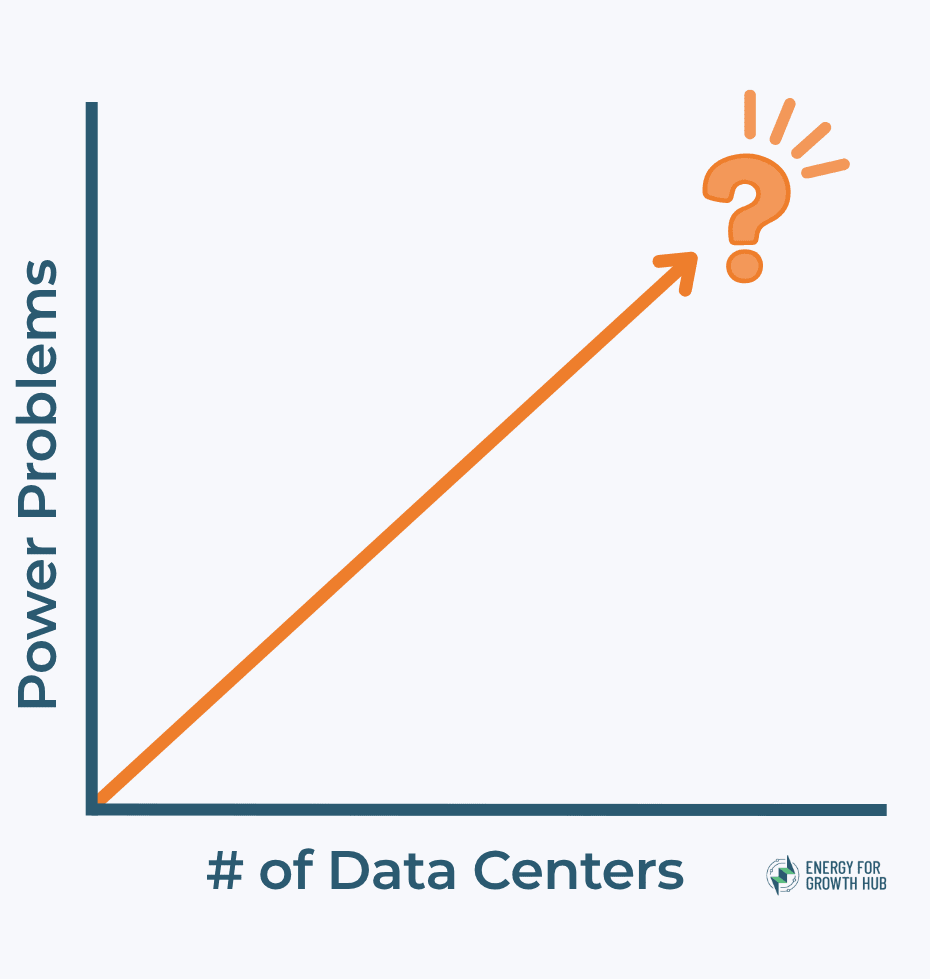
AI data centers’ impact on electricity prices in the United States has drawn mass attention from politicians (and, increasingly, the public). The White House recently introduced a ‘ratepayer protection pledge,’ progressives are pushing data center moratorium legislation, and governors are ordering rate freezes. All seek to manage the harms of data centers through temporary measures and voluntary action while overlooking the bigger opportunity data centers offer: to turn new demand into better and cheaper power for all.
I can’t blame these politicians. Energy generation almost always dominates energy conversations, while energy demand is often an afterthought, misunderstood, or stuck between hype from the tech-optimists or fear from conservation-minded advocates. At one extreme, people assume rising demand will trigger all kinds of negative economic and environmental impacts. At the other, people — especially in many emerging economies where demand is a major gap — view new sources of demand as a potential lifeline. In Ethiopia, for example, the government hopes demand from data centers will bridge utility finances and FX shortage.
But neither of these outcomes is inevitable. Demand itself does not determine whether power becomes more affordable or reliable. Policy does. In order for demand center projects — including data centers — to benefit everyone, policy must support adequate energy infrastructure, plan for demand, enforce transparency around energy dealmaking, and address core public economic and social concerns.
When policy fails, demand centers can raise power prices and lower quality.
With the right policy support, demand centers (whether on- or off-grid) can provide tremendous value: They can anchor new energy projects; strengthen utility revenue; support infrastructure expansions, upgrades, and services; reduce technology and financing risks; and ultimately help lower overall power costs. But in poor public policy contexts, demand centers fail to live up to this promise. In practice, policy failures around demand centers tend to fall into four categories:
- Demand increases without sufficient energy infrastructure to support it. When demand grows without corresponding investments in supply, grid, or service improvements, it begins to compete with existing uses of power, raising electricity prices or reducing quality of service for existing customers. In 2024, demand from bitcoin mining resulted in widespread outages in Iran. Most US states are underprepared for demand surges, a gap that will likely show up in price increases or quality of service declines.
- Poor demand planning leaves power projects exposed to low-value users. When power projects are built without planning the right mix of customers, utilities end up selling to quick-to-deploy and quick-to-pay users, without considering long-term economic value. Until recently, for example, data centers for bitcoin mining in Ethiopia paid just ~3 cents/kWh for power from the newly commissioned Grand Ethiopian Renaissance Dam plant — paying half the actual cost of power supply and shielded from tariff increases for other users. Without demand planning, utilities with excess capacity face similar financial loss.
- Politicians, with little transparency and expert input, shape demand deals poorly. In Kenya, the government just cancelled a celebrated data center deal with Microsoft due to lack of adequate supply. When politicians, without energy expert guidance, strike deals and often do so behind closed doors, operators and implementers are left managing the consequences. Failing to launch is just one example, and not the worst one, to be honest. In other instances, non-transparent and politically driven demand deals have also resulted in unsustainable debt, inflexible loads that strain the grid, higher prices, and declining power quality over time.
- Advocates propel demand centers without addressing core public economic or social concerns. Although rising energy prices have been the focus of backlash in the United States, data centers are also being banned in states where electricity prices have not yet increased. This is because the core public concern around AI-driven job loss remains unaddressed. Similarly, Angolans protested a major hydrogen export project in 2022 because they saw little connection between export and improving local electricity access. When policymakers fail to address core economic and social concerns, public backlash grows and raises energy development risks and costs, harming both current and future consumers.
Good policy determines whether demand centers help or hurt the public.
In both mature and emerging markets, affordable, reliable power depends as much on demand and policy design as it does on generation. When utilities and decision makers fail to plan for demand — how to supply it, which types to prioritize, the feasible terms under which it operates, and the broader public interest context — demand centers can end up raising electricity costs and weakening service quality. Politicians then rush in with short-term fixes instead of deep policy reforms that strategically make use of demand centers. This pattern matters even more in emerging economies, where decisions about which demand centers to attract and under what conditions can determine the long-term financial health of both the power sector and wider economy.