

Economist Lant Pritchett has a new paper arguing economic growth alone is enough to deliver better development outcomes.
He concludes we don’t need to worry too much about “pro-poor” growth (or any such caveats to growth) because he examined indicators for well-being such as health, education, sanitation, and living conditions across countries and found that GDP growth always produces better outcomes. No country gets rich without achieving high well-being — and no poor country achieves high well-being without getting rich first.
One point that especially resonates is that Pritchett finds growth matters much more in poor countries than in rich ones. A 1% increase in GDP improves lives far more in Ethiopia than in Denmark. In fact, he finds that the impact of GDP growth on human well-being is several times stronger in poor countries.
While this makes intuitive sense, we wondered if it also might tell us something about the impact of electricity on development.
We Know That No Electricity = No Prosperity.
Our Empty Quadrant scatterplot shows that countries simply cannot get rich without lots of electricity. All countries above $60,000 GDP per capita use at least 5,000 kilowatt-hours per person.
While (yes, yes) this is a correlation, not direct causation, it’s pretty strong evidence. But Pritchett’s paper made us ask a related question….
Does an increase in electricity consumption lead to more growth in poor countries than in rich ones?
We think yes. Looking at a snapshot of World Bank data for 140 countries in 2022, electricity consumption accounts for about 80% of GDP per capita variation across countries in a simple regression model.
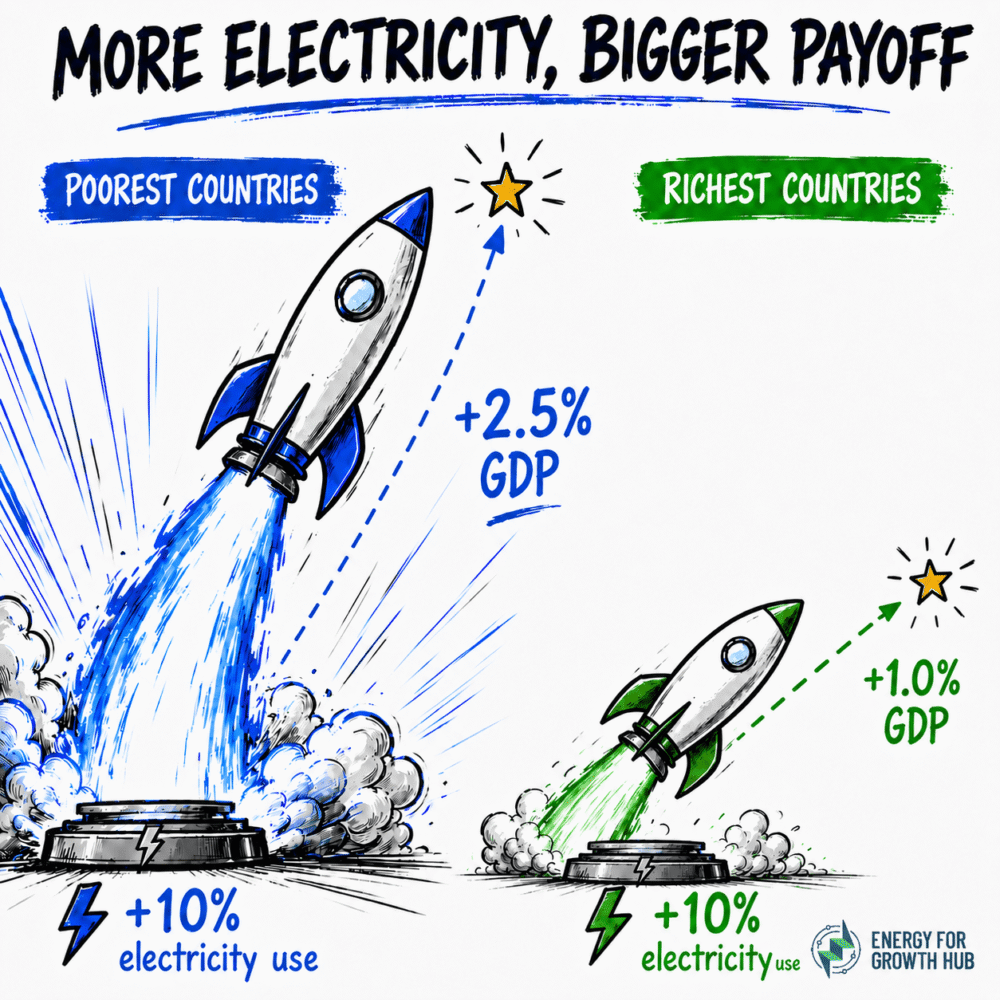
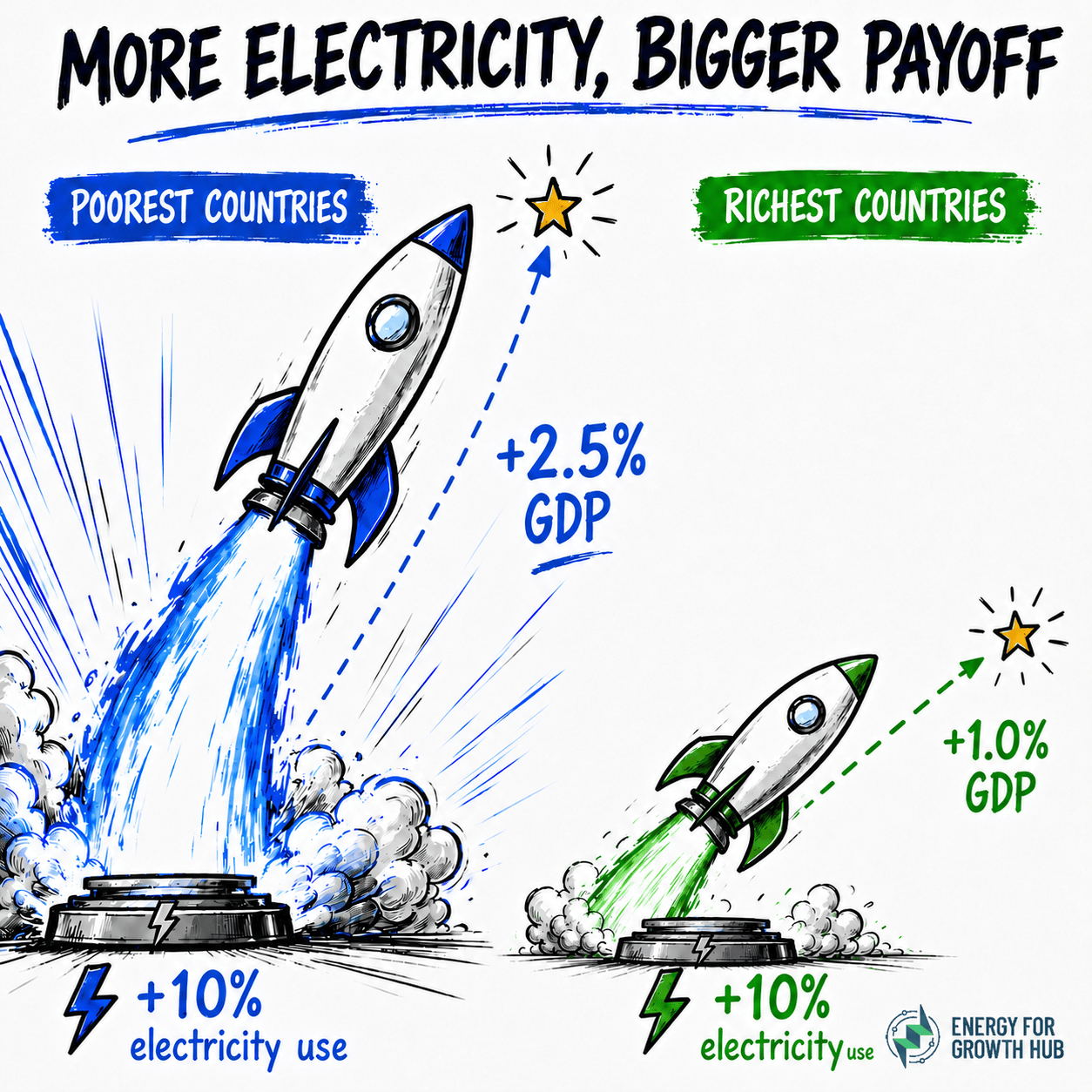
The same increase in electricity consumption is associated with 2.5 times more economic growth in poor countries than in rich ones. That is, a 10% boost in electricity use correlates with a 2.5% increase in GDP in the poorest countries, but only a 1% increase in the richest.
The elasticity of this relationship matters to development policy, energy investment, and philanthropy.
Pritchett’s point is that governments should focus more on economic growth and worry less about specific sectoral interventions. Growth will deliver human benefits, especially in the poorest countries.
Our parallel analysis of electricity suggests at least two implications for development financiers and effective altruists:
- Energy investments, even when specifically intended to mitigate extreme poverty, should target jobs and growth. The emphasis on providing initial electricity access instead of large-scale energy systems for the economy may have swung too far, even for meeting traditional development outcomes like health and education. The ‘families or firms’ debate often mistakes energy for business as meaning profits matter more than human outcomes. The data here suggests that’s dead wrong. The next big wave of energy poverty initiatives — i.e., whatever comes after Mission 300 — should probably tackle reliability and cost for industry rather than last-mile initial access.
- Returns on investment impact are greater in poor countries than in rich ones. The impact of a marginal kilowatt-hour is much higher in Liberia than in Louisiana. The AI-driven demand in the United States and Europe is (understandably) attracting all the attention for new energy investment because those projects are far more bankable. (OpenAI is a wealthy, creditworthy consumer; the Liberia Electricity Company is not.) But the human benefits are far less in richer countries. So, development policy must try to find practical ways to attract more energy investment into the poorer markets.
Watch this space. Our colleagues are working on both of these imperatives.