


Context
Nigeria must address its chronic electricity deficit, which remains a binding constraint on economic growth. It raises production costs, limits industrial expansion, and costs the economy an estimated 5-7% of gross domestic product annually. Unreliable power supply also forces widespread reliance on diesel and petrol generators, adding roughly 40% to the cost of locally manufactured goods. At the same time, Nigeria has committed itself to achieving net-zero emissions by 2060 under its Energy Transition Plan. Nigeria, therefore, faces a dual challenge of expanding reliable and affordable electricity supply while simultaneously reducing its emissions intensity.
The current Energy Transition Plan emphasizes renewables (mainly solar) and natural gas, but excludes nuclear power from long-term consideration. However, global experience and recent Nigeria-focused analysis suggest that nuclear power generation could play an important role in meeting rising demand while maintaining system reliability, especially under climate constraints. Advances in reactor design, safety systems, and project delivery models are reshaping the nuclear landscape, making the technology more adaptable to emerging economies. In this context, reconsidering nuclear is not about replacing renewables, but about broadening Nigeria’s clean energy options to ensure that evidence, reliability needs, and long-term development goals guide future power system decisions.
Five key misperceptions exclude nuclear from consideration in Nigeria
These five persistent assumptions drive the exclusion of nuclear from Nigeria’s energy planning, despite mounting evidence that the technology could play a potentially important role in the country’s future.
- Assumption 1: Nuclear is too costly and not economically viable for Nigeria
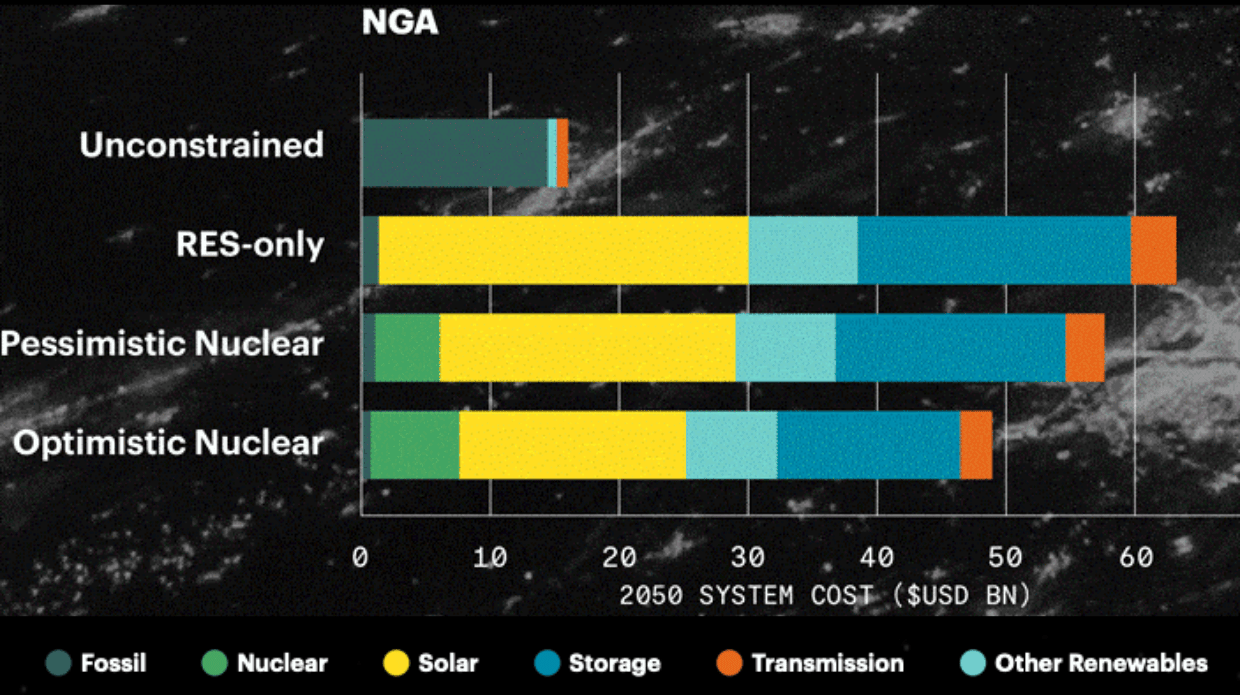
- Reality: Recent Nigeria-focused modeling shows nuclear to be cost-competitive in both pessimistic and optimistic nuclear scenarios, reducing long-run system costs by 8-22% compared to renewables-only pathways (assuming nuclear overnight capital costs on the order of $7,000–11,000/kW over 2035–2050, plus an 18% Nigeria weighted average cost of capital, nuclear availability from 2035, and constrained build rates). Nuclear displaces expensive diesel self-generation and avoids massive overbuilding of solar and batteries. While upfront capital costs are relatively higher, nuclear plants operate for 50-100 years with low operating costs, making them economically attractive over the full system lifetime.
- Assumption 2: Nuclear power is unsafe, especially in a conflict-prone region like Nigeria
- Reality: Advanced nuclear technologies, including SMRs, feature passive safety systems that automatically shut down and cool without human intervention or external power, and are housed in robust containment structures designed to withstand extreme events. The highly radioactive fuel is heavily shielded and cannot be accessed without specialized equipment, making weapons conversion or significant radiological release extremely unlikely even if attacked. These layered security and safety features make modern nuclear technology resilient in geopolitically fragile states.
- Assumption 3: Nigeria lacks the requisite institutional and technical experience
- Reality: Nigeria operates a research reactor, maintains technical expertise through the Nigerian Atomic Energy Commission, and has a trained workforce with experience in nuclear engineering. The country participates in Phase II of the IAEA Milestones Program and has engaged in extensive IAEA training, regulatory development, and international cooperation.
- Assumption 4: Nuclear projects are too difficult to finance
- Reality: It’s true that nuclear projects are capital-intensive and challenging to finance in countries with higher costs of capital. But financing models are evolving through build-own-operate structures, vendor-backed export credit, and multilateral guarantees. The World Bank and Asian Development Bank recently lifted nuclear financing bans, signaling a broader shift toward technology-neutral clean energy policies. Evidence shows that standardized, repeat builds through nuclear “orderbooks” reduce costs and improve timelines. For Nigeria, partnering with experienced vendors and aligning with deployment pipelines can mitigate first-of-a-kind risks and improve financing viability.
- Assumption 5: Nuclear takes too long to deploy to be relevant for Nigeria’s near- to mid-term needs
- Reality: Partly true. Nuclear is not an immediate solution to Nigeria’s current shortages. But proactive planning and regulatory preparation from 2027-30 could allow for deployment in 2035–45, exactly when Nigeria’s electricity demand is expected to surge under the Nigeria Agenda 2050. Building strategic partnerships now with experienced nuclear countries, vendors, and international institutions is essential to develop technical capacity, regulatory systems, and financing pathways ahead of deployment. Delaying consideration only postpones benefits, narrows future options, and risks leaving Nigeria unprepared for its long-term energy needs.
Five steps Nigerian policymakers should take to expand their long-term nuclear options
- Preserve Nigeria’s options by including nuclear in energy planning and transparent assessments. Nigeria’s Energy Transition Plan and future Integrated Resource Plans should evaluate nuclear alongside other generation options to transparently compare cost, reliability, land use, and emissions. Including it in planning does not commit Nigeria to deployment, but preserves options and strengthens long-term decision-making.
- Expand readiness assessments without committing to deployment to avoid premature lock-in. Nigeria can begin technical, regulatory, safety, and financing assessments with the IAEA and major vendors (such as the United States, Korea, Russia, China, and others) without committing to immediate deployment. A diversified vendor strategy also helps avoid single-vendor dependence and ensures competitiveness. Nigeria should also ensure the reactor size aligns with its current grid capacity and projected demand growth. Given the relatively modest and fragile state of the country’s grid, very large multi-gigawatt nuclear plants may pose integration and reliability challenges, while smaller-scale SMRs may be more suitable. These low-cost, non-binding steps can help determine whether and when nuclear deployment makes sense.
- Establish a phased decision pathway to manage risk and build capacity gradually. In the near term, Nigeria should focus on strengthening regulatory capacity, workforce development, financing models, capital source assessments, and grid and siting studies. In the medium term, the country can advance site evaluations, supply chain modeling, safety and environmental assessments, and preliminary financing. Only in the longer term should it initiate open, competitive vendor bidding and consider a final investment decision. This staged approach builds capacity gradually and preserves flexibility.
- Align nuclear exploration with industrial planning to support economic growth. If Nigeria ultimately pursues nuclear, it would be most strategic to build it in energy-intensive, high-demand industrial and urban corridors such as Lagos, Kano, or Port Harcourt that require large volumes of reliable, round-the-clock electricity. Advanced nuclear technology, specifically, can be co-located on industrial sites so the industrial actor can generate 24/7 power and heat.
- Leverage regional cooperation and seek multilateral support to strengthen readiness and de-risk early-stage development. Nigeria should explore regional nuclear collaboration with other West African countries, such as pooling financial resources, sharing technical expertise, reducing individual country risk exposure, and enabling shared infrastructure or power trade through the West African Power Pool. Also, Nigeria should actively engage multilateral institutions such as the World Bank and African Development Bank to support nuclear readiness activities, including grid assessments, regulatory capacity building, and project preparation. Early involvement can help de-risk investments, crowd in private capital, and support a more structured and feasible pathway toward potential nuclear power deployment.
Conclusion
Nigeria is not yet ready to build its first nuclear power plant. Significant regulatory, institutional, and financing groundwork remains, with readiness likely emerging between 2035 and 2045. However, evidence shows nuclear power is technically suitable and economically relevant for Nigeria’s long-term electricity needs. Keeping nuclear on the table allows Nigeria to build capacity gradually while preserving flexibility to meet rising demand, support industrial growth, and achieve long-term development and climate goals.