
Introduction
Nigeria has introduced several major programs, policies, laws, and regulatory frameworks since 2017 to improve electricity generation. Quarterly reports from the Nigerian Electricity Regulatory Commission show that these interventions have succeeded in leading utilities, industrial players, and private developers to request licences and permits to build new electricity generation capacity. However, the data also reveals structural barriers and emerging trends that are at odds with Nigeria’s Energy Transition Plan.
Insights
1. System Utilization Reflects Shrinking Reliability
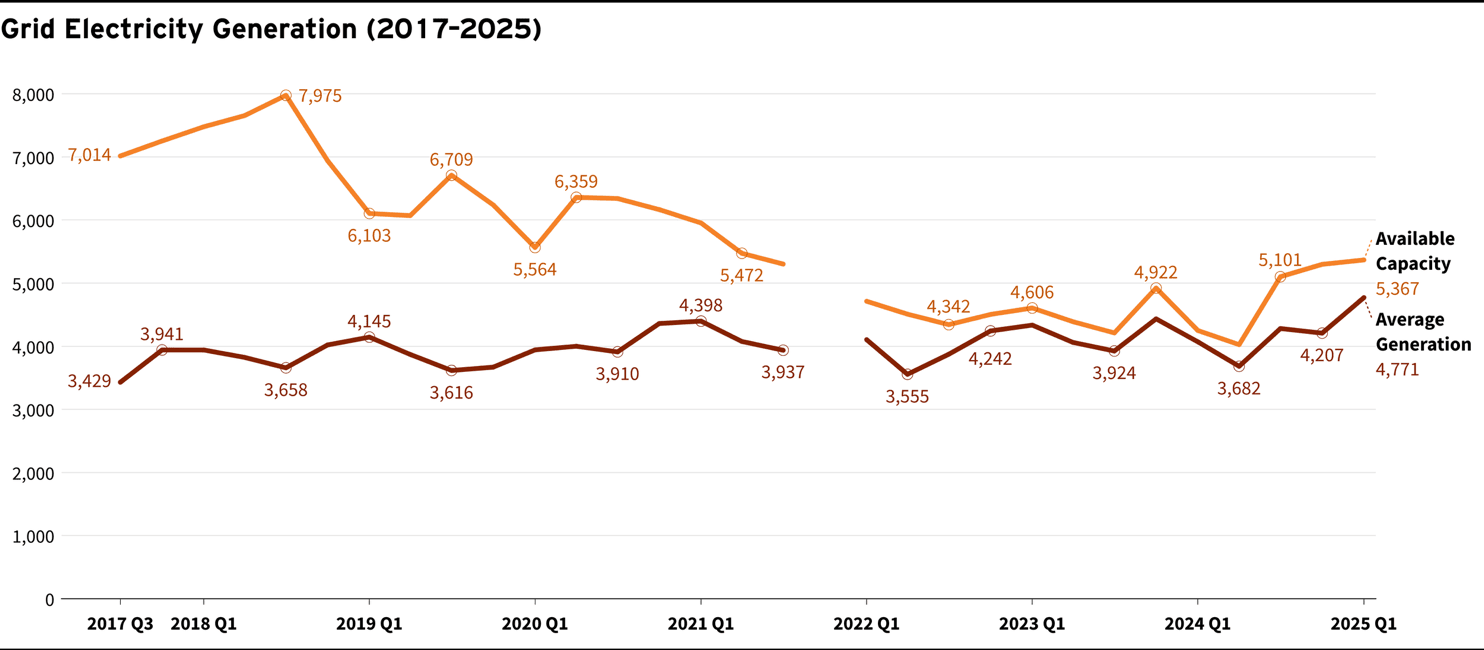
Available on-grid generation capacity peaked at ~8,000 MW in 2019 but declined to ~5,400 MW by Q1 2025. In the same period, average generation rarely exceeded 4,800 MW. Although utilization rates seem to have improved in recent years (e.g., 89% in Q1 2025), this reflects a shrinking capacity baseline rather than real progress. Chronic underinvestment, obsolete equipment, poor maintenance, and a lack of real-time management systems mean that existing transmission infrastructure cannot reliably evacuate power. Consequently, peak generation remains well below 6,000 MW in a country with over 200 million people and latent electricity demand exceeding 20,000 MW.2
Key Insight: The grid is not expanding to meet demand; rather, it is shrinking to match its constraints. This limits productivity and economic transformation across sectors.
2. Licensing Momentum Masks Deeper Failures
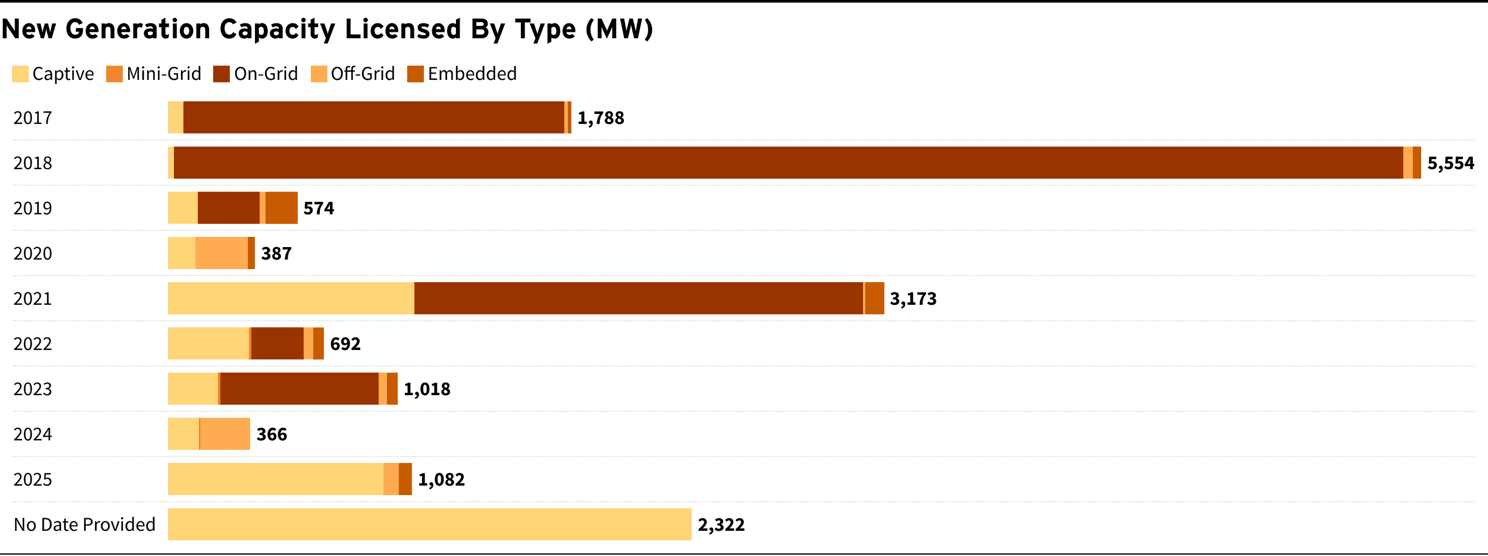
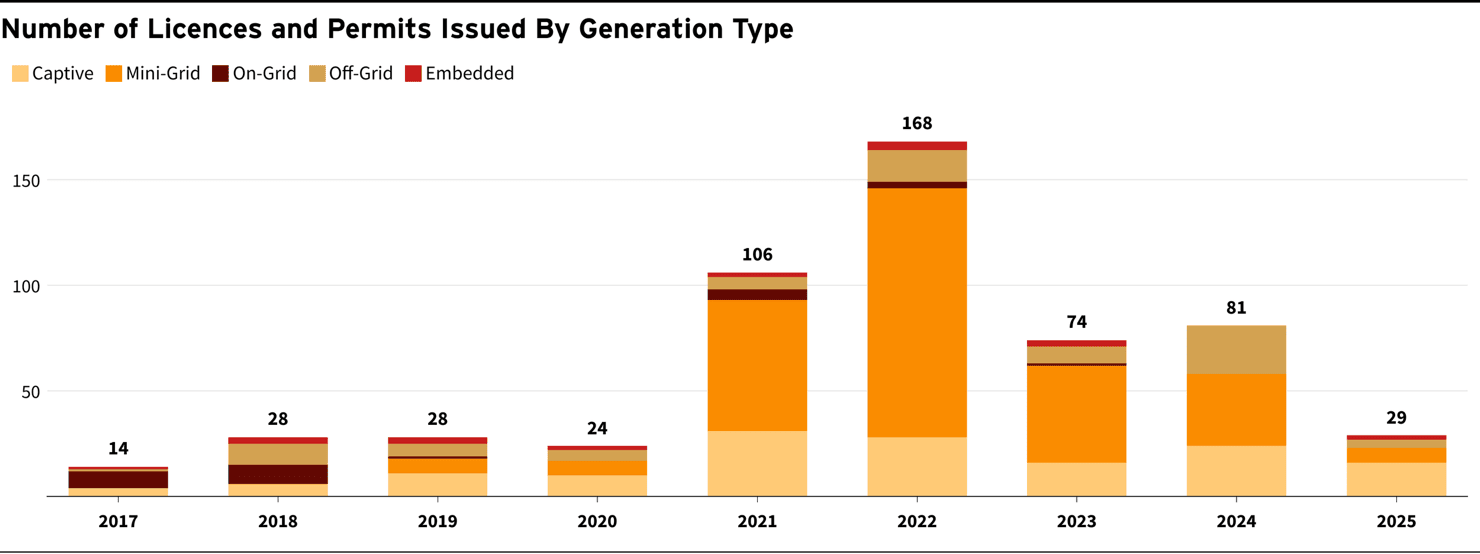
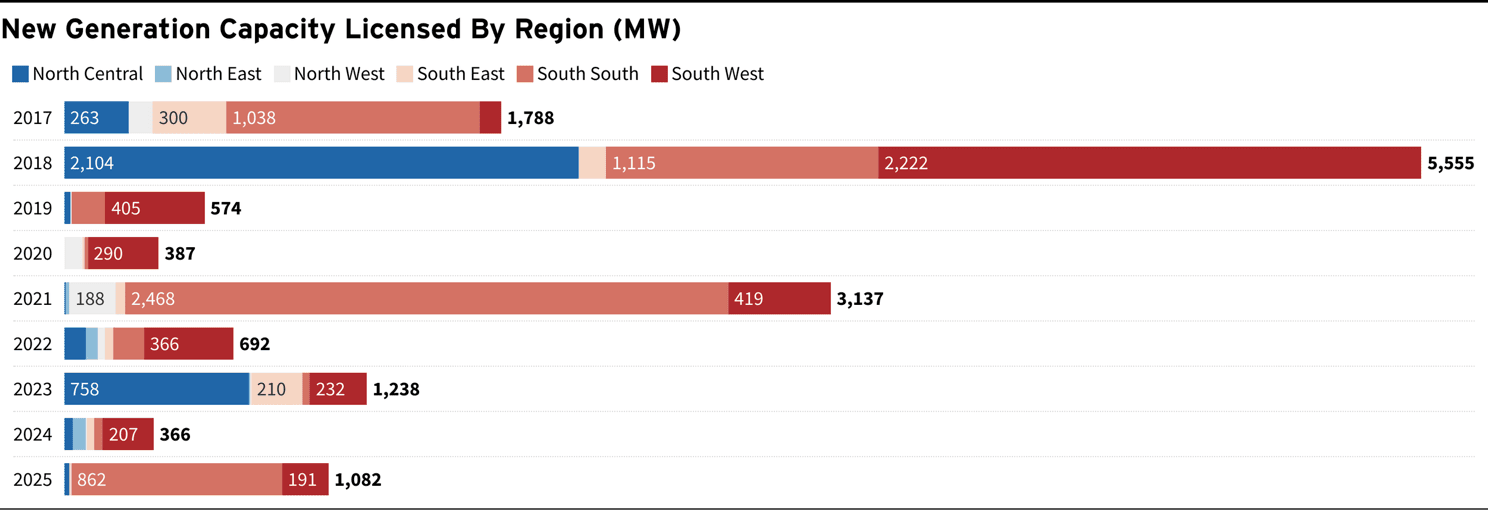
Between Q3 2017 and Q1 2025, NERC issued 645 new licences or permits for projects, including on-grid plants, captive generation for industries, and off-grid solutions such as mini-grids. Total licensed capacity exceeded 14,000 MW in 2025.3 Yet, actual generation remained flat. The licensing boom in 2021-2022 saw over 100 permits issued annually, but no proportional improvement in available or average generation. Many licensed projects remain unbuilt, delayed, or stranded due to financing challenges, weak grid infrastructure, and fuel constraints.
Key Insight: A vibrant licensing regime does not translate into delivery. Without bankable projects, creditworthy offtakers, and a grid capable of evacuating power, new capacity will remain only on paper.
3. Decentralization: An Emergent Workaround
The last three years saw a sharp increase in project permits for decentralized energy solutions, particularly in the commercial and industrial sectors. Licensing data shows a growing pivot away from on-grid generation to captive and mini-grid systems, especially post-2020 — they accounted for most of the projects licensed in 2023 and 2025. Developers and large consumers are increasingly investing in solar-hybrid and natural gas systems to hedge against the unreliability of the national grid. This decentralization signals a market shift but also systemic fragmentation.
Key Insight: Decentralized systems are a critical resilience strategy, but they also reflect a loss of confidence in the national grid and foreshadow revenue cannibalization for local utilities. Without national planning to integrate these systems at scale, Nigeria risks locking into a fragmented energy future.
4. Energy Transition Misalignment
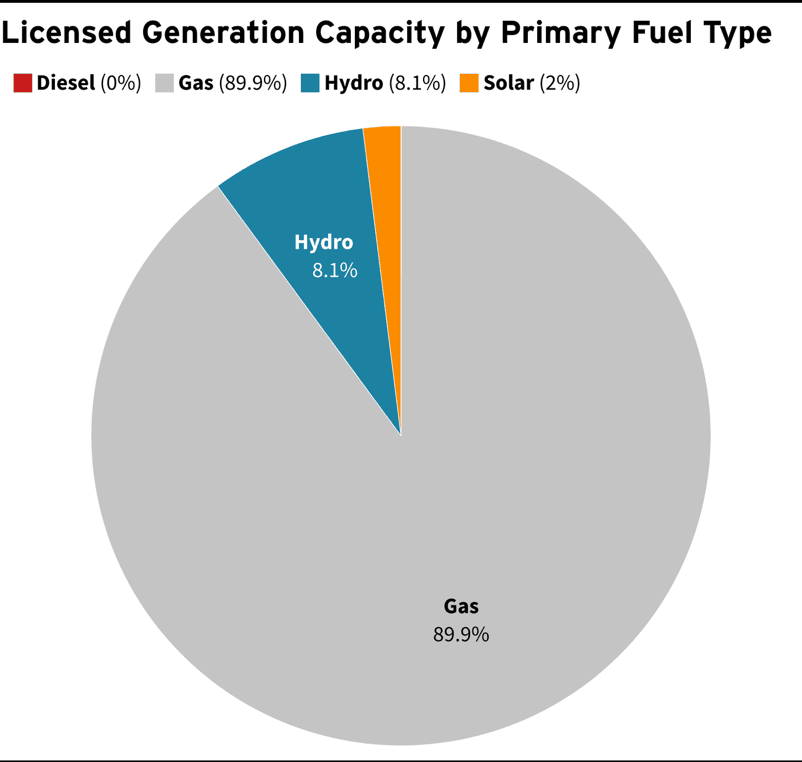
Despite Nigeria’s net-zero pledge and renewables-focused donor commitments (e.g., World Bank NEP4 and DARES5), natural gas generation still dominates proposed projects. While renewables are more prevalent in off-grid permits, their overall share of licensed capacity remains small. There is little correlation between licensing trends and the clean energy targets in Nigeria’s Energy Transition Plan, which targets 30 GW of renewable energy by 2030. The current regulatory model has yet to produce a clear pivot to low-carbon generation at scale.
Key Insight: Licensing does not equal transition. Without financial de-risking instruments, robust PPAs, and grid integration policies, renewables will remain marginal in Nigeria’s energy mix.
5. Regional Disparities in Investment Are Growing
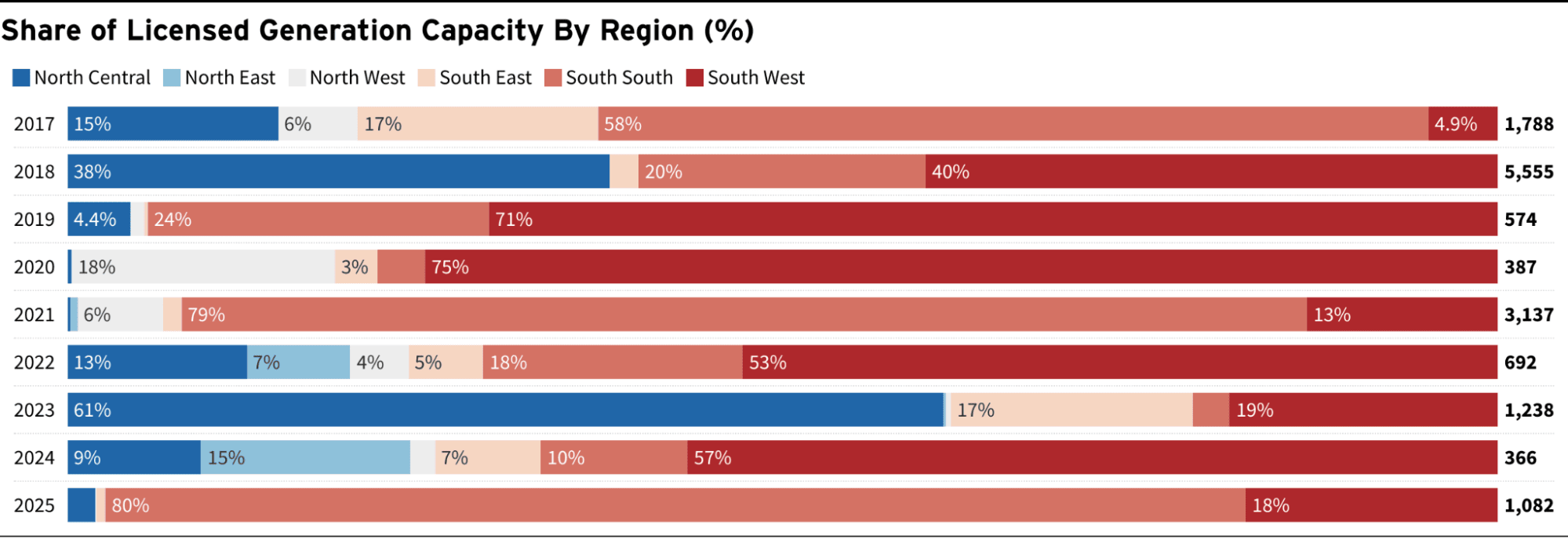
Licensing data reveals a regional concentration of new projects. The South West and South South regions of Nigeria consistently attract the bulk of licensed capacity, receiving 75%+ of licensed capacity in several years. North Central’s share of new projects surged in 2023 (61%) due to Abuja/Niger-based captive projects. However, the North East and North West are persistently marginal, despite having high energy poverty rates and solar irradiation levels.
Key Insight: Generation investment is skewed toward commercially vibrant regions with better infrastructure and access to finance. This raises questions about federal equity objectives. Without redistributive planning, new state-level electricity markets may exacerbate inequities in access.6
6. The Energy Transition Is Not (Yet) a Just One
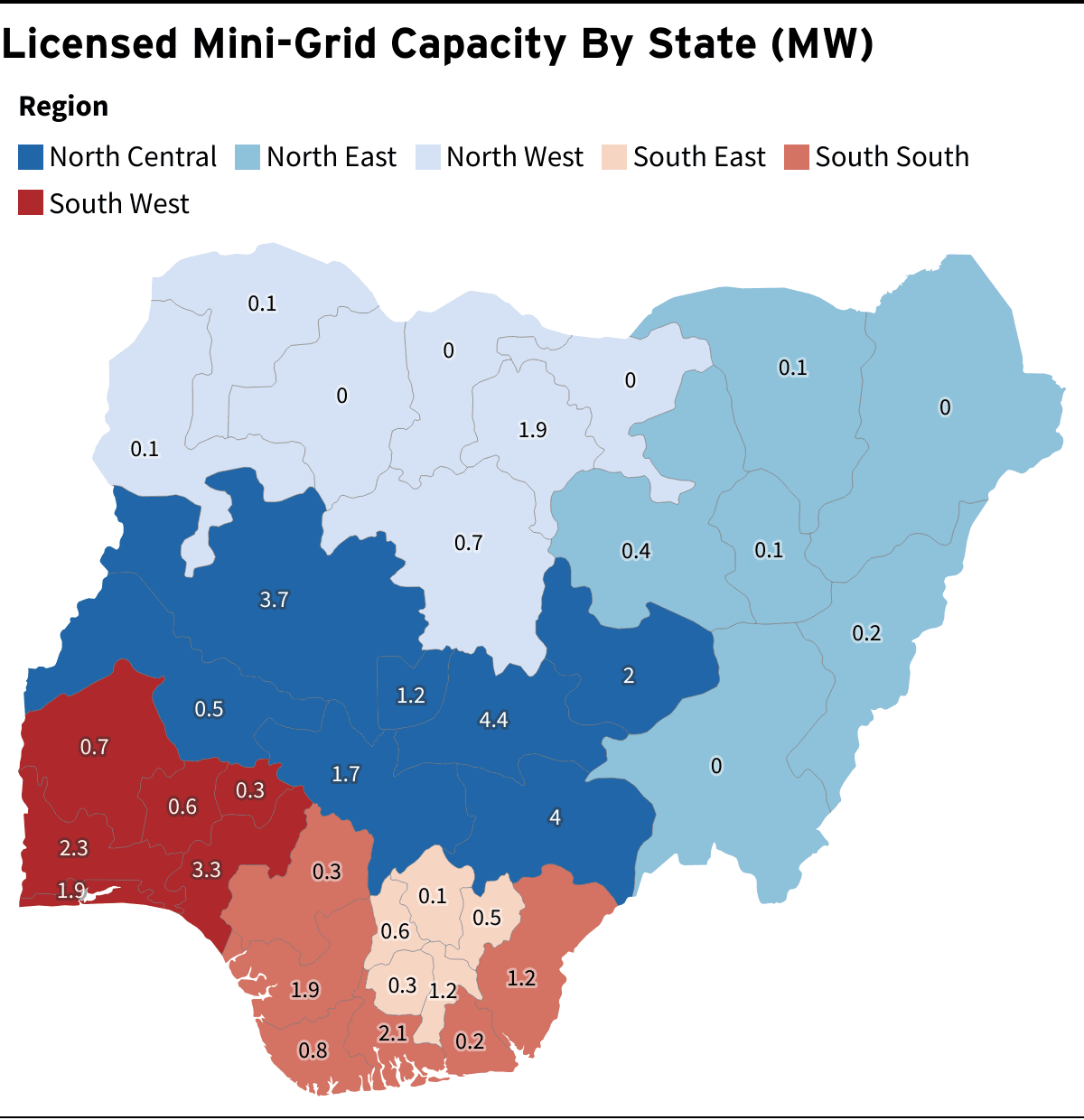
The deployment of mini-grids is highly uneven, with North Central, South West, and South South regions having the most mini-grid capacity. Large swathes of the North East and North West remain under-electrified, receiving almost no new licensed mini-grid capacity across multiple states over 8 years, despite having the highest solar irradiation in the country.7
Key Insight: Decentralization is reinforcing regional inequality. States with weaker governance, insecurity, and lower demand density risk being left behind in the energy transition. Without deliberate policy and incentive design, energy access gains will bypass Nigeria’s poorest and most insecure regions.
Policy and Donor Priorities Going Forward
To rehabilitate Nigeria’s electricity sector and unlock inclusive growth, the following are recommended:
- Track project delivery, not just licensing. NERC and donor partners should monitor how many licensed projects reach commercial operation and identify the reasons why others fail.
- Support renewables scaling and integration. Focus on de-risking private investments in mini-grids, embedded generation, and productive-use applications.
- Build state-level capacity. With the 2023 Electricity Act devolving authority to states, technical assistance is needed to establish licensing procedures, tariff regulation, and least-cost planning models that enable optimal electricity sector development.
- Invest in grid modernization. Generation alone is not the problem. Nigeria’s transmission and distribution systems require urgent modernization to absorb and deliver new generation capacity and integrate renewables.
Conclusion
Licensing is a necessary first step, but not a measure of progress. For Nigeria to build a reliable, sustainable, and inclusive electricity system, it must move from permits to power. This will require aligning licensing trends with structural reforms, investment mobilization, and equitable deployment across regions and technologies.
Endnotes
- Programs include the Rural Electrification Agency’s Solar Power Naija and the World Bank-funded Nigeria Electrification Project (NEP) and Distributed Access through Renewable Energy Scale-Up (DARES).
- IEA (2022), Africa Energy Outlook 2022, IEA, Paris https://wwwLicensed.iea.org/reports/africa-energy-outlook-2022, Licence: CC BY 4.0.
- Excludes licenses or permits that were renewed or transferred between entities.
- The Nigerian Electrification Project (NEP) was a US$500 million World Bank-supported program to deliver electricity to underserved rural communities primarily through standalone solar solutions and mini-grids.
- The Distributed Access to Renewable Energy Scale-Up (DARES) is a $750 million initiative, funded by the World Bank to scale-up Nigeria’s energy access gap by providing new or improved electricity supplies to more than 17.5 million Nigerians.
- The Electricity Act 2023 devolved regulatory authority for the power sector to states, empowering them to establish independent electricity markets.
- Global Solar Atlas