Electricity demand across Africa is expected to triple by 2050. Nuclear power could help meet a portion of this need. Newer technologies like small modular reactors (SMRs) are inching closer to commercial launch and may offer lower costs, faster deployment, and greater flexibility than large traditional reactors. But timely deployment will only be feasible if countries prepare and financing is made available.
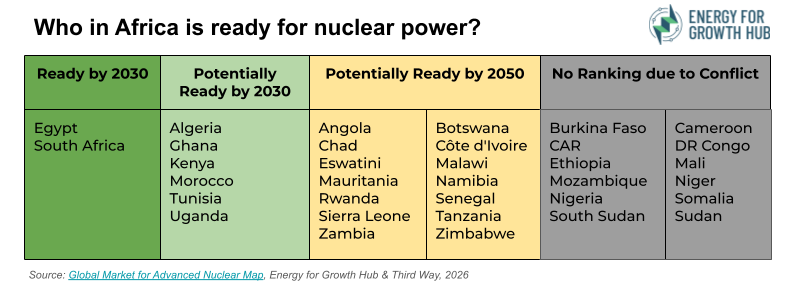
Here’s an updated summary of African countries’ nuclear readiness based on the latest analysis by the Energy for Growth Hub and Third Way.*
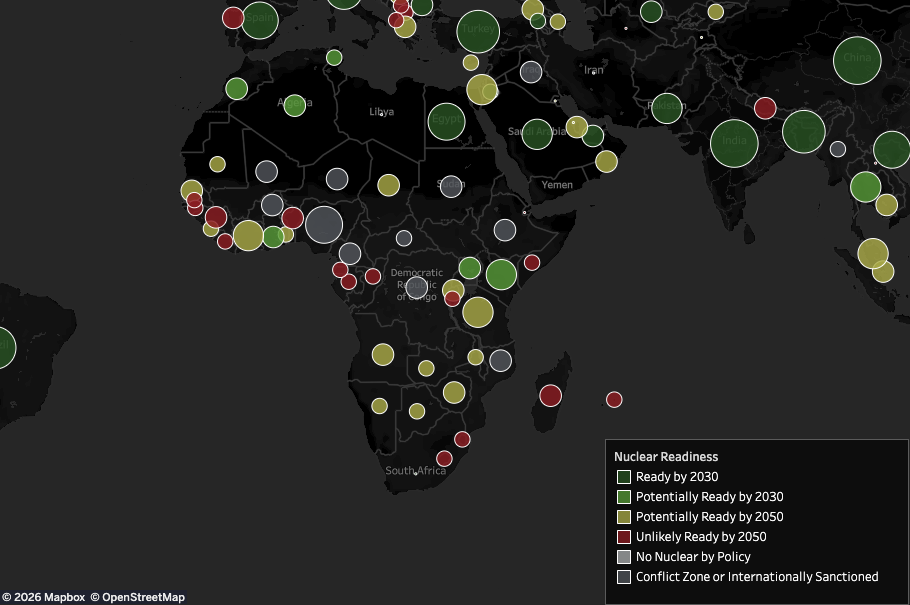
Source: Global Market for Advanced Nuclear Map, Energy for Growth Hub & Third Way, 2026.
Ready by 2030 (green)
Owned, operating, or actively under construction.
1. Egypt
- Egypt is constructing its first nuclear power plant at El Dabaa, with four reactors totaling 4.8 gigawatts (GW). Construction began in 2022 and completion is expected by 2030. Russia is financing the plant, building the plant, supplying the fuel, and will assist Egyptian partners in training personnel and plant maintenance for the first 10 years of its operation.
- Egypt has officially received the reactor pressure vessels, manufactured by Russia, for Unit 1 and 2 of El Dabaa. The reactor pressure vessel for Unit 2 was installed in July 2026.
- The country expects 9% of electricity generation to be from nuclear by 2030. Egypt has not yet formally explored SMRs.
2. South Africa
- South Africa operates the continent’s only commercial nuclear power station, Koeberg.
- In 2025, South Africa signed agreements with both local and Chinese partners to advance SMR development, including reviving its historic Pebble Bed Modular Reactor program.
- In August 2025, the Ministry of Forestry, Fisheries, and the Environment granted Eskom, South Africa’s public utility, environmental authorization (requested in 2017) to construct and operate a nuclear power plant in the Western Cape after obtaining additional statutory authorizations.
- In October 2025, the government approved its latest long-term electricity supply and demand strategy, which projects more than 5 GW of new nuclear capacity.
- In March 2026, the South African Nuclear Energy Corporation (Necsa), invited expressions of interest to identify technology partners for future SMR deployment.
Potentially ready by 2030 (light green)
Strong technical capability and close to ready for signing a vendor agreement.
3. Ghana
- Ghana currently operates a research reactor, and the government plans to commission its first nuclear plant by the mid-2030s.
- In 2024, Ghana signed non-binding agreements with Oregon-based NuScale to deploy SMRs and with China National Nuclear Corporation to build a large reactor.
- Ghana is participating in the US-led FIRST program, which will help the country establish a secure SMR supply chain.
- In February 2026, Ghana announced that it had made progress on Phase 2 of the IAEA milestones process.
- Ghana and the United States are working toward a 123 Agreement on peaceful nuclear cooperation, pending required approvals.
4. Uganda
- The Uganda Vision 2040 roadmap emphasizes the development of significant nuclear capacity as part of the country’s future energy mix, including a target of 24 GW of nuclear capacity by 2040.
- Uganda plans to build a plant at Buyende by 2031. In May 2025, the South Korean nuclear agency signed a contract with Uganda’s Ministry of Energy and Mineral Development launching a 26-month site evaluation project to assess the suitability of the Buyende region.
5. Morocco
- Morocco operates a research reactor and has signed multiple agreements with Russia and China on nuclear cooperation.
- In 2024, the country shared plans to partner with France to build an experimental nuclear reactor and explore SMRs.
- In March 2026, the prime minister of Morocco highlighted the potential role of civil nuclear energy in strengthening energy security and supporting climate goals.
6. Kenya
- Kenya continues to identify March 2027 as its target to break ground for its first nuclear plant, with commissioning targeted for 2034.
- In March 2025, Kenya signed a Memorandum of Understanding (MoU) with China National Nuclear Corporation for exchange of technical expertise in nuclear energy research and innovation.
- Kenya is actively exploring funding models and project structuring for 100-300 MW SMRs.
7. Algeria
- Algeria operates two research reactors, the Nur unit, completed in 1989 with the help of Argentina, and the Es-Salam reactor, completed in 1993 with the help of China.
- A 2024 roadmap with Russia includes nuclear medicine and energy, but there is no confirmed plant construction.
- In December 2025, the IAEA and Algeria signed a joint statement to reinforce cooperation on nuclear energy, with IAEA specifying support for Algeria to explore SMRs for electricity generation.
8. Tunisia
- Tunisia has had past plans that did not materialize (i.e., constructing its first plant by 2020). Tunisia signed agreements with Russia years ago, but no visible progress has been made.
Potentially ready by 2050 (yellow)
Has indicated interest but still building capability and not yet close to signing a vendor agreement.
- Rwanda is exploring both SMRs and microreactors. Although the government has ambitious plans, including nuclear supplying 60-70% of its energy mix and operationalizing its first SMR in the early 2030s, Rwanda remains coded yellow because these initial agreements have not yet led to clear progress. In July 2026, the Rwanda Atomic Energy Board and Rosatom held its first meeting of the Joint Coordinating Committee on cooperation in the field of the use of nuclear energy, including for power generation.
- Tanzania: In June 2026, the government expressed interest in exploring SMRs, including floating units, with Rosatom, though no agreement has been signed yet.
- Another 12 African countries have made initial steps and could, with more action, be ready by 2050.
Unlikely ready by 2050 (red)
Very low capacity or demonstrable progress.
- While some countries like Equatorial Guinea and Guinea have announced cooperation agreements with Russia, they, along with 12 other countries, are scored as unlikely to be ready by 2050.
No ranking due to conflict (grey)
On the World Bank’s list of Fragile and Conflict-affected States.
- Nigeria: Latest energy plan excludes nuclear, but recent modeling suggests that adding nuclear to the generation mix can reduce long-run costs by 22% and strengthen grid reliability. Nigeria operates a research reactor, maintains technical expertise through the Nigerian Atomic Energy Commission, and has a trained workforce with experience in nuclear engineering. The country participates in Phase II of the IAEA Milestones Program and has engaged in extensive IAEA training, regulatory development, and international cooperation.
- Ethiopia: Russia and Ethiopia signed a document in September 2025 calling for the development of a roadmap for the construction of a nuclear power plant, including technical and economic know-how, personnel training, and an eventual intergovernmental agreement. In March 2026, both countries signed a strategic roadmap document that details how their nuclear collaboration will unfold in the coming years.
- Niger: In July 2025, Niger and Russia signed an MoU for peaceful nuclear energy cooperation.
- Sudan and Mali have expressed nuclear ambitions and signed deals with China and Russia.
- Burkina Faso is reportedly cooperating with Rosatom, but plans seem a long way off.
Three notable trends
Russia dominates African markets. The state-owned Rosatom has signed nuclear energy partnerships with at least 20 countries in Africa, including Rwanda, Niger, Zimbabwe, Burundi, Ethiopia, Congo, and Guinea in addition to many countries listed above. While these agreements reflect some level of growing interest in nuclear power, most are very preliminary and represent only the first step in a long and complex process of nuclear project development. At the same time, US, Chinese, French, and South Korean engagement is expanding, making nuclear diplomacy on the continent more competitive.
SMRs will likely accelerate nuclear interest. As SMRs move toward wider commercial deployment, they could present a promising option for African countries with smaller grids or water constraints. Modular designs could allow for lower upfront capital requirements, improved safety features, and more flexible deployment. Several African countries, such as South Africa, Ghana, Kenya, and Morocco, are actively pursuing partnerships and feasibility studies for SMRs. As commercial models mature through the 2030s, early preparation today will determine which nations benefit first.
Announcements are not bankable projects. MoUs, cooperation agreements, and political declarations demonstrate interest, but they do not by themselves establish siting, licensing, financing, vendor selection, or construction readiness. The next phase of African nuclear development will be defined by which countries convert agreements into investable projects.