Why this matters:
African cities are the fastest growing in the world, but grid infrastructure is not keeping pace. National planning efforts have focused primarily on expanding electricity access. Yet, even in cities where electrification rates exceed 90%, households consume vastly different amounts of electricity. With 60–70% of Africa’s population projected to live in urban areas by 2050, understanding how energy use is distributed within cities is essential for designing policies that promote inclusive growth rather than reinforcing existing inequalities. This memo summarizes my latest analysis of energy consumption inequality across African cities at the University of Cape Town to develop policy recommendations.
How unequal is energy consumption in African cities?
To dig into this question, I built a bottom-up model of household energy consumption focused on six representative sub-Saharan African cities: Cape Town (South Africa), Nairobi (Kenya), Yaoundé (Cameroon), Dakar (Senegal), Kasese (Uganda), and Tsévié (Togo). I disaggregated household energy demand (such as heating, lighting, or cooking) by quintile, end–use, and fuel type, then calculated the Gini coefficient to measure distribution within each city. The lower the Gini value, the lower the inequality, and the higher the value, the higher the inequality.
Key Findings
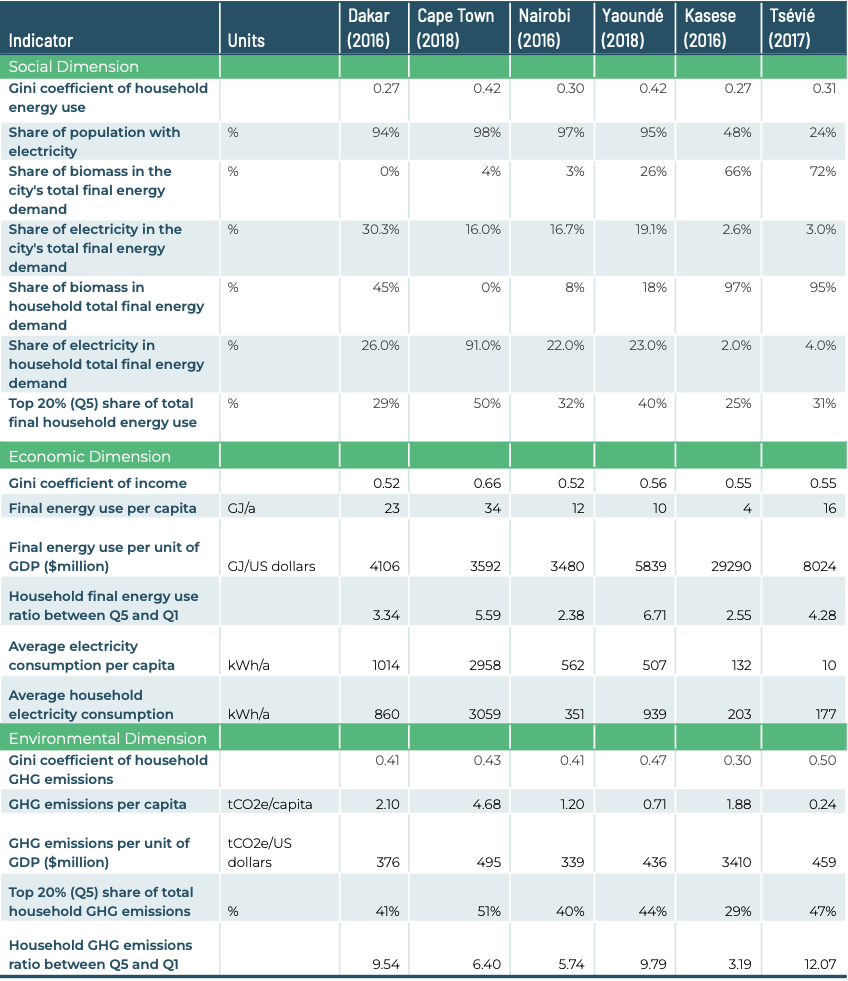
- Energy consumption is less unequal than income, reflecting energy as a basic necessity. Across all six cities, the Gini coefficient of household energy use (0.27–0.42) averages 41% lower than that of income (0.52–0.66), suggesting energy functions as a basic need that households prioritize despite income disparities.
- Household energy inequality in the six African cities is much lower than the global average. The average energy Gini across the six study cities is 0.29, roughly half the global average of ~0.58. This likely reflects the low consumption levels of African urban households, where energy still behaves as a shared basic need, rather than any structural equity advantage. As incomes rise and consumption shifts toward electricity, global inequality trends will likely be replicated in African cities without grid investments that deliver more reliable power. The window of opportunity to lock in equitable energy use in urban Africa is still within reach.
- Energy inequality shows no clear relationship to a city’s GDP or electricity access rate. Each city exhibits unique energy use and economic dynamics. Investment in local data can better explain how specific energy use patterns translate to positive equity outcomes at the sub-national level.
- Electricity is more unequally consumed than energy as a whole, even where nearly everyone is connected to the grid. Across all six cities, the Gini coefficient of household electricity consumption (0.39 to 0.64) is consistently higher than energy inequality and all the other fuels (charcoal, kerosene, or liquefied petroleum gas), even in cities with above 90% grid access. In Dakar, 88% of the poorest households are grid-connected, yet this group accounts for just 2% of residential electricity consumption, while the highest income households account for 60% of electricity consumption.
- In three cities, electricity use is more unequal than income. In Dakar, Yaoundé, and Tsévié, household electricity consumption inequality exceeds income inequality. Both observations above are symptomatic of electricity’s nature as a tiered good in a way other fuels are not: while a connection delivers basic electricity use across the income spectrum, higher-tiered uses such as electric cooking, cooling, or refrigeration mostly remain concentrated at the top. Where this concentration runs deeper than income inequality, grid access is amplifying economic disparity rather than buffering it.
- Cape Town suggests that strong grid and appliance markets may keep electricity from compounding inequality. Cape Town’s electricity use distribution (Gini: 0.42) is the same as its overall energy use (Gini: 0.42), despite having the highest income inequality of the six cities. High electricity access (98%), combined with reliable power delivery (pre-dating the severe 2021–23 outages) and an established appliance market, has enabled even lower-income households to move beyond basic lighting to cooking, refrigeration, and entertainment.
Three recommendations for equitable electricity infrastructure in African cities
Closing the urban electricity divide in Africa is as much about how power is used as whether it is available. To ensure that near-universal access becomes a near-universal benefit, donors and policymakers must focus on three priorities:
- Pair access targets with consumption distribution benchmarks. This process begins with establishing metrics, gathering local data, and setting clear, equitable goals to ensure income growth does not result in energy consumption inequality. In my thesis, I proposed a preliminary framework of indicators — see Annex A.
- Invest in subnational energy data infrastructure. African cities have heterogeneous profiles and require local data to guide policy implementation. Policymakers and donors can help develop local research expertise for context-specific modeling and targeted policy design.
- Redesign tariffs and subsidies around electricity’s tiered nature. Targeted and progressive electricity pricing, cross-subsidy schemes, and appliance financing for the lowest consumers are needed to ensure electricity continues to function as a common good that reduces, rather than reinforces, inequality.
References
- UN DESA, World Urbanization Prospects: The 2024 Revision.
- Millward-Hopkins, J. and Oswald, Y. (2023) ‘Reducing global inequality to secure human wellbeing and climate safety: study’, The Lancet Planetary Health, 7(2), pp. e147–e154. Available at: https://doi.org/10.1016/S2542-5196(23)00004-9.
ANNEX A: Indicators of energy sustainability for the study cities in the base years indicated