
Achieving universal access to affordable electricity can conflict with the goal of ensuring the financial solvency of utilities. In low- and middle-income countries, fewer than 40% of utilities recover their costs, yet almost 500 million people cannot afford to consume electricity, despite being connected.1,2 Is there an electricity tariff structure that can simultaneously achieve both objectives? This memo summarizes the research on this topic and identifies increasing block tariffs as the tariff structure best positioned to balance these competing objectives in developing markets.
Tariff structures create trade-offs between cost recovery and affordability
Common electricity pricing structures include flat rate tariffs, increasing block tariffs (IBTs), and time-of-use (TOU) tariffs, each with different implications for cost recovery and affordability.
Flat rate tariffs represent the simplest pricing structure, where consumers pay the same amount per unit of energy regardless of their total energy consumption or when the energy is used. While easy to implement, flat rate tariffs fail to reflect the actual marginal costs of electricity supply, which increase with higher demand. This pricing structure also creates equity concerns by generating cross-subsidization. Wealthier households typically consume much more electricity, which drives up the cost of electricity supply. This means poorer households, who tend to consume less electricity, end up effectively subsidizing wealthier households by paying the same per-unit rate.
Increasing block tariffs (IBTs) better align with cost recovery principles than flat rate tariffs by charging higher rates per unit as consumption surpasses predetermined thresholds. The first, lowest-priced tier, known as the “lifeline” block, covers basic household electricity needs to ensure that even poor households can afford essential electricity. The “upper blocks” are higher-priced tiers that kick in as consumers use more electricity. For example, an IBT structure might look like this:
Block 1 (0 to 50 kWh per month): $0.05 per kWh (lifeline block)
Block 2 (51 to 200 kWh per month): $0.10 per kWh
Block 3 (201 kWh and above per month): $0.15 per kWh
This tiered structure reflects the reality that the marginal cost of supplying electricity rises with increased demand since meeting higher demand often requires incurring the cost of starting up additional, more expensive generators when demand outpaces current supply. From an affordability perspective, IBTs reduce cross-subsidization from poorer to wealthier households by imposing higher marginal rates on larger consumers. However, this structure can inadvertently penalize poor households in settings where multiple families share a single meter, as their combined consumption may push them into higher-priced blocks.3 To mitigate this, utilities need to determine the number of households connected to each meter.
Time-of-use (TOU) tariffs offer the most accurate cost recovery among the pricing structures by charging different rates based on when electricity is consumed. The highest rates are typically during afternoon peak hours, when system capacity is most strained, and the marginal cost of supplying electricity rises fastest, followed by morning and then evening hours. However, the impact of TOU tariffs on equity and affordability is ambiguous since this depends on how electricity usage patterns vary across income levels. For instance, research shows that poorer households may lack flexibility in adjusting their energy demand in response to time-based price incentives.4 This may be due to inflexible work schedules or a lack of programmable devices. TOU tariffs could, consequently, disproportionately burden poorer households.5 TOU tariffs are also more complex to implement since they require an initial investment in smart meters to detect time of energy use, a cost that may be particularly challenging for developing countries with constrained budgets.
IBTs offer best solution to balance these competing objectives
Each pricing structure presents trade-offs across three key dimensions: implementation simplicity, cost recovery, and affordability. Flat rate structures excel in implementation simplicity but perform poorly on both affordability and cost recovery. TOUs achieve the strongest cost recovery but are complex to implement and also have ambiguous outcomes with respect to affordability. IBTs, therefore, emerge as the optimal compromise, ensuring affordability while achieving reasonable cost recovery with only moderate implementation complexity.
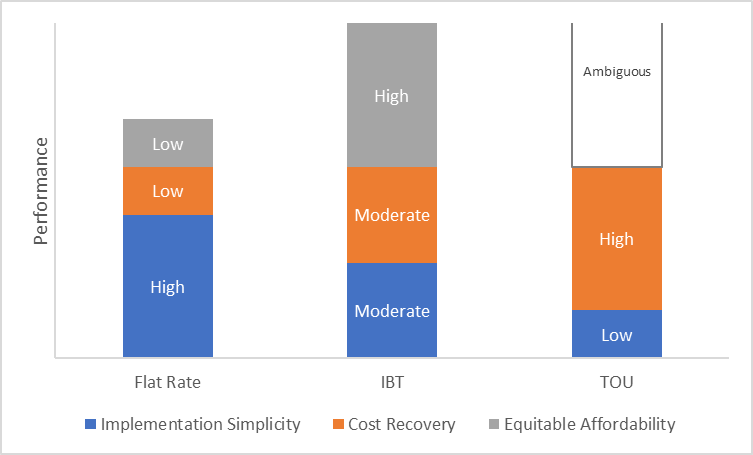
Based on author’s analysis.
Empirical evidence supports the potential of IBTs to achieve this balance when properly designed. While research on IBTs’ causal impacts, particularly in developing countries, is limited, studies from China and the US provide encouraging evidence of the affordability benefits of IBTs. A study in China found that switching from a flat rate to IBT reduced electricity bills for households, while a study in California found that IBT reduced the bills of the lowest-income households6 by about 17% relative to a flat rate.7 Although it is uncertain whether these results would translate directly to other contexts, they provide some optimism about the potential of IBTs to enhance affordability.
Success of IBTs depends on careful design and implementation
However, realizing IBTs’ potential depends critically on proper design. In South Africa, IBTs effectively subsidized the consumption of low-usage households at the expense of utility solvency8 due to improper design,9,10 — a relatively small pool of high-volume consumers and insufficient upper-block pricing. South Africa’s case underscores the fact that the success of IBTs hinges on the right design model.
Three principles for designing successful IBT structures
The following principles can guide policymakers in low- and middle-income countries to design IBTs that deliver on their promise of balancing affordability and cost recovery.
- Price the upper blocks high enough to recover costs, while keeping the initial (lifeline) block priced affordably to cover essential household consumption.
- Set the lifeline block at a low consumption level so that it effectively targets poorer consumers and avoids inadvertently subsidizing wealthier, higher-usage consumers.
- Ensure a sufficiently large base of high-volume consumers by improving reliability. High-volume consumers are crucial because they can absorb the higher marginal rates to offset the discounts embedded in the lifeline block. A key solution to this is improving electricity reliability. Reliable electricity has been shown to increase customers’ willingness-to-pay and prevent customers from leaving the grid for off-grid solutions.11,12
These design principles make IBTs more likely to ensure that the subsidy inherent in the first “lifeline” block, intended to guarantee basic energy access, is fully offset by higher rates in the upper blocks. Carefully designed IBTs can thus provide an ideal tariff structure for advancing both equitable affordability and utility solvency in low- and middle-income countries.
Endnotes
- World Bank. 2024. “The Critical Link: Empowering Utilities for the Energy Transition.” https://www.worldbank.org/en/topic/energy/publication/the-critical-link-empowering-utilities-for-the-energy-transition
- World Bank. 2024. “Beyond Access: 1.18 Billion in Energy Poverty Despite Rising Electricity Access.” https://blogs.worldbank.org/en/opendata/1-18-billion-around-the-world-are-unable-to-use-electricity
- Kojima, Masami, Xin Zhou, Jeesun Han, Joerie Frederik De Wit, Robert Bacon, and Christopher Philip Trimble. 2016. “Who Uses Electricity in Sub-Saharan Africa? Findings from Household Surveys.” World Bank Policy Research Working Paper 7789.
- Aristizabal, Ximena, and Erin Baker. 2024. “A Systematic Literature Review on Residential Demand Response, with a Focus on Equity.” https://scholarworks.umass.edu/server/api/core/bitstreams/8a8f6d03-1812-4db4-b152-16b97723b239/content
- Engelman Lado, Nathan, Richard Chen, and Saurabh Amin. 2025. “When Do Consumers Lose from Variable Electricity Pricing?” https://papers.ssrn.com/sol3/papers.cfm?abstract_id=5427954
- Zou, Hong, Bingjiang Luan, Xuemei Zheng, and Junbing Huang. 2020. “The Effect of Increasing Block Pricing on Urban Households’ Electricity Consumption: Evidence from Difference-in-Differences models.” Journal of Cleaner Production 257: 120498.
- Borenstein, Severin. 2012. “The Redistributional Impact of Nonlinear Electricity Pricing.” American Economic Journal: Economic Policy 4(3): 56-90.
- Kelly, Patrick John, and Hermanus Stephanus Geyer. 2018. “The Regulatory Governance of Retail Electricity Tariff Setting in South Africa.” Regional Science Policy and Practice 10(3): 203-221.
- Klug, Thomas W., Abebe D. Beyene, Tensay H. Meles, Michael A. Toman, Sied Hassen, Michael Hou, Benjamin Klooss, Alemu Mekonnen, and Marc Jeuland. 2022. “A Review of Impacts of Electricity Tariff Reform in Africa.” Energy Policy 170(2022): 113226.
- Huenteler, Joern Torsten, Denzel J. Hankinson, Nicole Rosenthal, Ani Balabanyan, Arthur Kochnakyan, Anshul Rana, and Vivien Foster. 2020. “Cost Recovery and Financial Viability of the Power Sector in Developing Countries: Insights from 15 Case Studies.” World Bank Policy Research Working Paper 9136.
- Cisse, Abdoulaye. 2025. “The Value of Electricity Reliability: Evidence from a Natural Experiment in Senegal.”
- Haeni, Jeffrey, and Meron Tesfaye. 2025. “Utilities and Regulators Take Note: Reliability Investments Pay Off.” Energy for Growth Hub.