As global demand for energy continues to surge, more countries are opting for nuclear energy as a reliable, firm, and clean source of baseload power. China, Russia, and the United States, top suppliers of nuclear technology, are actively signing nuclear energy agreements to build market share and expand their spheres of influence. The winner of the nuclear export race will set norms for transparency in contracts and standards on safety, security, and nonproliferation.
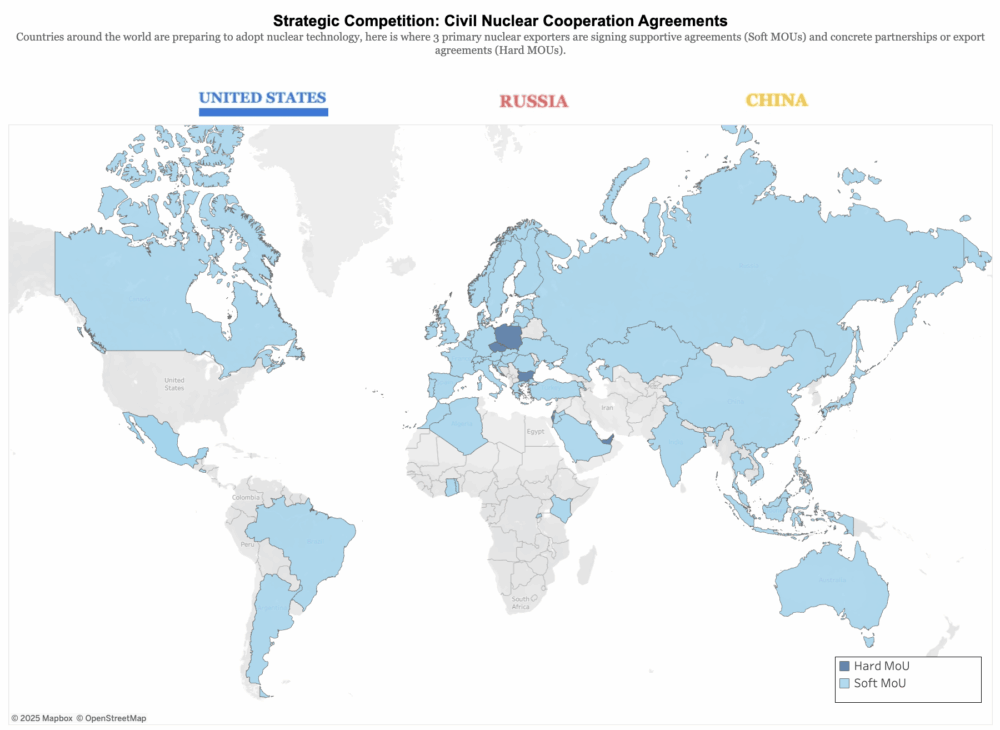
Because the stakes are so high, the Energy for Growth Hub and Third Way created a map in 2023 tracking global civil nuclear cooperation agreements signed by China, Russia, and the US. This 2025 update includes all nuclear agreements signed in the past 20 years. The full database can be found here.
Updates since 2023:
China has signed 14 additional MOUs (12 soft and 2 hard). These MOUs are geographically dispersed across regions. Many, but not all, focus on advanced reactor technologies.
Russia has signed 28 additional MOUs (20 soft and 8 hard). These MOUs are primarily signed with emerging markets and developing economies in Africa and Asia, with some focused on SMRs. Russia has the highest percentage of agreements for actual plant construction.
The US has signed 23 additional MOUs (20 soft and 3 hard). These MOUs are primarily signed with emerging markets in Asia and allies in Europe. Many are focused on SMRs or advanced nuclear, and they include three new 123 agreements (legally required frameworks that enable civil nuclear trade with the US).
Key Trends:
Emerging markets are target markets: Emerging economies need access to financing and technical expertise to turn paper agreements into operating reactors. With the World Bank and Asian Development Bank overturning their nuclear financing bans this year, and other development banks considering following suit, interest in nuclear in emerging markets is expected to continue.
Advanced reactors are a focus: Next generation nuclear reactors have added safety benefits, and their size make them ideal for smaller grids in developing economies. China is pursuing advanced nuclear with the UAE, South Africa, Ghana and France. Russia signed SMR MOUs with Iran, Myanmar, Uzbekistan, and India this year. The US has signed agreements with Ghana for SMR workforce development, Lithuania to focus on 4th generation nuclear technology, and Rwanda for the deployment of NANO nuclear SMRs.
Russia continues to lead, with the US playing catch up: Since 2005, Russia has signed at total of 118 nuclear MOUs, whereas the US has signed 104 (excluding 123 agreements signed before 2005, which are typically renewed every few years. Here is the list of active 123 agreements). Notably, Russia has signed 3x more hard MOUs (68 vs 21) compared to the US, which has typically opted for soft MOUs for nuclear cooperation. China trails far behind with 63 MoUs, but around 24% of these were signed in the past five years. As the Trump Administration commits to “aggressively pursue at least 20 new 123 agreements” by the end of the current term, we expect the US to accelerate global nuclear engagement, though it still has ways to go before it catches up to Russia.
Methodological Notes
How to Read the Map:
Hard vs Soft MOUs: Agreements are of two major types: (a) Hard MOUs are agreements that include the construction of a nuclear power plant, export of a reactor or reactor components, or services directly related to the operation of nuclear power plants; or (b) Soft MOUs are agreements intended to support the development of nuclear energy technologies, but not actual export of reactors or related services. These include knowledge-sharing and training programs as well as support for nuclear safety and security, planning, regulation, and complementary infrastructure. Agreements on exclusively uranium supply are not included in our analysis.
One Data Point per Country: The Map only shows the most recent MOU signed since 2005 between the supplier and partner countries. The Map does not focus on the number of agreements signed over time. All agreements since 2005 can be found in the database here.
Caveat for 123 Agreements: All current 123 agreements are included in the full database, including those signed 20+ years ago, as 123 agreements typically renew after every few years. If a 123 agreement was signed more than twenty years ago, and that’s the most recent agreement between the US and a partner country, then that agreement will be featured on the map. All active 123 agreements can be found here.
Notes on the Database:
Recent Updates: For more information on recent nuclear cooperation, see the “Recent Updates” tab in the database for MOUs that China, Russia, and the US have signed since 2023.
Cancelled MOUs: MOUs that have been cancelled are listed in the full database tab (column H). If the latest MOU is cancelled, this does not necessarily cancel all previous MOUs, unless the cancellation explicitly calls for terminating all existing agreements. If all MoUs since 2005 have been canceled with a partner country, then that country has been removed from the map. Otherwise, the most recent non-canceled MoU is featured on the map.
War in Ukraine: Some European and allied countries have effectively ended their cooperation with Russia due to the war in Ukraine, but have not formally cancelled their MOUs, including Australia, Czech Republic, Finland, France, Japan, UK and the US Since these MOUs are not formally cancelled, they are still listed in the map.