Electricity demand across Latin America is projected to nearly triple by 2050. More than 70% of regional demand growth will be in Argentina, Brazil, and México, which have nuclear power today and could use the technology to meet this need. As the Inter-American Development Bank joins the World Bank and Asian Development Bank in lifting restrictions on supporting nuclear energy, this move could also support other nuclear-curious countries across the region.
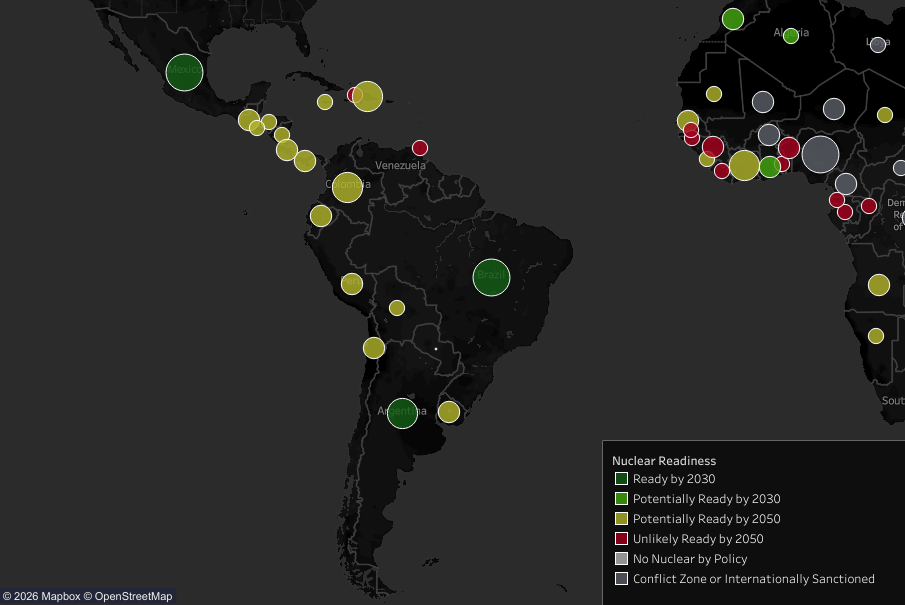
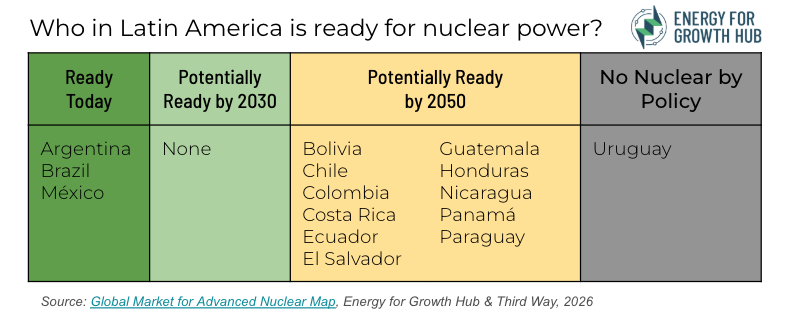
Based on the latest Global Market for Advanced Nuclear map from the Energy for Growth Hub and Third Way, here’s where Latin American countries stand on nuclear readiness.
Ready today (dark green)
1. Argentina
- Argentina operates three commercial nuclear reactors supplying roughly 7% of the country’s electricity.
- Progress on Argentina’s domestic 32 megawatt-electrical (MWe) CAREM small modular reactor (SMR) stalled in September 2024 after construction was halted because of budget cuts. A United States-Argentinian joint venture is planning to construct four 300 MW SMRs.
- China agreed to build and finance the fourth reactor of Argentina’s Atucha nuclear plant in 2017, but no progress has been made since. In April 2015, Argentina signed an agreement with Russia for the construction of a 1200 MWe unit, with Russian financing. However, these plans were reportedly shelved. Argentina signed a cooperation Memorandum of Understanding (MoU) with Russia in 2018.
- In September 2025, Argentina joined the US-led FIRST program, which supports countries considering SMRs or other advanced reactors. Argentina has an active 123 Agreement with the US.
2. Brazil
- Brazil operates two commercial nuclear reactors generating 2% of the country’s total electricity. It is working toward its third reactor, although the project has faced repeated delays. The latest target commissioning date is now 2031.
- In 2025, Brazil announced plans to develop SMRs with Russia’s Rosatom and launched a national microreactor development program, which aims to demonstrate the feasibility of the development of a Brazilian 3-5 megawatt (MW) microreactor.
- Brazil’s 2050 national energy plan considers increasing nuclear power from 2 gigawatts (GW) in 2022 to 8-10 GW by 2050.
- Brazil has an active 123 Agreement with the US.
3. México
- México’s two Laguna Verde reactors will continue operating under recently approved license extensions through the 2050s, and constitute about 3% of total electricity production.
- A Secretariat of Energy report in 2022 projected that annual electricity production from nuclear energy would double by the early 2030s. However, no new reactor has yet broken ground. México’s latest power expansion plan in June 2026 does not mention nuclear power. No detailed plan for SMR deployment has been shared yet.
- México has an active 123 Agreement with the US.
Potentially ready by 2030 (light green)
None
Potentially ready by 2050 (yellow)
4. Bolivia
- Bolivia’s first research reactor, built by Rosatom but funded entirely by Bolivia, is nearing completion and underwent an International Atomic Energy Agency (IAEA) safety review in 2025.
5. Chile
- Chile operates two research reactors built in the mid-1970s. It continues to study the potential role of advanced nuclear technologies, particularly for energy-intensive industries such as mining.
- Per the Chilean Nuclear Energy Commission, there are no regulatory barriers to nuclear installation, but development requires changes to the nuclear legal framework and ensuring national regulatory authorities are effectively independent in their safety-related decision making.
6. Colombia
- Colombia introduced its first comprehensive nuclear safety bill in 2024, establishing the legal and regulatory framework needed for commercial nuclear deployment.
- Government planning documents envision deploying a 300 MW SMR by 2035 and expanding nuclear capacity to 1,884 MW by 2050.
- In June 2026, Colombia passed a law to govern and regulate nuclear technology, which mentions exploring the nuclear option around 2035.
7. Ecuador
- Following severe electricity shortages in 2024, Ecuador has renewed interest in nuclear energy.
- Ecuador aims for nuclear energy to contribute 26% of electricity by 2050, with a 300 MWe small modular reactor as a medium-term objective. In the long term, Ecuador plans to build a 1000 MWe reactor.
- The Ecuadorian Deputy Energy Minister commented that the country is discussing with Russia, France, and the US to build a 300 MW SMR. In 2009, Ecuador signed an MoU with Russia to cooperate on nuclear energy for peaceful purposes.
- In May 2025, the IAEA Director General signed two agreements with Ecuador to support the country’s adoption of the Milestones Approach for nuclear power development.
- In April 2026, Ecuador signed a 123 Agreement with the US.
8. El Salvador
- El Salvador’s long-term energy plan aims for 15% of electricity generation via nuclear by 2050, potentially through SMR deployment.
- In February 2025, El Salvador and the US signed a MoU to cooperate on strategic civil nuclear development. In March 2026, El Salvador signed a 123 Agreement with the US. In response to the agreement, the ambassador from El Salvador to Washington, DC commented that El Salvador will have nuclear energy in seven years.
9. Paraguay
- Paraguay is increasingly exploring SMRs despite already generating nearly all of its electricity from hydropower. Paraguay signed a nuclear cooperation MoU with Russia in 2017.
- In 2026, the IAEA launched technical cooperation on SMR planning, and Paraguayan officials joined a US-sponsored advanced nuclear delegation alongside several regional governments.
10. Peru
- In 2026, Peru approved legislation promoting commercial nuclear and SMRs, creating the country’s first legal framework for nuclear electricity generation.
- The government is now developing a national roadmap to assess future SMR deployment while leveraging decades of experience operating its two research reactors.
Unlikely ready by 2050 (red)
None
No nuclear by policy (grey)
11. Uruguay
- Uruguay continues to legally prohibit nuclear despite occasional discussions about revisiting the ban.
Early-stage interest
Costa Rica, Guatemala, Honduras, Nicaragua, and Panamá continue cooperating with the IAEA on nuclear science, radiation safety, and institutional capacity building. While some have signed peaceful nuclear cooperation agreements or begun discussing future nuclear energy, none has announced concrete plans for commercial nuclear power deployment.
What about the Caribbean?
The Caribbean has seen little movement on nuclear energy. Jamaica signed an MoU with Canada in 2024 to explore the region’s first nuclear power plant, but there has been no progress since. Other Caribbean nations have yet to formally explore nuclear energy beyond peaceful applications.
Conclusion: Beyond growing demand, US engagement and next gen models are stoking interest
The United States is becoming a much more active nuclear partner in the Western Hemisphere. While Russia has nuclear partnerships with several Latin American countries including Brazil and Bolivia, recent regional activity has shifted toward the United States. Colombia, Ecuador, El Salvador, Paraguay, and Argentina have all expanded cooperation with the US through 123 Agreements, the FIRST program, or technical assistance initiatives.
SMRs are driving new interest beyond traditional nuclear states. Countries without commercial nuclear power, including Colombia, Ecuador, El Salvador, Paraguay, and Peru, are increasingly framing SMRs as a way to diversify electricity systems without building conventional GW-scale reactors. As financing from multilateral development banks expands and SMRs approach commercialization, early institutional preparation could determine which countries deploy first.