
Why It Matters
Industrial growth is critical to meeting the soaring demand for jobs across Africa. Without solutions to Africa’s dysfunctional grids, electricity for industrial activities will remain expensive and heavily dependent on imported diesel. Despite rising solar imports, grid challenges persist and industrial solar uptake remains low. Emerging energy solutions — where the US currently holds technological leadership — can address these challenges and create new opportunities for international cooperation.
Dysfunctional Grids Undermine Africa’s Industrial Competitiveness
For four out of ten firms in sub-Saharan Africa, unreliable power supply is a major obstacle to productivity, causing equipment damage and revenue loss.
- Frequent grid power disruptions drive firms to captive power. To avoid disruptions, companies, particularly large export-oriented manufacturing firms, generate their own power onsite using diesel, solar, or compressed/liquified-natural gas. In 2022, off-grid diesel generator capacity exceeded total installed grid capacity across 17 African countries.
- But captive power is costlier and a poor substitute for reliable grid power. Due to smaller unit size, higher fuel costs, and lost economies of scale, electricity from diesel generators typically costs 3 to 5 times grid power across sub-Saharan Africa. In Nigeria, overreliance on back-up diesel drove electricity costs to over 40% of manufacturers’ total production costs, compared to just 1–10% in industrialized economies.
- When firms leave the grid, it becomes even harder to fix it. In 2024, more than 250 large firms in Nigeria exited the grid for captive diesel generation. With African utilities already struggling with insolvency, the loss of high-demand, reliable commercial and industrial customers further diminishes resources for improving the grid.
- The recent surge in solar imports has yet to address the core challenge. Africa has seen a recent surge in solar imports. However, due to grid integration challenges, these are mostly deployed as distributed solar. With its zero fuel cost, solar is a promising displacement for expensive diesel, but many industrial projects use it for less than 35% of their energy needs due to land and technical constraints.
These Next-Generation Technologies in the US Can Help
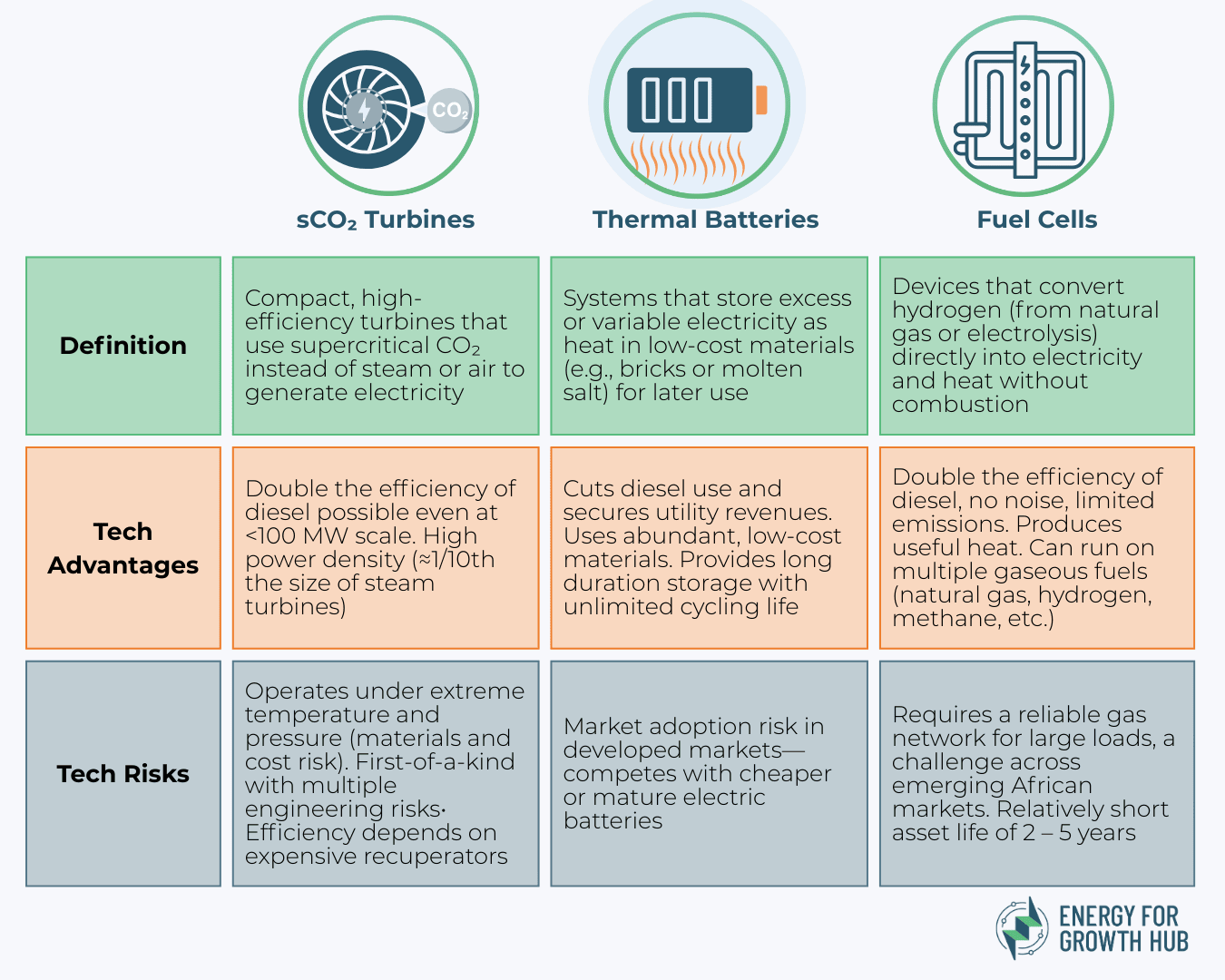
Ultimately, fixing Africa’s electricity grids remains the most consequential solution, but it is unlikely to happen quickly or uniformly. In the meantime, industrial firms need captive power options that (1) are more efficient, (2) support energy-intensive operations, (3) integrate with — or transition to — reliable grid power over time, and (4) align with national environmental and energy-transition goals. The United States leads on three next-generation technologies well-suited to these needs. These technologies are not yet fully mature and still face high investment and other early-stage costs, but they can substantially reduce imported diesel use and deliver strong long-term benefits, as grid improvements continue.
- sCO₂ turbines offer twice the efficiency of diesel generators. Unlike the steam or air-driven gas turbines used in most thermal plants today, sCO₂ turbines are driven by supercritical CO₂ — a fluid that combines liquid and gaseous properties — and can be fueled by any source (gas, diesel, nuclear, geothermal, waste heat, etc.). Even at scales below 100 MW, typical for most African industrial firms, they can enable combined-cycle plants with twice the fuel efficiency of diesel units, a range where today’s steam turbines are not commercially viable. The US currently leads commercialization, achieving the world’s first sCO₂-cycle power generation in May 2024 while China deployed its first sCO₂ power units in December 2025.
- Heat batteries can slash diesel use and support grid improvement. Heat batteries, also called thermal energy storage (TES), store variable electricity from wind, solar, or unreliable grids as heat in low-cost materials such as bricks or molten salt. When needed, the stored heat can be used directly for industrial processes or converted back to electricity through conventional or next-generation turbines.
With TES, firms can stay connected to unreliable grids and avoid expensive diesel use without suffering the damaging effects of fluctuating power. For utilities, TES could help retain large consumers and sustain the revenues needed to fix the grid. TES also enables excess captive power to be sold back to the grid, creating strong incentives for firms to remain grid-tied and supporting both utility revenues and overall grid reliability. US firms such as Antora and Rondo Energy lead global industrial heat battery commercialization, with Rondo deploying a 100 megawatt-hour system in California in October 2025. - Fuel cells can deliver power and heat with high efficiency and flexibility. Unlike turbines or diesel engines that rely on combustion, fuel cells generate electricity through electrochemical reactions. They can be twice as efficient as diesel engines, offer quick start-stop functionality to fill grid gaps, and operate continuously with low emissions. Fuel cells are a mature, scalable technology, capable of providing both power and heat with fuel flexibility. With natural gas likely to power many African industries for the near future, fuel cells offer a practical option that works with today’s fuels and can transition to cleaner fuels as they become available. The US company Bloom Energy is the global market share leader, having installed over 1.5 gigawatts of solid oxide fuel cells worldwide.
Conclusion
African industries are stifled by stubborn utility and grid challenges that will require time and investment to resolve. In the interim, industrial firms need power solutions that offer more efficient alternatives to diesel, can support advanced industrial operations, and are future-proofed to integrate with reliable grid power and evolving energy-transition goals. This presents a major opportunity for the US to expand research and development, drive down costs, and strengthen its existing market leadership in solutions like sCO2 turbines, heat batteries, and fuel cells. In its energy engagement with Africa, the US should therefore prioritize industrial growth — the sector where it holds both a competitive technological edge and the potential to deliver transformative economic impact.
Endnotes
- A supercritical fluid is a substance at a temperature and pressure where it is no longer a true liquid or gas but behaves like both simultaneously, giving it valuable properties (flows like a gas, carries heat like a liquid) that make it ideal for many high-performance applications. https://www.sciencedirect.com/topics/engineering/supercritical-fluid
- International Finance Corporation (IFC). (2019). The Dirty Footprint of the Broken Grid: The Impacts of Fossil Fuel Back-Up Generators in Developing Countries. https://www.ifc.org/en/insights-reports/2010/dirty-footprint-of-broken-grid
- Adeyemi, K., & Adetunji, A. (2025). Energy poverty and industrial productivity: Evidence from Nigeria. Energy for Sustainable Development, 81, 101252. Elsevier. https://www.sciencedirect.com/science/article/pii/S2214629625002051
- APA News. (2025, January). 46 more firms abandon Nigeria’s grid network for self-generated power. https://apanews.net/46-more-firms-abandon-nigerias-grid-network-for-self-generated-power
- UK Parliament – International Development Committee. (2016). Written evidence submitted by the Manufacturers Association of Nigeria (EVD0127). https://committees.parliament.uk/writtenevidence/65756/html
- Ember Climate. (2025). The first evidence of a take-off in solar in Africa. https://ember-energy.org/latest-insights/the-first-evidence-of-a-take-off-in-solar-in-africa
- CrossBoundary Energy. (2025). Project portfolio: Renewable energy for African industry. Review of several projects to assess solar contribution to industrial activities. https://crossboundaryenergy.com/projects
- Market Data Forecast. (2025). Africa Diesel Generator Market – Industry Analysis, Size, and Forecast (2025–2033). https://www.marketdataforecast.com/market-reports/africa-diesel-generator-market
- Southwest Research Institute (SwRI). (2024, May). STEP Demo pilot plant makes new breakthrough in sCO₂ power generation. https://www.swri.org/newsroom/press-releases/step-demo-supercritical-co2-pilot-plant-generates-electricity-the-first-time
- PR Newswire. (2025, April 9). Rondo powers up world’s largest industrial heat battery. https://www.prnewswire.com/news-releases/rondo-powers-up-worlds-largest-industrial-heat-battery-302585582.html
- Bloom Energy. (2025, February 12). Oracle and Bloom Energy collaborate to deliver power to data centers at the speed of AI. https://investor.bloomenergy.com/press-releases/press-release-details/2025/Oracle-and-Bloom-Energy-Collaborate-to-Deliver-Power-to-Data-Centers-at-the-Speed-of-AI
- Chen, L., Zhang, Y., Xu, J., & Brun, K. (2017). Fundamentals and Applications of Supercritical Carbon Dioxide (sCO₂)-Based Power Cycles. Elsevier. https://www.sciencedirect.com/book/9780081008041/fundamentals-and-applications-of-supercritical-carbon-dioxide-sco2-based-power-cycles