

Industrial growth in developed countries has always relied on abundant energy: No country has become high-income with low-energy consumption, and industrial power is a major piece of that higher consumption. As aid declines, trade terms shift, and political momentum builds around resource extraction deals, African countries are prioritizing pathways to rapid industrialization that will grant them faster economic development and greater geopolitical leverage. Meeting these ambitions will require reliable, abundant energy for industrial activity — a luxury many African economies do not have. Reaching their industrialization goals requires clearly defining the problems, honestly assessing what hasn’t worked, and confronting the hard policy questions ahead.
To that end, the Hub has begun a new initiative to pinpoint Africa’s core industrial energy needs and propose sector- and country-specific policy solutions to power Africa’s growth.
Four power-fault lines of Africa’s industrial prowess
Let’s start with the basics. Africa’s industrial development is constrained by four major energy barriers:
- Costly and unreliable power undermines existing manufacturing. More than two-thirds of firms in sub-Saharan Africa experience power outages. Unreliable power damages equipment, reduces productivity, and results in staggering job loss. To cope, firms (especially large manufacturers engaged in exporting) switch to producing their own power or relying on back-up systems. This drives up their cost of doing business and erodes much-needed revenues for utilities.
- Deficient power keeps industries low-tech, low-energy demand. Poor and declining power infrastructure also limits growth by suppressing demand for more sophisticated industrial activities. While existing firms are hurt by unreliable power, the impact is likely even greater on the many firms that never get created in the first place. Africa’s global contribution from medium- and high-tech industries like metals, machinery, electronics, and industrial chemicals has persistently remained less than 2%. Suppressed industrial energy consumption hinders participation in advanced, global supply chains and makes local goods export-reliant and costly.
- The lack of power stifles efforts to retain more economic value domestically. Because of unreliable electricity, Africa’s minerals (like cobalt or lithium) and high-value agricultural commodities (like cashews and rubber) get exported from the continent with minimal value addition. This locks countries into extractive models and stymies opportunities for diversified growth and job creation. Efforts to expand processing capacity through export quotas and resource-nationalization policies have been undermined by power shortages in places like the DRC, where waivers have become increasingly common. Whatever policies are in place, more processing requires more power.
- Countries rarely connect industrial demand plans to energy planning. Power plants in countries like Uganda, Angola, and Ethiopia generate more electricity than is used — a ‘build it and they will come’ approach that overlooks the need to couple generation with demand stimulation and distribution infrastructure to drive economic growth. Countries also pursue new demand opportunities, like minerals, hydrogen, and data centers, through behind-closed-door deals that are often isolated from broader planning. This creates unproductive cycles of hype and disappointment, fosters an opaque and inhospitable investment environment, and shortcuts strategic, realistic assessment of demand centers.
Unreliable power results in low-productivity and stalled growth
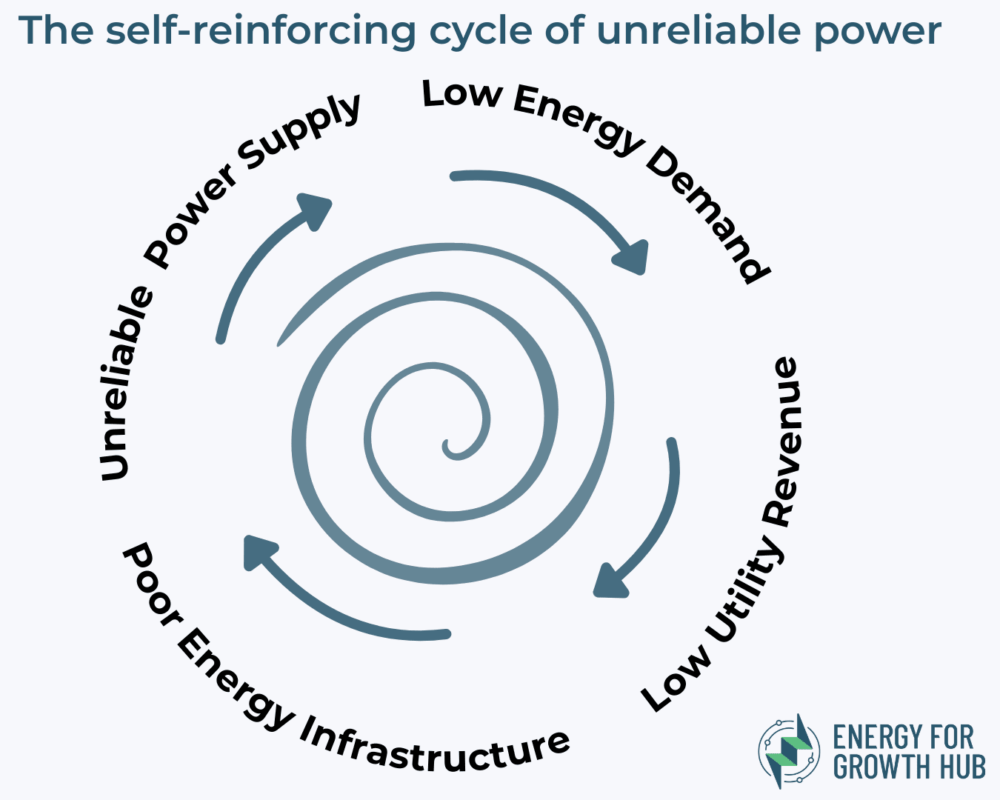
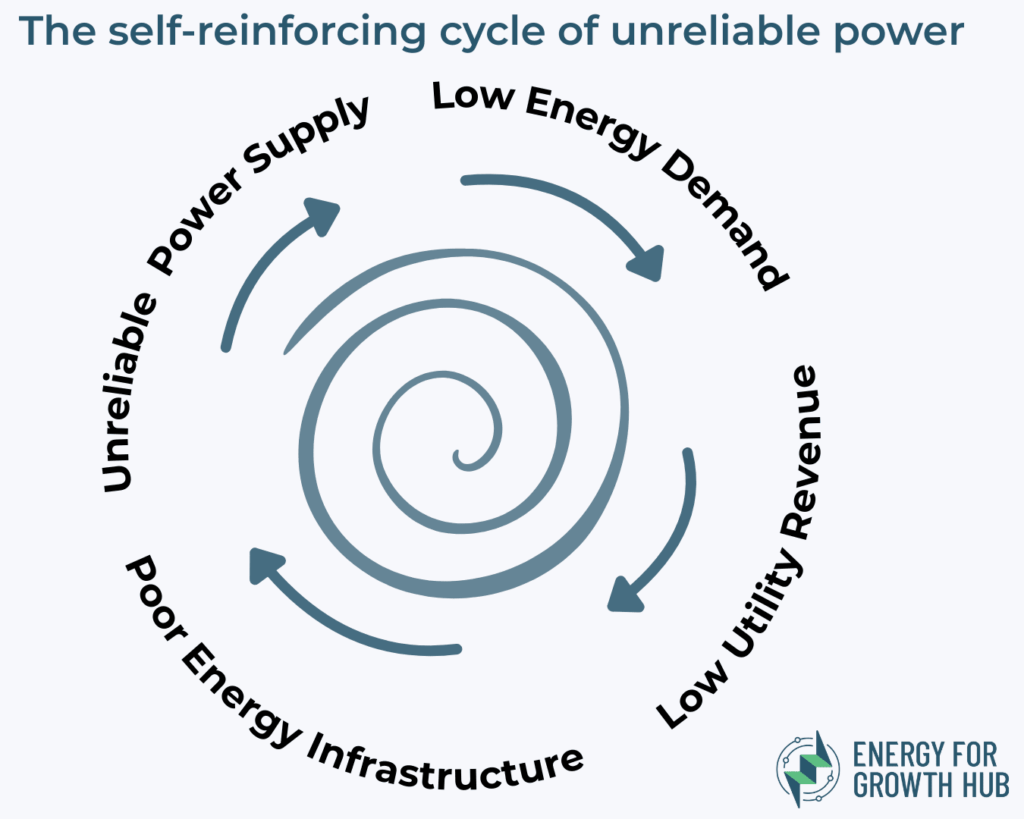
The four fault lines are different manifestations of weak power infrastructure. Unreliable power forces industrial customers to turn to independent supply or back-up power which increases cost for firms, suppresses new and growing power demand for manufacturing. With fewer consumers, utilities lose resources to maintain or expand energy infrastructure, power remains unreliable and energy systems continue to deteriorate. Economies, as a result, stay concentrated in low-energy activities like extraction, services, and agriculture, limiting production of higher-value goods and deepening dependence on imports for medicine, construction materials, chemicals, and more. This culminates in a self-reinforcing cycle of poor power infrastructure that results in poor economic productivity and growth.
Abundant and reliable energy is the antidote
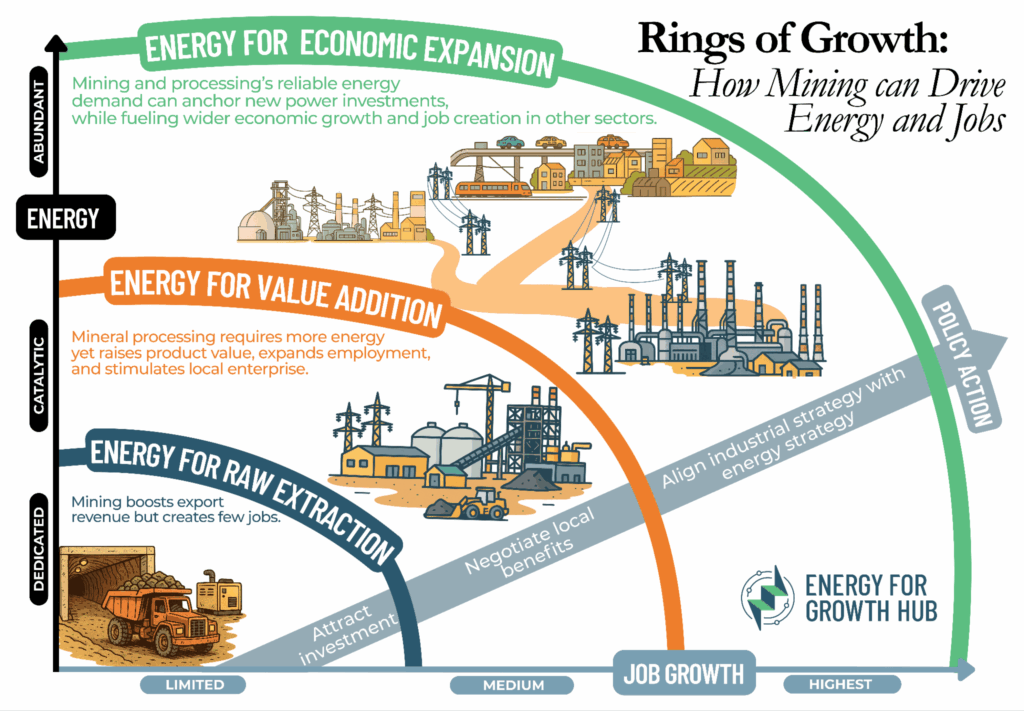
Solving the perpetual low-power and low-productive cycle not just for a single firm, but in a manner that unlocks growth for an entire nation requires a shift in development policy. That is why we have begun this work by introducing the Three Rings of Growth for energy and jobs. Africa’s current reality is largely Ring 1: limited energy that supports only extractive activities. Today, most African leaders are focused on Ring 2: building energy infrastructure to enable value addition at home. But true economic transformation depends on Ring 3: energy development designed to power a broad range of economic activities, not just specific firms, technologies, or sectors. This is the kind of abundant, reliable power needed to drive industrial growth, job creation, and long-term economic expansion.
Delivering on industrial power means answering hard questions
The need for abundant industrial power is clear. But delivering it through the right mix of policy, investment, and prioritization has proven difficult time and again. Ensuring that power leads to industrial growth depends on factors beyond electricity, including trade policy and geopolitics.
- In the 1960s & 70s, the buildout of large hydropower energy projects anchored to industrial users was initially transformative. But as demand grew, many utilities became locked into non-cost-reflective prices and long contract terms that limited their ability to accommodate new demand or invest in new infrastructure.
- By the early 2000s, hopes shifted to special economic zones and efforts to anchor mining and other industrial activities to the power sector, with few results.
- More recently, optimism has centered on the idea that transformative growth will come once countries tap their renewable potential or ride the latest green-technology wave. The promise was that Africa would grow faster with clean energy.
Each of these approaches to pairing energy with industry have failed to transform industrial growth. In the meantime, countries are relying on diesel generators, small-scale solar, and expensive floating power plants for backup power that cannot support a growing industrial base.
This time, we need to do better. Moving forward, we’ll be asking key questions like:
- What lessons learned from past short-term triumphs or failed attempts should guide Africa’s latest approach to power industrial growth?
- Which reforms must be prioritized to ensure industrial firms don’t continue to defect from the grid?
- How should countries approach captive power and energy infrastructure financing to give industries reliable, high-power options while keeping the flexibility to reconnect to the grid as it improves?
- Under what conditions does new or existing demand (like mineral processing) translate into broader energy and industrial development?
- How should countries pair industrial strategy with power-sector planning and incentives to create the strongest catalytic impact on growth?
- What shifts in investor, multilateral, funder, and national priorities are needed to move beyond extraction and support real industrial growth?
Sign up here for The Hubstack, the Energy for Growth Hub Substack newsletter, to receive all of our newest analysis on these questions.