


This piece is co-published with the African Tech Futures Lab.
Summary
Most grid-connected Africans experience interrupted electricity supply.1 Generation deficits, transmission bottlenecks, and grid instability are often lumped together in public discussions, making it hard to zoom in on the specific drivers of unreliable power in each African country. Using media reports and other public sources, we assessed major power disruptions (affecting a whole country or large regions of it) in 13 African countries from 2020 to 2025. We covered both planned load shedding and unplanned outages, and traced each disruption to its technical or operational cause.
Why It Matters
Behind every factory line that goes dark, every hospital running on backup power, and every small business struggling to scale is a power system trying to keep up. Understanding where each system breaks helps decision-makers direct policy and investment toward fixes that work.
Methodology: Using Media and Other Reports to Assess the Causes of Grid Unreliability in Africa
We performed a systematic, country-by-country search of news media (international, regional, and local news) and other publicly available documents (utility reports and statements, government announcements and press releases, policy research documents and reports). Load shedding is characterized as “present” if scheduled outages announced in advance are reported in our sources at any point in a given year, “absent” if they are not reported, or “unclear” if our sources are ambiguous as to whether a scheduled, pre-announced outage occurred. Unplanned outages refers to incidents in which grid electricity was reported to have failed or been disrupted unexpectedly, with each such outage coded to one primary cause based on our sources. For both load shedding and unplanned outages, we considered only incidents that had an impact that was nationwide or affected a significant region of the country. We assessed 13 countries for both load shedding and unplanned outages, but only 10 had incidents that met our inclusion criteria for the latter.
Due to uneven media coverage, the incident counts show patterns rather than precise frequencies that can be compared directly between countries. Further details on methodology and the full data set are available online here.
Key Findings: Africa’s Electricity Reliability Challenge Goes Beyond Generation
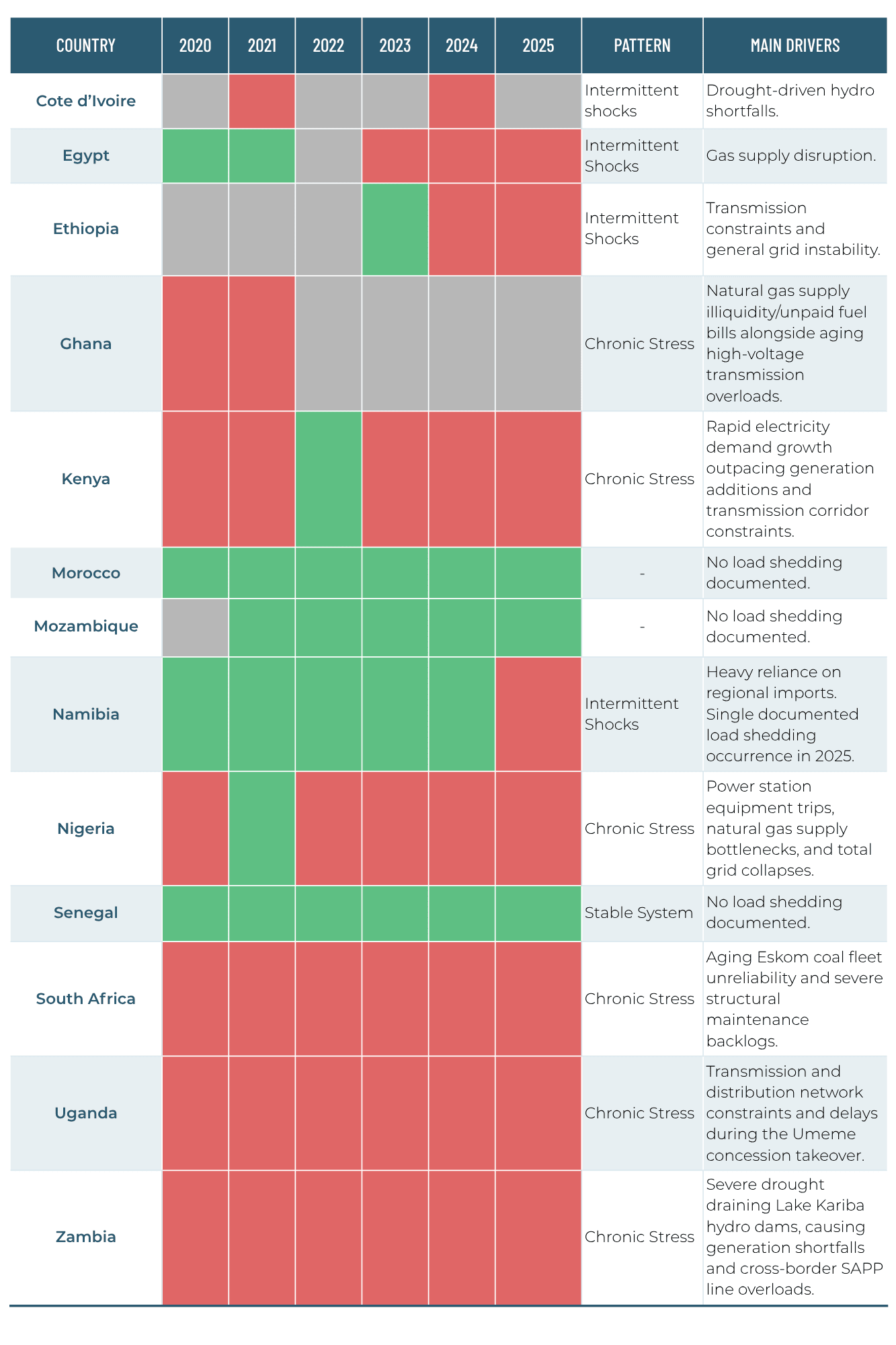
1. Load shedding is widespread, and driven by both supply shocks and grid constraints. Ten of the 13 countries reported large-scale power rationing in at least one year between 2020 and 2025 (Figure 1). Of these, six countries (South Africa, Zambia, Uganda, Ghana, Kenya, and Nigeria) experienced chronic load shedding, with incidents reported in at least five of the six years studied. Generation shortfalls grab headlines, such as South Africa’s coal fleet failures and Zambia’s drought-driven hydropower crisis, but transmission constraints and grid instability also drive rationing in most of the worst-affected countries. Uganda, for example, has experienced large-scale power rationing every year despite having installed capacity well above its peak electricity demand,2 because weak transmission and distribution infrastructure constrain the delivery of that power to customers.
FIGURE 1: Load shedding reported by country and year (red = load shedding reported in that year, green = no load shedding reported in that year, gray = evidence from our data sources is unclear).
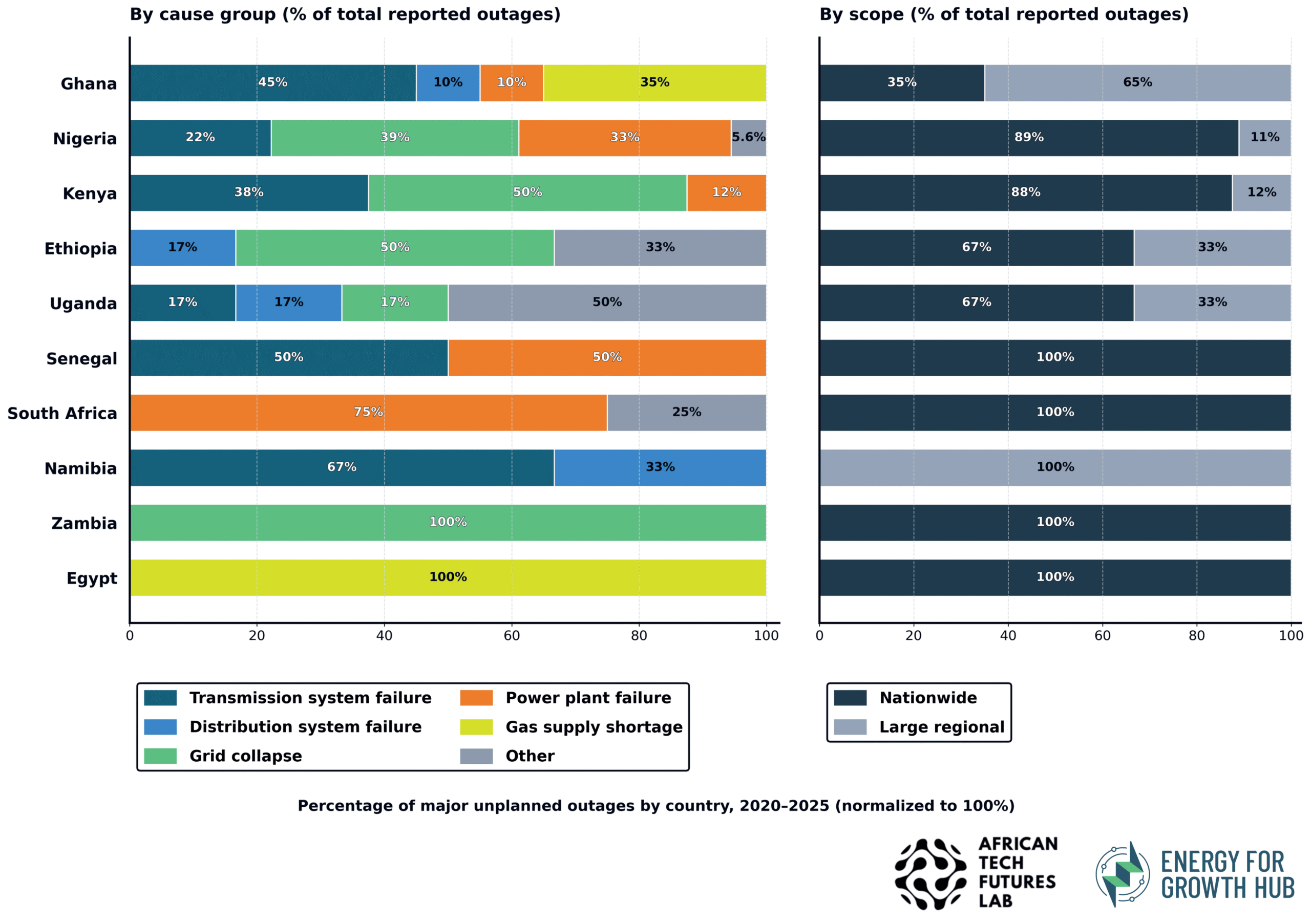
2. Failures in one part of the grid can trigger wider system disruptions. Transmission failures and supply-side failures such as power plant breakdowns and gas shortages were the two leading causes of large-scale blackouts in our sample (Figure 2). Another quarter were system-wide grid collapses, in which a fault cascades across the network and the original source is often unclear from reporting. Together, these point to weaknesses in how generation, transmission, and distribution work together, and the need to build resilience across the whole system. Kenya and Nigeria exemplify this clearly: faults in generation, transmission, and other areas repeatedly brought down the national grid, and nearly 90% of recorded outages in both countries were nationwide in scale (Figure 3).
FIGURE 2: Primary causes of major unplanned outages, 2020-2025
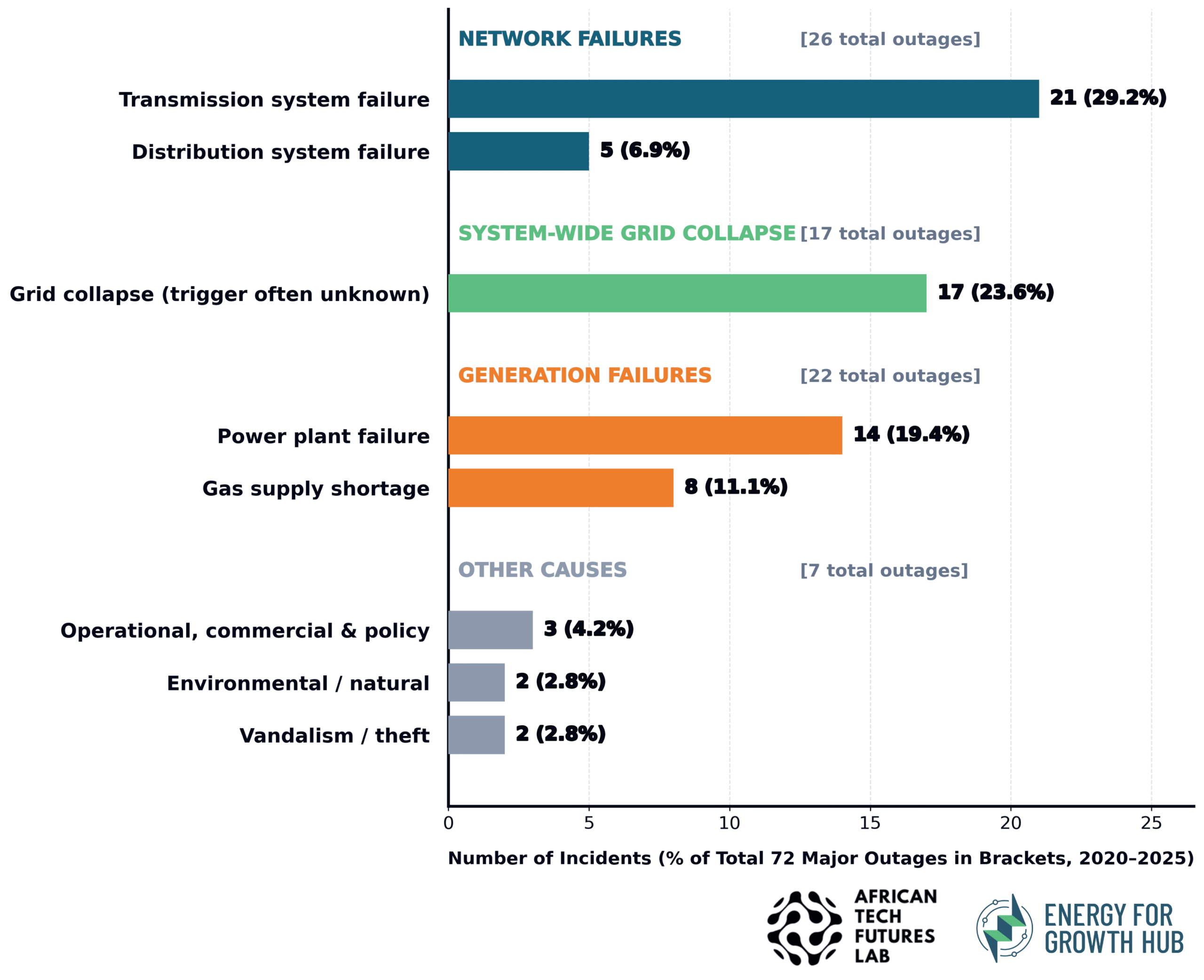
FIGURE 3: Major unplanned outages in each country by primary cause and scope, 2020-2025
3. Regional interconnectors share supply across borders, but can also spread failures. Vulnerabilities within one country’s power system can often extend beyond its borders. About one in six major outages in our sample involved cross-border electricity or fuel links. All four of Senegal’s nationwide blackouts reported in major media outlets involved the regional OMVS transmission line, which in 2022 also disrupted supply in parts of Mali and Mauritania. A 2020 transmission fault in Kenya triggered a blackout in Uganda, despite Uganda having sufficient generation of its own. Zambia illustrates both sides of regional interdependence, having relied heavily on imports through the Southern African Power Pool as drought constrained its hydropower generation, while its two national blackouts in 2024 also affected Zimbabwe.
Recommendations: The Path to Improving Grid Reliability in Africa
This review of the causes of electricity outages, both planned and unexpected, underscores the degree to which the electric grid is a sprawling and complex machine. As power plants throughout a country convert fuel into electricity and deliver electricity through transmission and distribution networks, the system operator must apply technology and know-how to balance supply and demand at every location and point in time, ensure no lines exceed their rated capacities, and maintain voltage and frequency within specified limits. A failure at any point can disrupt supply. Three priorities emerge:
- Give the grid as much attention as generation. Policy targets, and the investments that follow, often focus on adding megawatts. Yet transmission and distribution networks, and the capacity to operate them well, matter as much as ensuring sufficient supply.
- Build resilience across the whole system, not just its parts. Many of the outages we recorded were system-wide collapses, in which a single fault cascaded into a national, and sometimes regional, blackout. Preventing them requires planning that looks at the power system as a whole to find and fix its weak points. This includes ensuring adequate reserves, a diverse generation mix, redundancy in the network, physical security for infrastructure, and skilled, well-equipped grid operators. As regional electricity markets and interconnections expand, countries must also strengthen coordination on system reliability through joint contingency planning, aligned operational protocols, and mechanisms to contain disruptions before they spread across borders.
- Invest in measuring reliability better and make data public. Consistent, public reliability data for African countries are scarce, which is why this study had to rely on media reports as proxy data. Regulators and utilities should regularly publish standardized outage data and broader power sector statistics. Meanwhile, further research can develop better proxies to fill the gaps.
Endnotes
- Afrobarometer, “Still lacking reliable electricity from the grid, many Africans turn to other sources,” April 2022, https://www.afrobarometer.org/wp-content/uploads/2022/04/AD514-PAP10-Still-lacking-reliable-electricity-from-the-grid-Many-Africans-turn-to-alternative-sources-Afrobarometer-11april22.pdf.
- International Trade Administration, “Uganda Country Commercial Guide,” December 2025, https://www.trade.gov/country-commercial-guides/uganda-energy.