Context:
Ghana’s electricity system is heavily burdened. Sector debt has ballooned to over US$2.5 billion owed to independent power producers and gas suppliers. The World Bank estimates that the cumulative shortfall is projected to exceed US$9 billion by the end of 2026. At the same time, the national utility, the Electricity Company of Ghana (ECG) recorded power losses amounting to 32% of its total electricity purchases in 2024, the highest in over two decades. Blackouts and rising tariffs continue to burden both households and industry, while flagship industrialization programs have been hamstrung by unreliable supply in the past.
For a country trying to build an industrial and manufacturing base, the current energy model is unsustainable. While natural gas has served as the country’s transitional energy mainstay, forecasts signal that its viability may peak by 2030. Ghana and the rest of the continent urgently need a reliable, cost-effective baseload solution that can stabilize the grid, reduce reliance on volatile fuel imports, and power economic growth. That’s where nuclear energy might come in.
Ghana’s Interest in Nuclear Energy is Not New
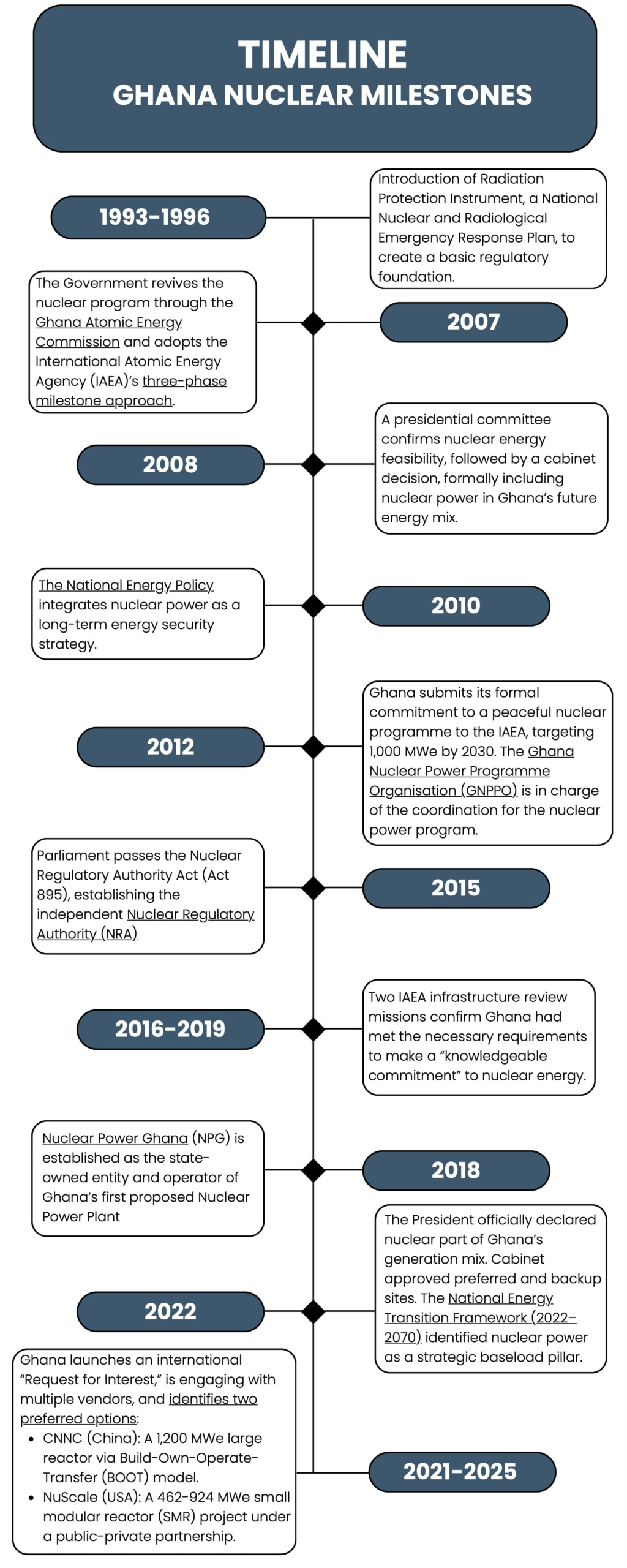
Ghana’s nuclear aspirations date back to the 1960s, but the modern phase of its program began in earnest in the early 2000s. Successive governments have worked to lay the legal and institutional foundations for a peaceful nuclear program. In 2007, the government revived its nuclear program and began building key institutions. It established the Ghana Nuclear Power Programme Organization (GNPPO), passed the Nuclear Regulatory Act (2015) to create an independent regulator, and created Nuclear Power Ghana as the owner-operator of future plants. The National Energy Policy and Ghana’s Energy Transition Framework (2022-2070) have positioned nuclear power as a long-term pillar of Ghana’s energy security and decarbonization strategy. Importantly, the country has followed the International Atomic Energy Agency’s (IAEA) phased roadmap for nuclear development and is now in the decisive stage of selecting vendors and securing project financing.
Bottom line: Ghana has never been more prepared to launch a nuclear program. The regulatory structures are in place, site selection is completed, and institutional leadership exists. But institutional readiness does not guarantee commercial success.
What Makes This Moment Different: The Opportunity and the Risk
The World Bank’s reversal of its nuclear funding prohibition in June, fundamentally alters Ghana’s energy financing landscape. This policy shift opens possible avenues for concessional financing, technical assistance, and risk mitigation instruments that could significantly reduce project costs and development risks. Ghana, now in Phase 2 of the IAEA roadmap (Table 1 below), could be one of the first African countries to benefit from this opportunity.
TABLE 1: Phase 2 Milestone Approach Activities and Processes of Ghana’s Nuclear Programme

However, the country’s current procurement approach, which is centered on bilateral negotiations with pre-selected vendors from the US and China, risks locking in high costs and excluding the benefits of competition. This approach is dangerously familiar: negotiating behind closed doors with predetermined vendors risks repeating the mistakes that precipitated Ghana’s current energy debt crisis. Opaque contracts, signed without competition, burdened the country with excessive long-term liabilities, many of which later had to be canceled or renegotiated.
With nuclear, the stakes are even higher. Nuclear projects are too large, too expensive, and too long-term to proceed without rigorous procurement. ASMR would require up to US$3-10 billion in upfront capital with construction timelines of three to seven years, and an operational lifespan of 50 plus years. A typical 1000 MWe conventional nuclear plant requires even more.
The OECD shows that lowering construction costs through better governance and risk management, such as open bidding, is critical to ensuring project viability. Similarly, the IAEA emphasizes that enabling cost reductions requires strong regulatory frameworks and supply chain efficiency. Without these safeguards, Ghana risks repeating history.
Nuclear Power as a Catalyst for West African Energy Abundance
Ghana’s nuclear program is not just about securing domestic energy security—it holds the potential to reshape West Africa’s energy future and unlock broader economic transformation across the region. A mid-sized SMR could help Ghana meet the industrial demand for its mining sector, minerals processing, and manufacturing expansion. With a 1000 MWe nuclear plant generating approximately 8000 GW/h per year, Ghana could meet its own baseload needs and export surplus to neighbours through the West Africa Power Pool, a cooperation of national electrical companies under ECOWAS, which faces power supply issues.
The regional implications extend beyond electricity exports. Ghana’s nuclear program could also establish the technical expertise and regulatory frameworks that other African nations need for their own nuclear programs, complementing South Africa and Egypt’s programs. Nigeria, Kenya, and others have expressed nuclear ambitions, and Ghana’s successful competitive procurement could establish best practices for the entire region. The country’s approach to leveraging multilateral financing—particularly the World Bank’s new nuclear funding capability—could become a template for sub-regional nuclear development more broadly.
The Path Forward Requires Immediate Action
Ghana must act quickly to establish a competitive framework that can leverage the World Bank’s policy shift. The country should:
- Reopen vendor selection. Expand the vendor pool and issue new Request for Proposals (RFP) inviting global participation, not limiting its options to just a few companies or countries.
- Design and adopt a transparent, competitive framework and use standardized templates. Develop clear bid specifications, prequalify vendors and assess proposals using a transparent matrix covering cost, safety, financing, and local content.
- Strengthen institutional independence, capacity and project governance. Steps could include GNPPO establishing a dedicated procurement unit, actively developing local nuclear expertise through international training programs, and creating community consultation mechanisms for transparency. Learning from the extractives sector, GNPPO could include civil society as observers in the review process to ensure accountability and build public trust.
- Engage multilateral partners. Simultaneously, Ghana should initiate formal discussions with the World Bank Group on nuclear financing options, exploring both IFC private sector financing for NPG and World Bank technical assistance.
Conclusion
Ghana is doing the hard work of preparing for nuclear power. It has built institutions, passed laws, and earned the confidence of the IAEA. With the World Bank’s policy shift, the financing door is now open. But the hardest and most consequential decisions lie ahead. The path Ghana chooses will determine whether nuclear power becomes a solution to its energy crisis or another expensive burden. If it moves quickly, transparently, and strategically, Ghana could not only address its own electricity challenges, but could also become an anchor for energy security and abundance across West Africa.