
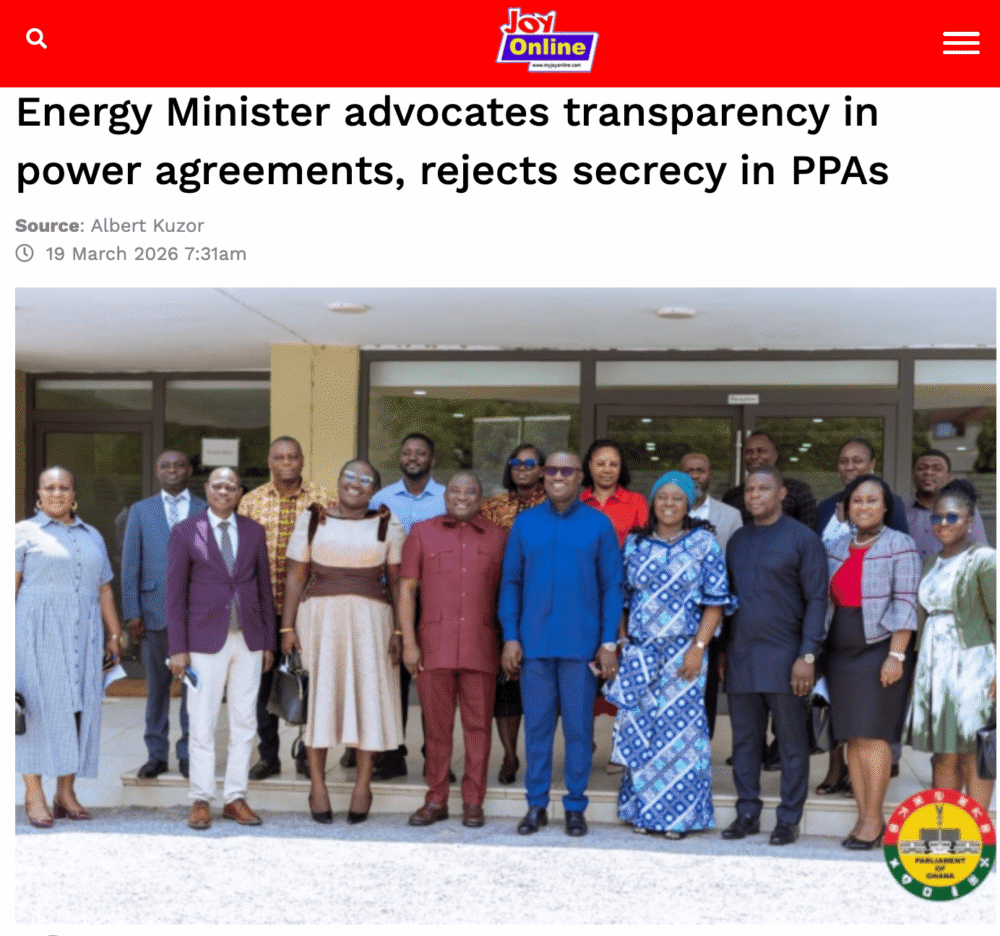
In a bold statement, Ghana’s energy minister is shunning secrecy and shining a light on its electricity agreements. Not long ago, the country was a textbook case of how power sectors go wrong. Deals were negotiated in the dark and disclosed selectively, resulting in excess capacity, mounting arrears, and rigid payment obligations. Dozens of power purchase agreements (PPAs) eventually had to be renegotiated and cleared at huge cost. The Ministry of Finance recently spent roughly $1.5 billion to stabilize the energy sector, which bought time, but did not fix the underlying system that created the problem.
Ghana is moving from one of the continent’s most troubled energy sectors toward leading in governance
The country’s reform path is starting to take transparency, planning, and procurement discipline seriously. Contracts are becoming recognized as central — not peripheral — to how markets function. Here’s what’s happened:
- In 2023, the regulator launched a public register of active PPAs, a first step toward a more transparent and credible market.
- In 2025, competitive procurement was formalized under the Energy Commission’s regulations (L.I. 2508), replacing discretionary deal-making with structured bidding and reducing the space for poorly structured contracts.
- Last month, Ghana’s Energy Minister Hon. John Jinapor, at a meeting of the Open Government Partnership (OGP), announced that all PPAs will soon be published on the Ministry’s website.
These steps all matter because, as we’ve seen in South Africa and other countries, markets only work if the system is visible. Competition without transparency is just another closed process. If contract terms, evaluation criteria, and risk allocations are not accessible, then there is no way to verify outcomes or enforce discipline.
And this moment for transparency matters beyond Ghana!
Power contracts are becoming one of the largest sources of long-term public financial obligations across emerging markets, yet they remain mostly outside debt transparency frameworks. That gap is closing as more countries confront the consequences, including Pakistan, Sri Lanka, and Zambia.
This is the exact shift my colleagues and I have been pushing: disclosure, standardization, and integration of PPAs into fiscal decision-making. Through PPA Watch and work with partners like the OGP and the Extractive Industries Transparency Initiative (EITI), it is gratifying to witness advocacy turn into policy change.
Transparency in the extractive sectors shows what can be done
It’s really not that complicated. African power markets are relatively small and becoming deeply interconnected, which means countries inevitably learn from one another.
The oil, gas, and mining sectors have already demonstrated the value of contract disclosure: it created a shared base of knowledge that allowed governments to benchmark deals, institutions to compare approaches, and agencies to coordinate more effectively. Disclosure did not completely eliminate risk, but it made poor decisions easier to identify and harder to defend.
The same logic applies to power. Focusing only on the headline tariff, which most countries publish, misses the real story. What matters is how that tariff is constructed and the embedded obligations — from sovereign guarantees and foreign exchange exposure to payment terms — that can ultimately bind the public balance sheet. Without visibility into those elements, it is difficult to assess whether a contract is sustainable, let alone comparable. Opacity creates market uncertainty for governments and private investors alike, raising costs and harming everyone.
Ghana now has a chance to move ahead of the curve. Competitive procurement introduces discipline at the point of entry, but transparency will ensure that discipline holds over time.
While disclosure will be a huge step forward, the problems will not be solved by uploading a few contracts to a website
Real transparency will require a system that does not fall apart after a well-meaning politician is out of office. It requires:
- Embedding disclosure into the legal and regulatory framework so it survives political cycles.
- Creating a central platform where contracts, amendments, and procurement data are published in a consistent and usable format.
- Making the information usable by those who need it. If disclosure does not feed into budgeting, tariff setting, and fiscal risk analysis, then it is not doing its job.
Fortunately, Ghana can adapt workable models from extractives and public procurement.
Ghana has already shown it can respond to crises. The harder task will be creating an open system that prevents the next one — and puts the country on a firm path toward reliable, low-cost power to meet the economic ambitions of the nation. The government’s commitment to power contract disclosure is a serious step forward.