

What’s the cost of the power crisis to Nigeria’s economy?
One number dominates the conversation, but it has no source. For eight years, a single estimate — claiming that unreliable electricity causes an annual GDP loss in excess of $25 billion — has served as the definitive economic measure of Nigeria’s power problems. It has appeared in World Bank publications, academic research, Bloomberg articles, and Standard Bank reports, shaping the world’s understanding of both Nigeria’s specific challenges and the degree to which energy poverty holds back economies in general.
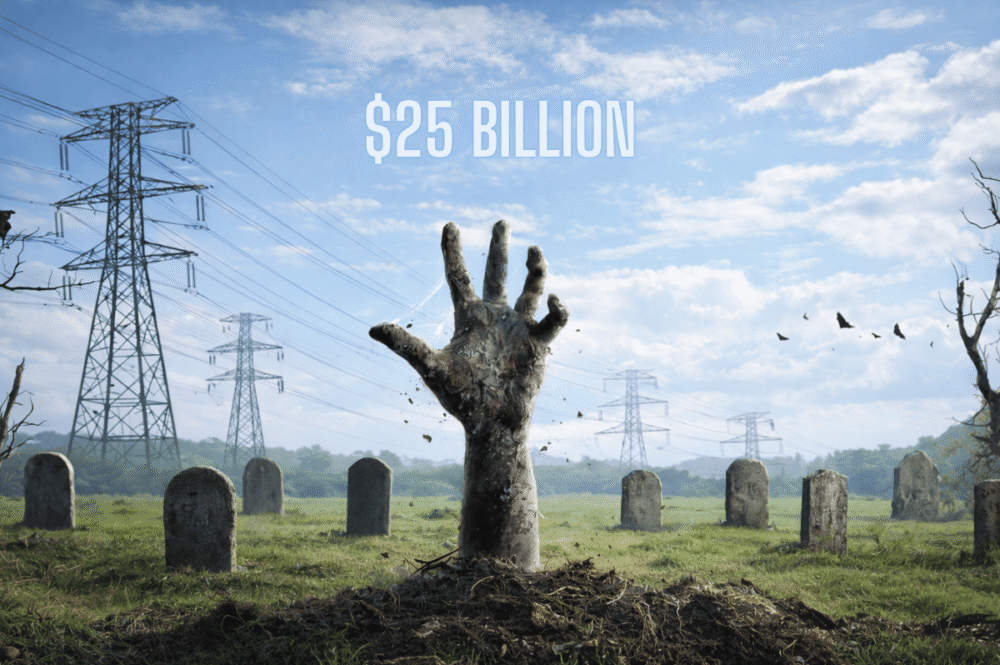
But there’s one problem: it’s a ‘zombie statistic’. Zombie statistics are endlessly repeated, but without verification or context. We dug into it and (as far as we can tell) it first appeared in the Federal Government of Nigeria’s 2018 Power Sector Recovery Programme (page 17). Yet the $25 billion figure includes no calculation, methodology, or underlying assumptions. It’s since been repeated by countless trusted researchers and institutions, but we have no idea whether it’s anywhere close to accurate.
The $25 billion statistic does have some value. Compelling, eye-catching statistics fill important gaps in our understanding of complex problems. Even if they’re not exactly accurate, they can illustrate the scale and urgency of a problem. This one successfully communicates the (very real) point that unreliable power creates significant economic drag – and can therefore help mobilize resources and attention to fix it. In practice, the actual dollar figure doesn’t matter as much as the broader point: that unreliable electricity means massive economic harm.
But it also holds us back. Without a credible way to measure the economic impacts of power outages, we cannot fairly assess the scale of the problem or its importance relative to other barriers. Does the $25 billion figure measure the economic damage from lost production, generator costs, or suppressed demand? We don’t know. Without this clarity, driving specific policy interventions becomes difficult. When widely-used statistics lack clear assumptions or calculations, it can also lead to mistakes in what gets funded, who cares about it, and which solutions are ultimately tried. We need to do better.
Three ways we can improve how we measure power service gaps.
More transparent methodologies and a better use of existing data are a good start. The development finance community has several opportunities to strengthen how we estimate impact:
- Make estimates transparent. Even rough calculations become more useful when assumptions are clear. Knowing how $25 billion was arrived at and what it’s measuring helps calibrate responses appropriately.
- Invest in rigorous economic impact research. Robust studies using transparent methodologies can reveal how outages affect employment, productivity, business formation, and broader economic impact. New tools that map consumption patterns at the building level enable development institutions to track economic impacts dynamically and measure whether interventions are actually working. Recent efforts demonstrate what’s possible: Justice Mensah’s work across African countries shows which sectors and skill levels are most affected by outages. Open Energy Maps uses machine learning to track building-level consumption patterns, enabling measurement of grid reliability over time.
- Use the operational data we already have to target interventions. The 2018 report contains valuable metrics that could better guide operations: 22 system collapses in 2016, details on tariff shortfalls by distribution companies, and collection rates by region. These granular numbers offer a roadmap to targeted interventions. The same attention given to headline economic figures could be applied to system collapse frequencies, transformer failure rates, and collection percentages.
Creating space for uncertainty. Not having precise measures for everything is a normal part of economic policymaking. The Nigerian government report notes that suppressed demand remains unmeasurable and self-generation is largely untracked. But much greater transparency can help focus efforts on what we can and should measure — and make Zombie statistics based on mysterious assumptions less ubiquitous.