

Climate resilience in Africa depends on quality power, but nobody fully understands how they intersect.
Climate risks, including floods, heatwaves, and droughts, are intensifying across Africa and stressing already-fragile electricity systems.1 The ability of the most climate-vulnerable populations to adapt depends on reliable, affordable power.2 Yet Africa’s grids remain structurally weak, with frequent outages and poor power quality, which climate extremes will further exacerbate.3 To date, there has been limited evidence on how — and to what extent — extreme weather drives grid failures across the continent.
So we did an in-depth analysis of Accra, Ghana
This memo summarizes early findings from ongoing original research examining how extreme weather events intersect with power supply reliability and quality, and the resulting impacts on climate-vulnerable communities. Specifically, we wanted to understand the odds of grid disturbances occurring during extreme weather events, and who is most impacted.
We use Ghana’s Greater Accra Region as a prime case study. But many major African cities face similar exposure to the triple threat of climate extremes, structurally weak urban distribution networks, and high concentrations of climate-vulnerable populations.6,7 This suggests the patterns documented here are likely broadly consistent across the continent.
Our two key insights
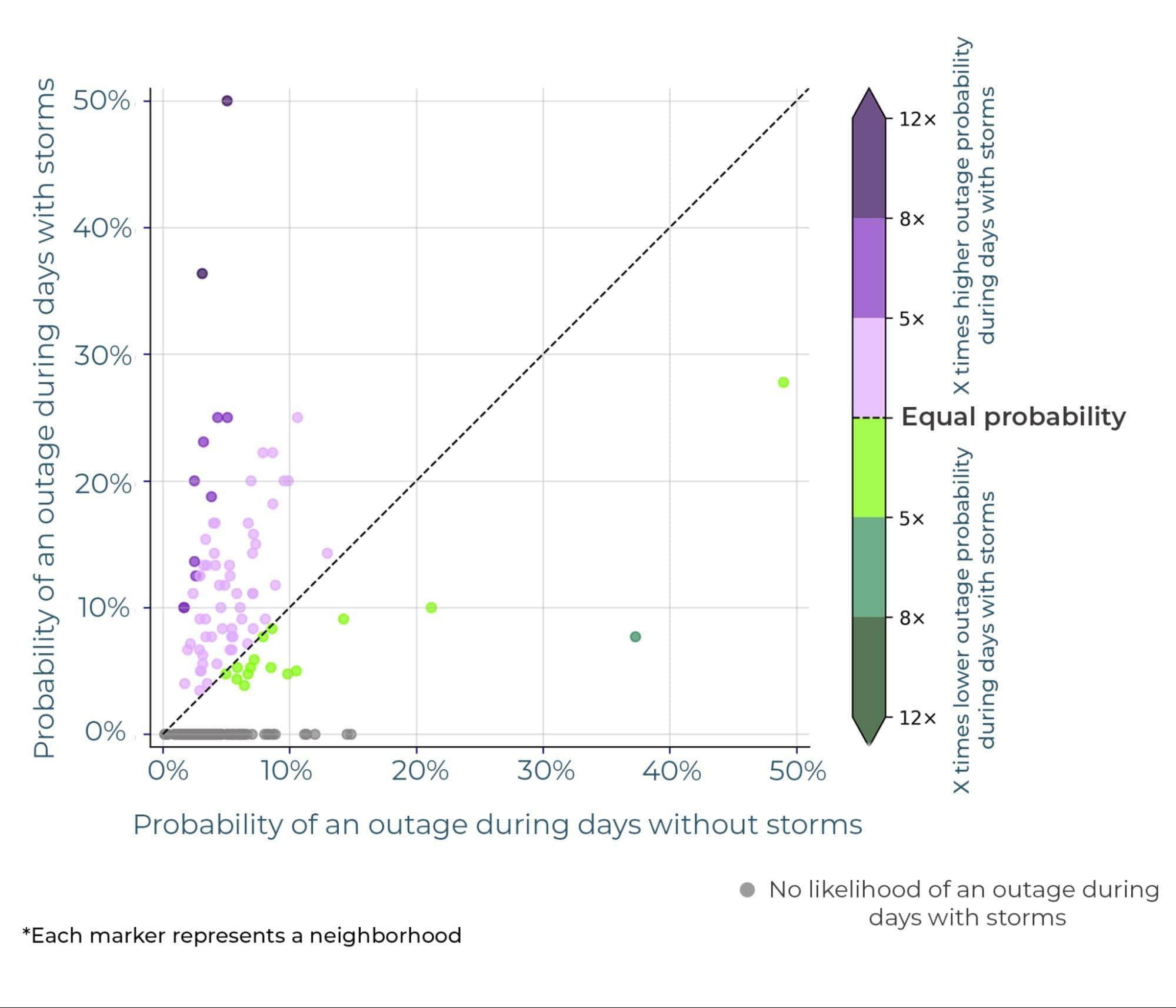
- Climate-related service disruptions vary widely across neighborhoods. Over the study period, only 39% of neighborhoods experienced outages during storms — defined as days with heavy rainfall (over 17 mm) and intense lightning (more than 6 strikes). Yet, in half of these neighborhoods, outage risks more than doubled relative to fair weather conditions. And in 10% of neighborhoods, outage risks jumped more than fivefold. In one particular neighborhood, the probability of an outage spiked to 50% during storms compared to just 5% in normal conditions (Figure 1). This heterogeneity likely reflects differences in local distribution infrastructure conditions, maintenance practices, and surrounding land cover.
- Climate-vulnerable neighborhoods experience disproportionate service disruptions. We characterized only 15% of Accra’s neighborhoods as highly climate vulnerable — meaning they have elevated flood risk, poor air quality, and high levels of informality associated with precarious living conditions and socioeconomic marginalization.10 But these areas bear a disproportionate burden of electricity service disruptions. During storms, they experience a 300% increase in outage risk, compared to 190% in low-vulnerability neighborhoods.
FIGURE 1: Increased likelihood of outages on extreme-weather days relative to normal conditions
Policymakers need better data, cross-sector coordination, and reforms to align electrification and resilience strategies.
Our study findings underscore two critical challenges: first, that extreme weather is likely a major driver of grid disruptions, and second, that the impacts of these failures are unequally distributed, compounding risks for already-vulnerable communities. Yet climate resilience and power sector planning too often occur in silos. National climate adaptation strategies and investments rarely prioritize resilient energy infrastructure.4 Climate vulnerability assessments seldom incorporate electricity reliability.5 And energy sector resilience strategies frequently overlook climate-risk indicators and unequal community exposure. This disconnect risks deepening inequality, leaving behind communities that are most at risk when climate shocks collide with grid failures.
Tackling these challenges requires moving beyond siloed planning. Key priorities include:
- Publishing existing data from measurement systems and enforcing transparency. Governments, utilities, and private sector companies should publish high-resolution climate and grid performance data already collected through smart meters, weather stations, and other multipurpose measurement tools. Regulators should mandate service quality performance disclosure and require utilities to contribute to open-access data platforms to enable climate-informed grid planning, targeted upgrades, and community-level resilience strategies. Development partners can support by investing in public data infrastructure.
- Developing guidance on grid hardening options and cost-benefit quantification. Utilities often have access to a range of grid hardening options with great variations in cost and performance. They would benefit from clear guidance on the efficacy of these options for addressing specific service quality issues. However, quantifying the cost-benefit tradeoffs of grid hardening is still in its nascency, particularly for high-impact, low-likelihood events. Regulators and energy ministries should collaborate with researchers to develop clear guidance, more open tools, and rigorous frameworks to support utility decision-making (and regulatory justification). Development partners can support this effort by funding pilot studies, convening technical working groups, and disseminating best practices across countries.
- Fostering a climate–energy community of practice. National agencies and development partners should establish cross-sector initiatives that link utilities, meteorological services, data scientists, AI researchers, and planners — building on established initiatives such as Forecast4Africa. Embedding utilities in climate-data initiatives can enable the co-design of predictive maintenance strategies and outage response plans informed by weather forecasts. Partnering with local universities can strengthen research capacity, support data analysis, and create pipelines for training the next generation of climate and energy professionals. This collaborative approach ensures that climate and grid data are translated into actionable insights for resilient, inclusive power system planning.
- Embedding climate resilience in electrification planning, standards, and regulation. Development partners, funders, and regulators should require that all electrification plans explicitly account for extreme-weather risks — an approach only recently gaining traction. National grid codes should mandate climate-impact assessments for new infrastructure, embedding climate resilience into design from the outset. Utilities should be required to conduct climate vulnerability assessments to prioritize investments in the most exposed communities and maximize resilience returns. At the same time, regulators should strengthen service quality mandates by setting clear reliability targets and enforcing them through financial incentives, penalties, or customer compensation — following models already in place in countries like Nigeria, Kenya, and Brazil.
Climate adaptation and grid resilience must be treated as two sides of the same coin. Power systems must be able to withstand a changing climate and actively support climate adaptation by delivering reliable service through climate shocks. This isn’t just smart planning, it’s a development imperative. The opportunity is clear: align climate adaptation and power system investments now to protect the most vulnerable and power a more resilient future.
*Note: In this study, we use a spatiotemporal, data-driven approach, where we combine ground-based weather observations8 with high-resolution, customer-level reliability data from nLine’s GridWatch sensors9, from 2022 – 2023, to construct aligned, hourly datasets of temperature, precipitation, wind, lightning, outages, and voltage conditions of the Greater Accra region. We define extreme weather events using percentile-based thresholds, map both weather and grid events to neighborhoods, and calculate how often outages occur on days with extreme weather events. Finally, we link these technical exposures with a locally tailored climate vulnerability index — capturing flood risk, air quality, and social vulnerability — to assess inequities in how climate hazards and grid disturbances jointly affect different neighborhoods.
Endnotes
- Global Center on Adaptation (2022). Climate Risks in Africa. States and Trends in Adaptation Report. https://gca.org/wp-content/uploads/2023/01/GCA_State-and-Trends-in-Adaptation-2022_Climate-Risks-in-Africa.pdf
- UNECA (2023). 17 out of the 20 countries most threatened by climate change are in Africa, but there are still solutions to this crisis. https://www.uneca.org/stories/17-out-of-the-20-countries-most-threatened-by-climate-change-are-in-africa%2C-but-there-are
- ESMAP (2024). Utility Performance and Behavior in Africa Today. https://www.esmap.org/Utility_Performance_and_Behavior_in_Africa_Today
- IEA (2020), Power Systems in Transition, IEA, Paris https://www.iea.org/reports/power-systems-in-transition, Licence: CC BY 4.0 https://www.iea.org/reports/power-systems-in-transition/climate-resilience
- Perera, A. T. D., & Hong, T. (2023). Vulnerability and resilience of urban energy ecosystems to extreme climate events: A systematic review and perspectives. Renewable and Sustainable Energy Reviews. https://doi.org/10.1016/j.rser.2022.113038
- Leck, H., et al. (2025). “Climate change: Crosscutting report”. ACRC Working Paper 2025-27. Manchester: African Cities Research Consortium, The University of Manchester. https://www.african-cities.org/wp-content/uploads/2025/03/ACRC_Working-Paper-27_February-2025.pdf
- WMP (2024). State of the Climate in Africa 2023. https://library.wmo.int/records/item/69000-state-of-the-climate-in-africa-2023
- https://tahmo.org/climate-data/
- https://nline.io/public-data/gridwatch
- Ouma, S., et al. (2024). “Informal settlements: Domain report”. ACRC Working Paper 2024-09. Manchester: African Cities Research Consortium, The University of Manchester. https://www.african-cities.org/informal-settlements/