


Why Did We Build This Platform?
Access to electricity is only valuable if it can improve quality of life, create jobs, and drive economic growth. Connecting people to a source of power is an important first step, but not the end goal.
While countries track initial access rates, the world historically has not had a way to measure what happens next. Post-connection, are people actually using electricity? How much over time?
If all we know is whether a building has an electricity connection or not, a home with one light bulb looks the same as one running a fridge and a TV or one using electricity to run a growing in-home business. Progress isn’t binary, so we shouldn’t measure it that way. Measuring consumption would allow us to track how much electricity people actually use, and whether they’re consuming electricity at higher, more productive levels.
But there’s a data gap.
Everybody agrees electricity consumption is an important indicator of access quality. The World Bank’s Multi-Tier Framework (MTF) sets five levels of quality, each with an implied consumption level. The Energy for Growth Hub’s Modern Energy Minimum proposes a threshold of 1000 kilowatt-hours (kWh) per person per year, with one-quarter used at home.
But historically, we’ve never had a way to measure it. We haven’t had consumption data in every country — or consistently year after year. MTF household surveys are very detailed but expensive and infrequent. Utility data is patchy, while many customers aren’t metered at all. That left institutions counting connections because that’s all they could track.
Until now.
We built Open Energy Tracking, a tool that uses geospatial, machine learning-trained data to measure a population’s annual electricity consumption, to solve this problem. Open Energy Tracking estimates the population at each of the five tiers of the World Bank’s MTF. For the first time, we know not just whether people are connected to power, but how much electricity they actually use — and whether they are moving up the ladder over time.
How Open Energy Tracking Works
Open Energy Tracking is built on Open Energy Maps (OEMaps), a Hub-supported machine learning-enabled platform that estimates the electricity consumption of every mapped building in (nearly) every low- and middle-income country. OEMaps combines hundreds of remote sensing features from more than a dozen data sources, including high resolution satellite imagery, nighttime lights, building footprints and features, and internet speeds. It learns how those signals relate to real electricity use by training on metered consumption data from utility partners.
Open Energy Tracking turns these millions of building-level estimates into a calculation of how many people within any given country consume electricity at each World Bank tier.
To do this, the model first filters out clearly non-residential buildings, such as large commercial and industrial users. It then adjusts for the messy reality on the ground: apartment blocks where many households share a building, and clusters of homes that share a single meter. Next, it reshapes the household consumption distribution using patterns learned from utility-reported consumption ranges, which helps the model generalize across regions. After that, it scales the distribution so its average matches national figures for residential electricity use. Finally, it converts household consumption into per-person estimates, so each country’s population can be sorted into each of the five MTF tiers.
The model is continuously updated with better information and validated against meter data, surveys, and regional statistics.
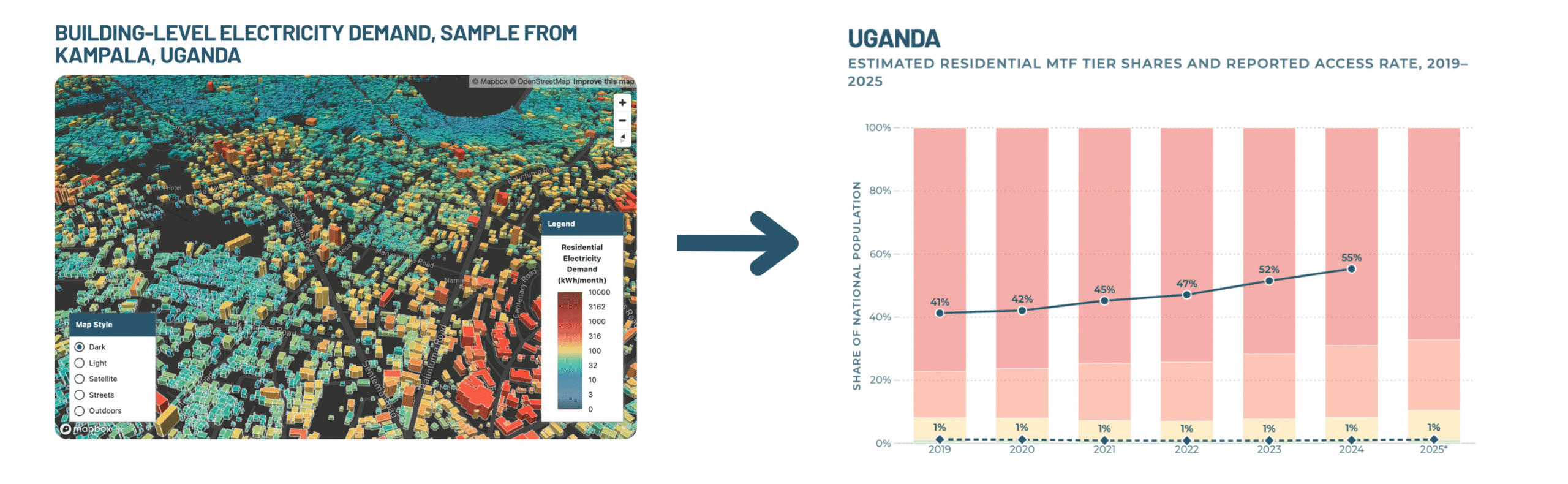
A look at Open Energy Maps (left), which powers Open Energy Tracking (right).
Users can see which countries are making progress — meaning that greater shares of their populations are consuming at higher tiers — and which countries remain stagnant. This tool can guide practitioners on where to direct investments in electricity infrastructure that can stimulate economic growth, or growth in higher, more productive electricity tiers.
Can we trust the data? In tests in East Africa, OEMaps’ demand estimates cut error by 15 to 46% compared with the World Bank’s Global Electrification Platform. The platform correctly identified whether a building had electricity 81% of the time, compared with 71% for the next-best model. And our country-level Tier 4 estimates closely track national poverty rates, even though the two are measured completely independently.
Read more about the methodology here.
A Look Inside: Country Snapshots
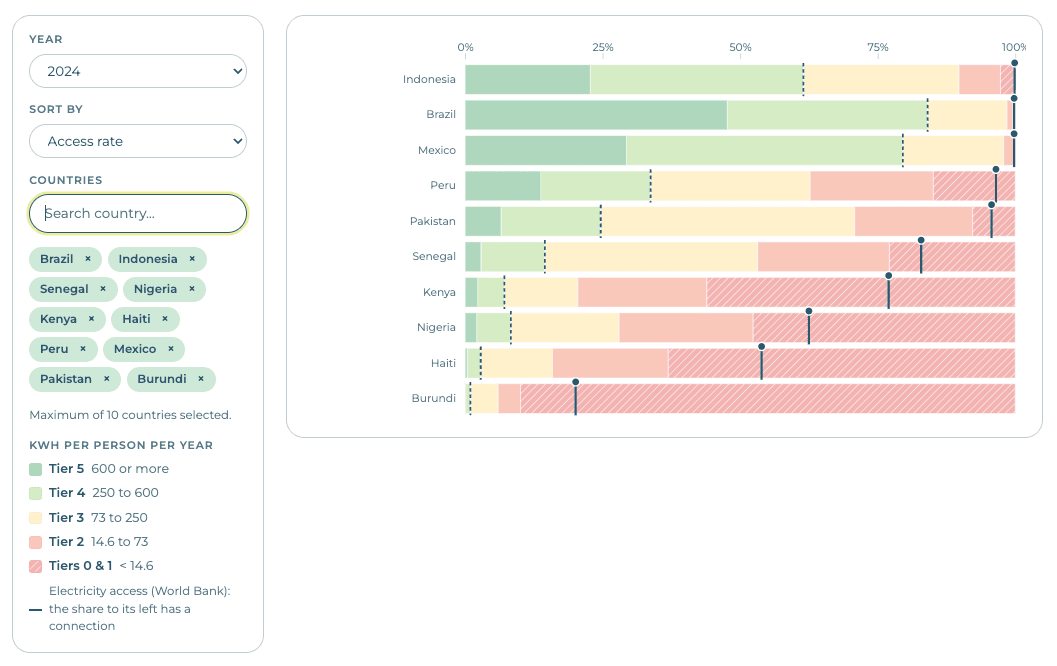
Access doesn’t tell the whole story: Countries with near 100% basic access still have low shares of the population consuming at Tier 4 or higher.
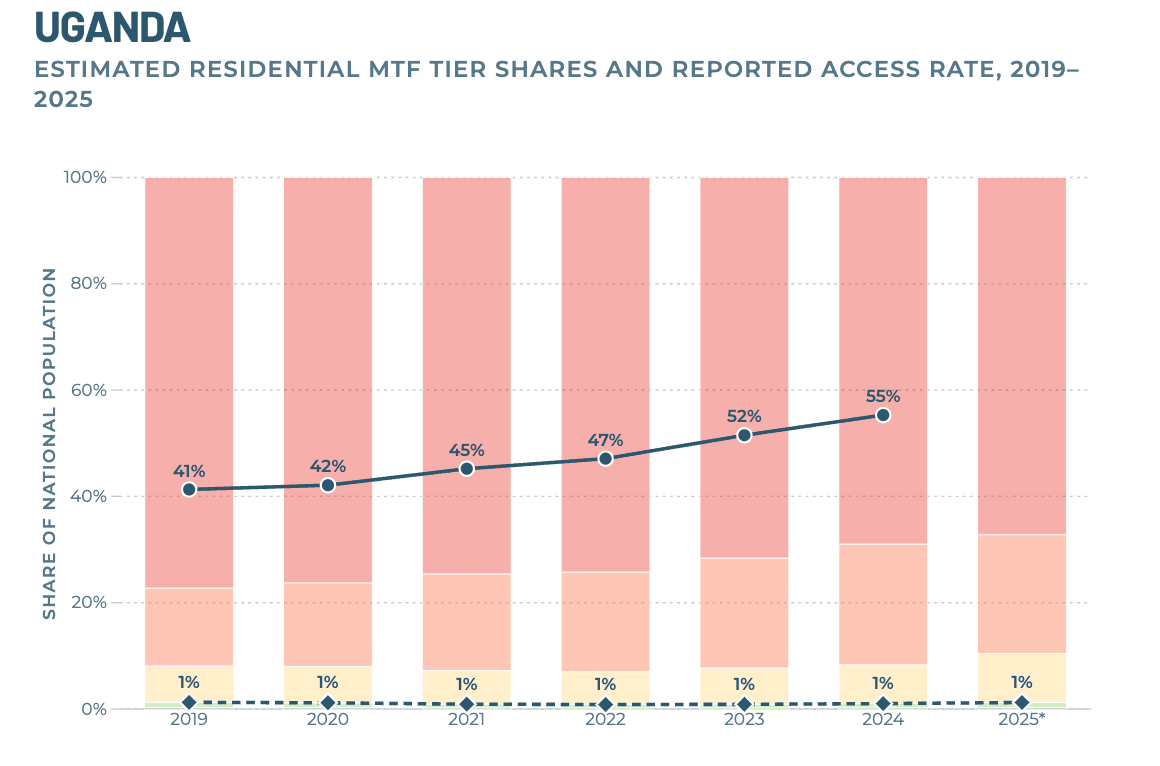
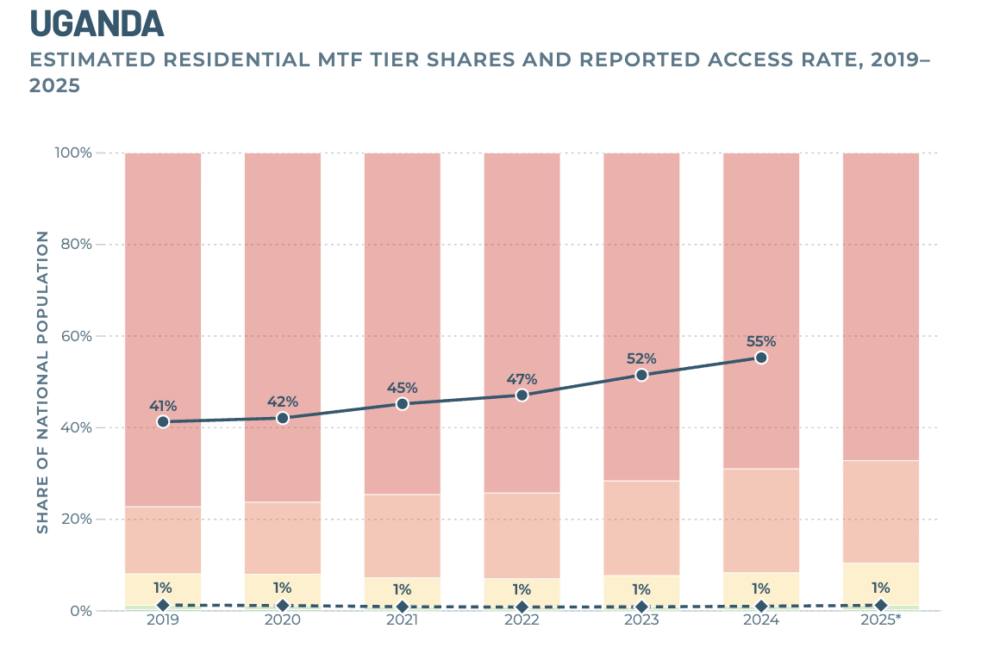
Progress over time: Are people moving up the ladder? Uganda has made strides in improving basic access, but progress in higher tiers correlated with productive use remains stagnant.
Who Might Use Open Energy Tracking?
Open Energy Tracking is built for people making decisions and directing resources to improve electricity: government officials, Mission 300 compact teams, development banks, investors, philanthropies, and researchers. It is especially useful as a monitoring and evaluation tool for programs that aim to create jobs and drive growth with better quality electricity supply. Tracking all five tiers of consumption enables governments, utilities, and donors to spot gaps, target interventions, and chart progress over time. The full dataset covering every country is free to download.
What’s Next?
We are currently sharing Open Energy Tracking with M300 compact implementation teams, leaders in African governments, development banks, UN affiliates, and other practitioners. In the coming months, we’ll release analysis on consumption data and trends, exploring themes like inequality, which countries are expanding electricity consumption, what electricity use looks like in countries with key industries like critical minerals, and provide bespoke analysis for interested country teams. We’ll also release a whole new dataset for the Modern Energy Minimum, showing which countries are getting closer to 1000 kWh per person.
Connecting people to electricity is a great start to ending energy poverty. Now we can measure what comes next.
Author’s note: Thank you to the many partners, donors, friends, and former Hub colleagues who made this work possible.