

When the president of Namibia came to New York this fall for the United Nations General Assembly, she called out foreign investors for simply extracting and exporting the country’s critical minerals.
“When you are coming to Namibia, you don’t want to be a briefcase business,” she told Semafor at a side-event following her address.“You have to put up a processing plant in our country.”
She joins many other African presidents from Nigeria, Gabon, Ghana, Kenya, Zambia, Sierra Leone, and Tanzania who have made similar calls over the past year. While African leaders’ admonish foreign investors, ordinary Africans are frustrated with their own governments for failing to turn this demand for the continent’s resources into value-addition, growth, jobs, or benefits for citizens.
What’s at the very heart of this problem ? Electricity — or the abiding lack of it. Costly electricity prices and unreliable or unavailable power supply across mineral-rich African countries are raising mining costs or pushing some existing facilities to relocate or close down entirely. It’s not just mines; firms and businesses of all kinds need sufficient, reliable, and affordable power to grow. Without it, economic activity stalls, and many countries get trapped in a low-energy, low-growth cycle.
Reversing this vicious cycle is possible if policymakers think differently about energy demand — starting with understanding the different types of demand and how they work together.
To Reverse Africa’s Low-energy, Low-value Addition Cycle, Old Demand Assumptions Must Go
African leaders often make two assumptions about energy demand that feed the low-energy, low-value addition vicious beast.
The first is the age-old ‘build it and they will come’ approach. They prioritize building large power assets, trusting paying demand will surely follow. But this is not guaranteed. Ethiopia, Uganda, and Tanzania, for example, have all expanded installed capacity, yet some of this power is offline because their utilities lack paying customers or can’t actually get the power where it needs to go.
The other equally flawed approach is one we’re calling ‘promise growth, assume power.’ Governments, like Zambia and Democratic Republic of Congo, set ambitious raw material bans, and local content targets, only to turn around and grant mining operators waivers when local processing facilities struggle to find affordable and reliable power to meet those requirements.
Both approaches fail to understand demand as the connective tissue between power infrastructure and economic goals. Building power does not guarantee demand for that power will materialize. Setting industrial targets does not guarantee that power will follow. And simply bringing the two together does not achieve growth. The right demand must be matched to the right energy system and economic objective.
To Maximize Energy and Economic Outcomes, Understand Demand Center Types First
Different types of ‘demand centers’ offer different benefits, and recognizing this fact gives African decision-makers real power: they can strategically target, attract, and combine demand centers to meet their energy and economic objectives.
What’s an ‘energy demand center’? It’s a fancy term for either one large or a collection of several existing or potential power consumers. No two demand centers are alike; they differ in how they use power and what they do for the energy system and economy. A mine, for example, needs lots of power but can also help finance large energy infrastructure by committing to long-term offtake. As a result, policymakers may offer them discounted prices. Small and medium enterprises, on the other hand, cannot offer the same long-term certainty. But they often pay the full cost of power, strengthening utility revenues and creating more economic benefits through jobs than increasingly mechanized mines.
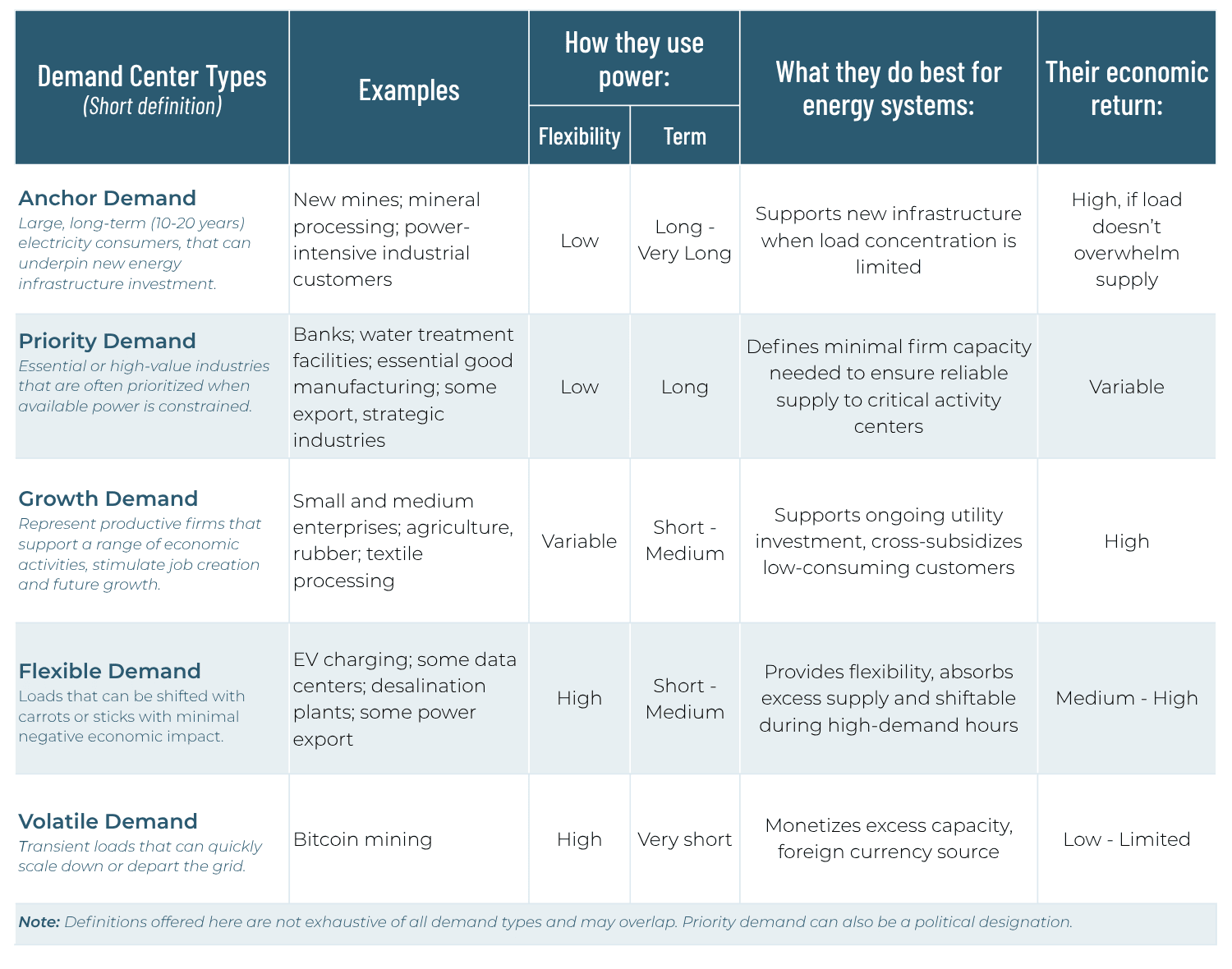
Here are five types of energy demand centers to help policymakers map out economic outcomes:
- Anchor Demand: these are large, long-term (10-20 years) electricity consumers, like new mining facilities, that can underpin new energy infrastructure investment.
- Priority Demand: are essential or high-value facilities, like strategic or export industries (for example, a national airport or perishable goods export), that are often prioritized when available power is constrained.
- Growth Demand: represent productive firms, like textile processing and small & medium enterprises, that support a range of economic activities and often stimulate job creation and future growth.
- Flexible Demand: are loads that can be shifted with carrots or sticks with minimal negative economic impact, like EV charging.
- Volatile Demand: are transient or price-sensitive loads that can quickly scale down or depart the grid, like bitcoin mining.
Table 1: Choosing Demand Centers: What each type offers the power system and the economy
Energy Demand Centers Always Form a Mix. The Question Is Who Chooses It, and to What End
Ditching false assumptions and identifying demand centers is not enough to turn up the value-addition and growth. Foreign investors and project operators approach governments one deal at a time: a data center here, a new mine there. But demand centers don’t operate in silos; they function as a stack. When deliberate design is missing or left to outside actors — or actors whose priorities are not necessarily local, long-term economic benefit — demand centers can assemble “organically” in less than optimal ways, often producing poor outcomes.
As demonstrative examples, consider these strained demand stacks, requiring critical policy intervention to remedy:
- An anchor-heavy demand stack strains utility finances and growth by committing large amounts of firm power to long-term customers at discounted rates. For example: Ghana allocated 70% of Akosombo hydropower to aluminum smelting in the 1980s at a steep discount, making it near impossible for the utility to recoup its costs. The remedy: Policymakers can use volatile and flexible demand to bolster utility revenue in the short-term, while expanding generation for the long-term.
- A volatile-heavy demand stack ties up power in low-economic return activities. For example: Ethiopia provides large power to bitcoin miners, generating foreign currency for the utility but providing few jobs and little service to the local economy. The remedy: Policymakers can gradually dial down volatile demand, protecting utility revenue during the transition while redirecting power to growth demand centers.
- A priority-heavy demand stack compounds power and economic shocks by locking supply to inflexible demand. For example: In Zambia, mining generates a large share of domestic revenue while consuming a substantial share of electricity. When a drought in 2024 collapsed Kariba’s hydropower output, utility revenue drastically fell and the government and mine operators scrambled to buy power at two to five times the usual price and deprioritized other economic activities. The remedy: Policymakers can simultaneously expand energy infrastructure and diversify their demand stack using anchor demands.
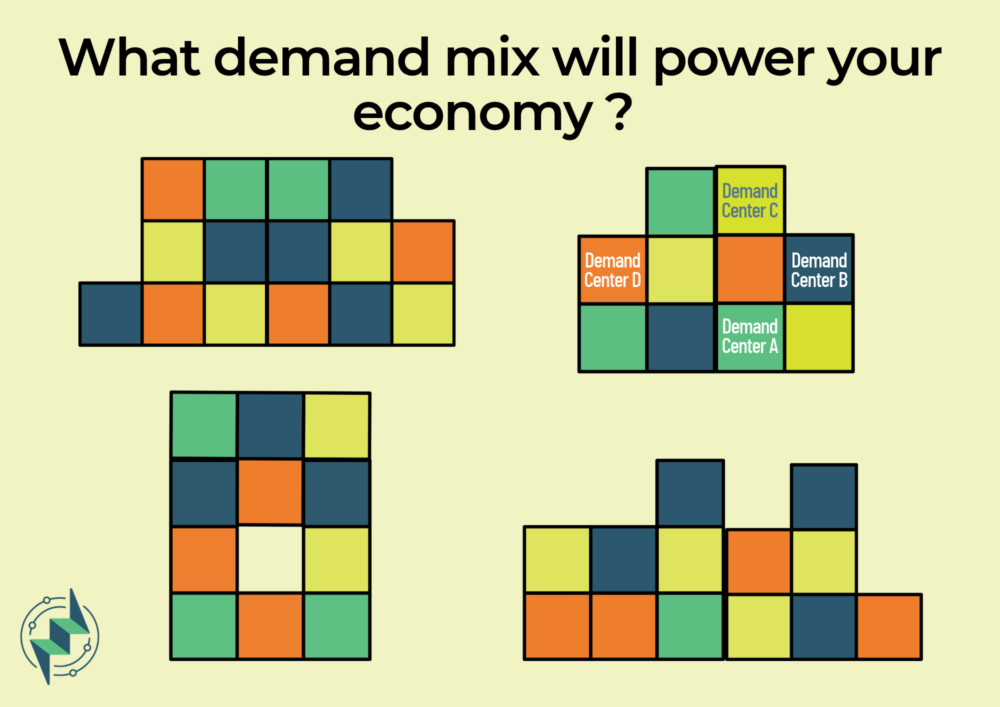
Figure 1: Graphic illustration comparing ideal, pro-growth demand mix with less-than ideal demand mix scenarios.
With the Right Energy Demand Mix, African Leaders Can Fuel Local Value Addition and Durable Growth
The strained archetypes above are simplified, but they reflect some reality. African energy systems cannot afford to lurch from one imbalanced stack to another. African decision-makers can design their country’s demand stack to set off a virtuous cycle where energy demand from different centers drives energy investment and the new and improved infrastructure powers economic growth. That growth — through utility revenue, jobs, and better income — pays for the next round of investment to supply new demand and perpetuate more growth.
More tangibly, that means:
- Stop treating demand as one load with binary outcomes, focus on demand policy at large. Different types of demand bring different benefits and risks. It is policy, or lack-there-of, that ultimately determines whether demand centers help or hurt energy availability and price — and the broader economy.
- Make deliberate choices about demand centers to match national economic goals. African leaders cannot afford to wait for “good” foreign investors to add value, or chase the latest critical mineral, hydrogen, or data center demand hype. Instead, they must start from their economic goals, work backward to the energy system needed to reach them, and court the demand centers that connect where they are to where they want to be.
- Every new demand deal must be seen as part of the collective. African governments and finance ministries assess financial deals against the government’s broader balance sheet, weighing new revenues against existing costs and obligations. They should treat energy the same way: every investment deal adds power commitments that must be weighed against existing commitments and supply before — not after — a deal is signed.
- Utilities must make the demand stack visible. African utilities understand both the short- and long-term pressures and capacities of a country’s energy infrastructure. Making this information visible to senior decision-makers across sectors can help ensure new demand is paired with the right infrastructure and revenue arrangement to sustain it and maximize its economic value.
African political leaders can shout from their bully pulpit, but foreign investment in value addition cannot happen without the necessary power infrastructure. Turning Africa’s resources into jobs and growth requires decision-makers to abandon the ‘build it and they will come’ and ‘promise growth, assume power’ approaches to energy demand.
Instead, using different demand types as building blocks, policymakers should assess their current demand stacks, define the stack that serves their national economic goals, and design policies to bridge the gap between the two.