Our recent memo, Sizing Africa’s Shadow Power System, estimated the size of Africa’s massive diesel generator footprint. Although these gensets are everywhere on the continent, no national or global database captures their full scale.
After we presented our findings at the Future of Energy Conference in Accra, the work sparked many conversations with peers, energy thinkers, and journalists. These discussions made one thing clear: we need to extend this analysis to understand how consumers, utilities, and governments are navigating this expensive, emissions-intensive, distributed diesel power system paralleling the electricity grid and other alternatives.
That means we have more questions to answer.
The Recap: Africa’s Diesel Footprint Is Massive
Before we go to those new questions, let’s review what we know so far.
How big is Africa’s diesel power generation footprint?
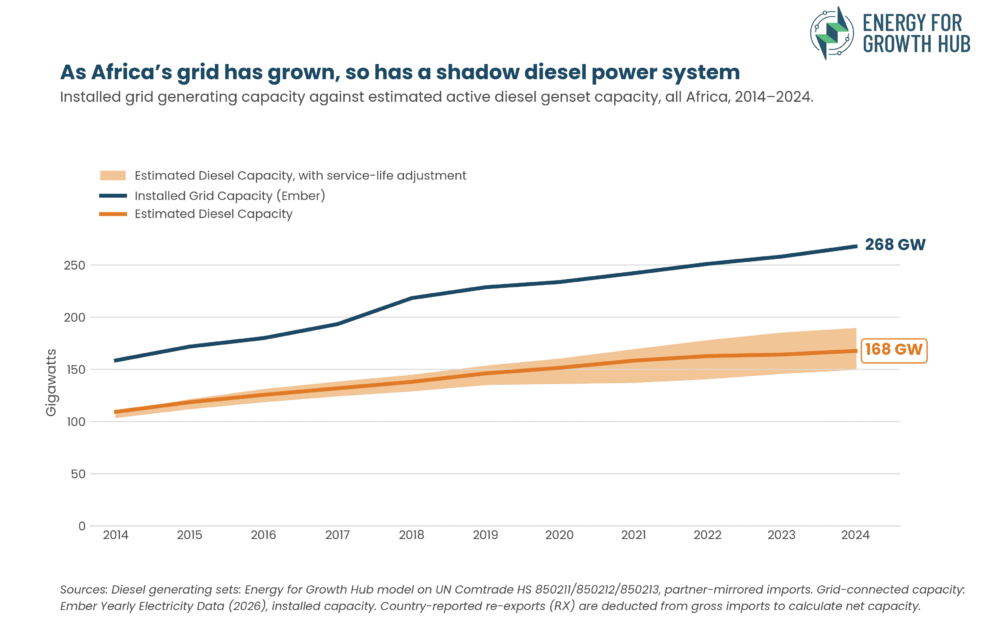
Almost as big as the grid. With no comprehensive database tracking diesel generators, and gensets too small and dispersed to geospatially map, we used generator import data to estimate their scale. We believe Africa’s operational diesel generator capacity is 150–190 gigawatts (GW), equivalent to more than 60% of the continent’s ~270 GW of grid generation capacity. Of course, installed capacity doesn’t mean generated power for the diesel fleet or grid capacity. But absent better data, this offers a reasonable asset-to-asset comparison.
Backup diesel generation is so common; why call Africa’s a ‘shadow grid’?
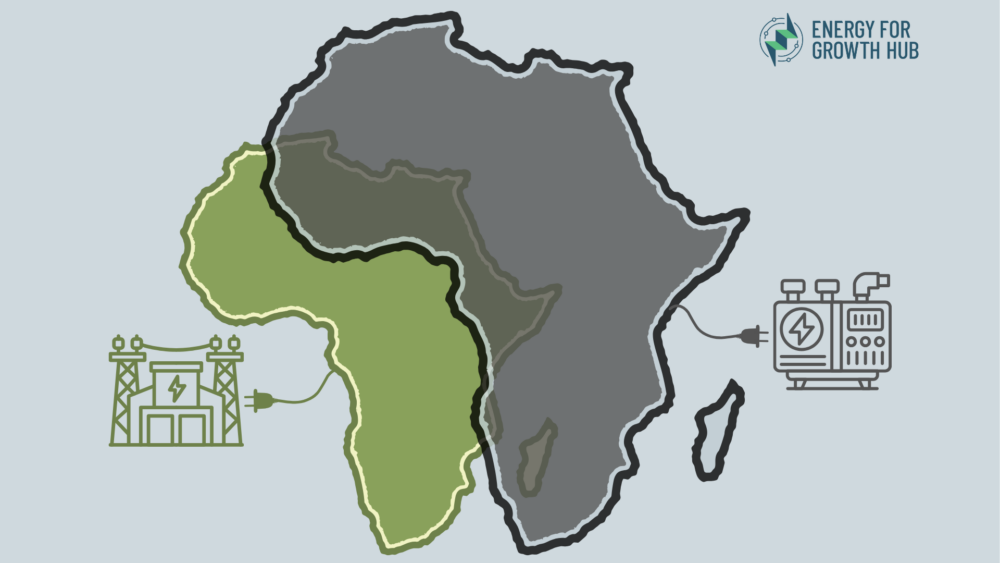
Because its scale defies norms. It’s common, and even wise, for certain businesses to possess diesel generators, even in well-functioning grids. Residents, especially in urban centers in countries with reliable power, however, often have little need for backup generators. That is not the case for many Africans; fewer than half enjoy reliable electricity, and seven out of ten commercial and industrial firms report experiencing outages. The extent of this insecurity shows up most acutely in 26 sub-Saharan countries, most with limited manufacturing, low- and lower-middle-income economies, and struggling utilities, where backup diesel generation capacity is between one and eight times the size of their grid, far surpassing global norms.
But aren’t these diesel gensets expensive?
Yes, but power insecurity costs more. By our rough calculation, African importers spent at least $26 billion to acquire these generators between 2000 and 2024, not including the cost of diesel fuel, which has gone up 40% or more since the US-Iran war began. Yet consumers in African countries with both low and high electricity tariffs continue to invest in diesel generators. They’re not necessarily trying to save money; they’re paying a premium for reliable power. Research from Senegal, India, and California provides evidence of this willingness to pay; generator ownership serves as a powerful signal of demand for reliable power.
Open Questions: Backup or Baseload, Solar’s Role, and Utility Impact
Knowing the scale and cost of Africa’s diesel generator fleet doesn’t tell us how consumers use it in tandem with the grid, how it interacts with alternatives like solar, or what it means for utilities. Some questions we need to explore next:
Are consumers buying gensets for insurance or as baseload power?
Hypothesis to test: More of Africa’s diesel fleet is running like baseload than as backup power, especially for reliability-sensitive firms.
In trade records, a generator at a hospital only running during 30 hours of downtime a year looks identical to a same-sized generator at a mine running 10 hours a day as primary power. How heavily consumers use these generators depends on diesel availability and cost, grid reliability and power quality, and access to alternatives like solar and batteries. It also depends on the type of consumer: large, export-oriented, and power-sensitive industries may rely more heavily on diesel generation to keep operations running or avoid equipment failure. Our model estimates installed capacity (gigawatts), not actual electricity generation (gigawatt-hours). To answer this question, we’d need to estimate utilization by combining our genset import model with fuel import and outage data surveys; experimentally, satellite nighttime lights measurements can help here too.
Solar is booming in Africa; is it replacing diesel, or adding to it?
Hypothesis to test: For now, solar is adding to diesel, not replacing it. Firms will likely move in three steps: diesel for reliability, add solar to cut costs, then install solar plus battery storage to displace diesel when fuel costs get too high. Most African consumers are likely between steps one and two.
Solar is taking off across Africa, yet diesel capacity has still been growing by 9 to 12 gigawatts a year. African firms often hedge their power risks through redundancy. In one South African survey, roughly 98% of businesses had a generator and about half also had solar. With so much suppressed or unmet demand, there’s likely room for both. Diesel keeps operations running when the grid fails, while solar helps lower electricity costs but cannot always meet demand without storage. Solar-plus-battery systems are also emerging as a more direct alternative to diesel. A closer look at genset imports, solar imports, and satellite-mapped solar installations by system size could help us understand how these technologies complement or displace one another.
How does prevalent diesel genset impact utilities?
Hypothesis to test: Utilities aren’t losing customers; rather they are losing their most valuable customers’ demand. Total demand keeps growing, but high-volume customers are buying less grid power in favor of diesel and, increasingly, solar. Many utilities may have an opportunity to compete to win it back.
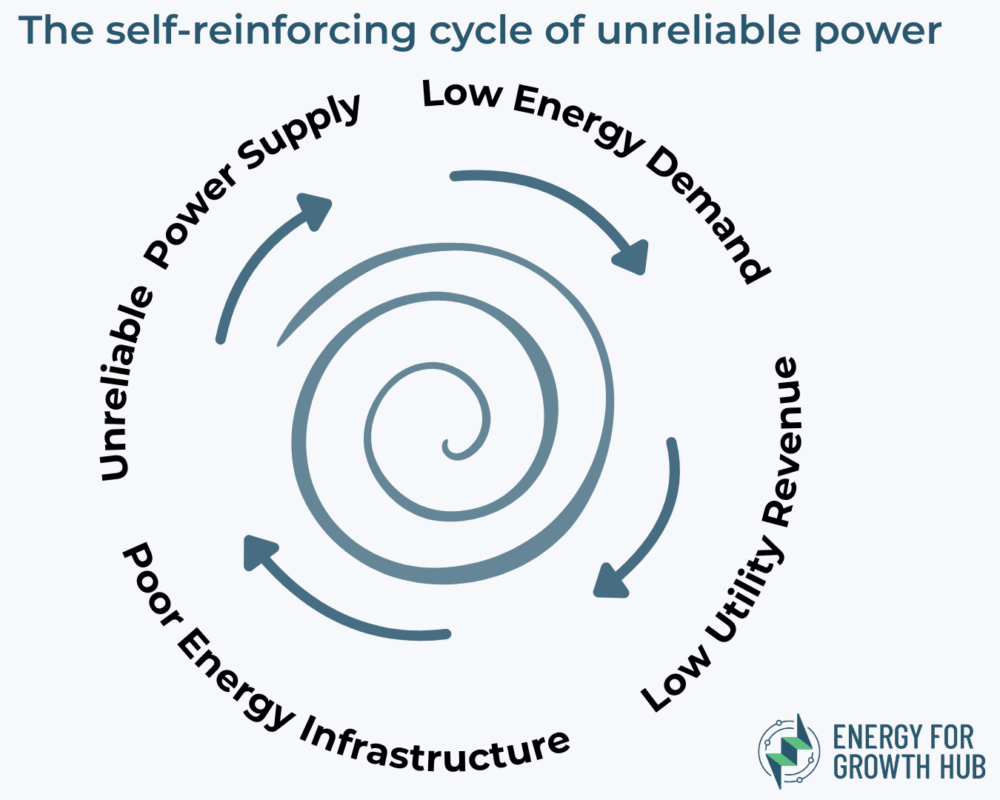
Electricity customers who require 100% uptime, like hospitals and telecom towers, would own generators even with a perfectly reliable grid. Others run generators daily because the grid lets them down. Winning back either group doesn’t mean convincing individuals and businesses to scrap their generators. It means giving customers fewer reasons to use those generators, allowing existing units to remain on standby and reducing the need for new ones over time. This matters because as more Africans gain access to electricity, utilities may serve more customers even as those who can afford generators draw less power from the grid or leave it altogether. Utilities risk losing revenue from their highest-paying customers while the costs of maintaining and expanding the grid continue to grow. Comparing public utility tariffs with the cost of supply from diesel and solar could help identify which utilities have the most revenue at risk.
Where We Go From Here
Illuminating the size of Africa’s shadow grid was just the first step. Many more impactful questions lie beyond capacity: how heavily these generators are used, how they interact with other power sources, and what this means for businesses, utilities, policymakers, and, ultimately, growth. We’re now working with Hub fellows Professor Jay Taneja at University of Massachusetts Amherst and Joel Nana, PhD at African Tech Futures Lab and Sustainable Energy Africa to use satellite solar mapping and reliability measurements to help us understand the evolution of the shadow grid. Stay tuned for more, and let us know if you have data, questions, or ideas. We’d love to hear from you.
Special thanks to Murefu Barasa and EED Advisory for sparking these follow-up discussions, and to Jay Taneja and Joel Nana for their thought partnership and ongoing research insights.