
Why this matters: Kenya launched its Green Hydrogen Strategy in 2023 with a goal of applying its renewable resources to the domestic production of hydrogen-derived products like fertilizer, focusing on standalone energy sources disconnected from the grid. Since then, the government has introduced incentives and regulatory guidelines to encourage investment. At the end of 2025 — with hydrogen costs still high, global investment cooling, and four proposed projects stalled in early development — the Kenyan government announced the start of construction on just one project, powered by a dedicated 165 MW geothermal power plant. This memo uses recent modeling work by Xi Xi and co-authors to argue against a standalone hydrogen production strategy in Kenya, and for a more integrated approach.
Kenya’s standalone hydrogen production strategy is costly
Kenya’s hydrogen strategy has three core problems:
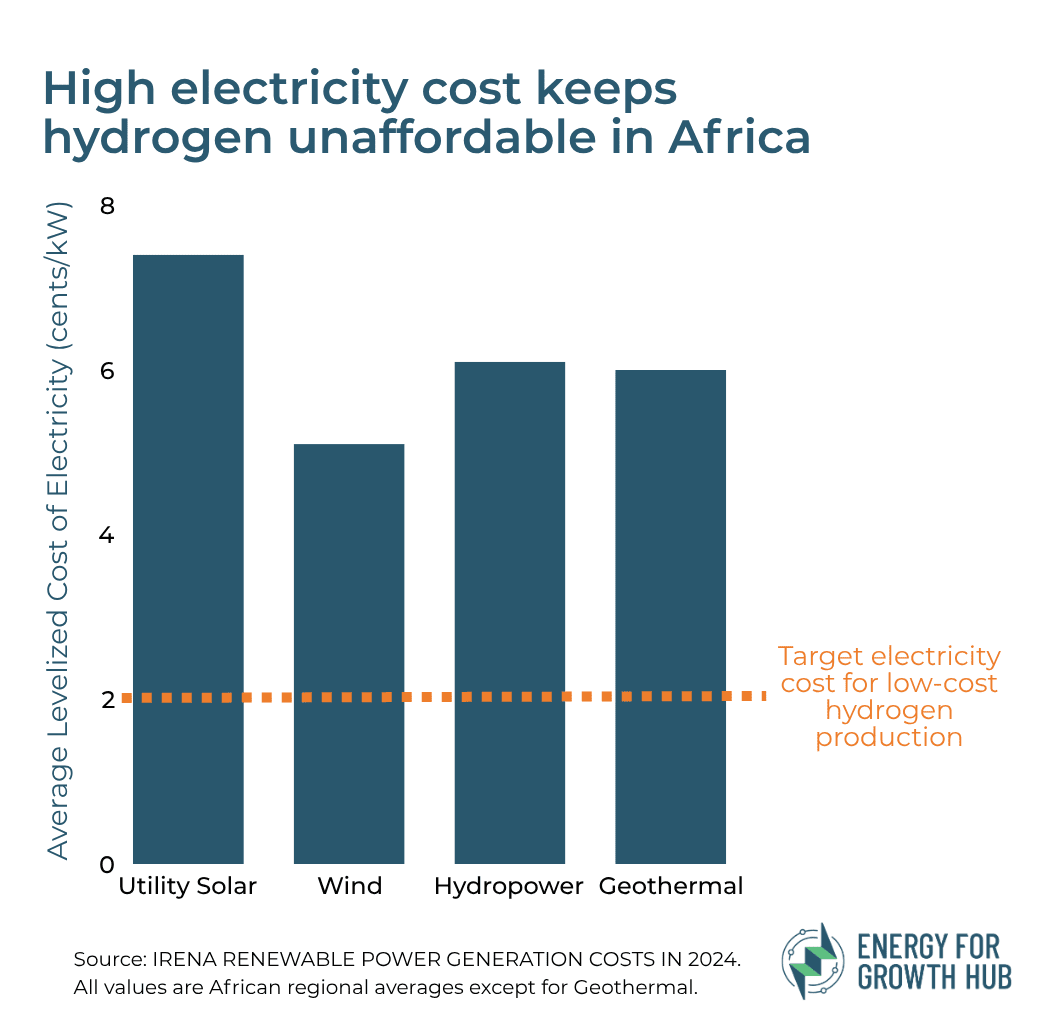
- Using dedicated renewables for hydrogen production raises costs. Most of the Kenyan hydrogen projects announced since 2023 rely on new geothermal or solar capacity (see table below). Electricity accounts for up to 70% of hydrogen production costs, and large-scale renewables remain 2–3 times more expensive than what is needed for low-cost hydrogen. While scaling can reduce costs, it requires high upfront capital and risks locking in production without confirmed buyers. Storage and transport infrastructure further increase cost. Hydrogen will remain expensive without major cost reductions in electrolyzers and renewables.
- Renewable hydrogen-based fertilizer would remain unaffordable for locals. Estimates from the World Resources Institute show fertilizer produced in Kenya from renewable hydrogen would cost well above current prices (excluding the impacts of shocks associated with the U.S.-Israeli attack on Iran in March 2026). For local farmers, who already pay nearly twice as much as global prices, high-production costs would mean a prohibitively inaccessible fertilizer market.
- Treating hydrogen as a standalone sector to be built at any cost is risky. Kenya’s hydrogen strategy narrowly focuses on fertilizer and methanol production, without considering cost, viability, demand, early adoption risks, or interaction with the broader energy and industrial sector. Without a serious account of these factors, Kenya is on the path to building a sector that is high cost, high risk, and has limited spillover benefits.
Grid-integrated hydrogen provides greater benefits than standalone
Xi Xi and co-authors modeled Kenya’s future electricity system with grid-connected hydrogen and standalone hydrogen. They found that grid-connected hydrogen, with technology cost declines, lowers both hydrogen production costs and total electricity system costs by:
- consuming excess power and producing hydrogen during low-cost electricity times,
- enabling demand shifting for Kenya’s growing variable solar and wind adoption,
- allowing generators to operate at higher utilization, lowering the cost of electricity, and
- being deployed as local power sinks near expanding generation sites where transmission development is either difficult or more expensive.
This study showed grid-connected electrolyzers reduce levelized electricity costs in Kenya by more than 17% and generate more than $135 million in cumulative system cost savings by 2050, while producing hydrogen that is at least as cost-competitive as standalone projects.
Kenya: Ditch standalone solutions; grid-integrate hydrogen instead
To meet its long-term food security and affordable power goals, Kenya should pursue grid-integrated hydrogen, where it fits within industrial strategy. In the near-term, Kenya should:
- Avoid promoting green fertilizer before costs fall to sustainable levels through technological breakthroughs, risk reduction, or a decline in energy project costs in Africa.
- Focus on reducing the cost and improving the reliability of the grid, as it is the largest cost determinant for hydrogen production and a bottleneck for economic growth.
- Be a regional first-mover but a global second-mover on hydrogen. Technology risks and costs have to decline to make hydrogen projects (on- or off-grid) financially viable. Kenya can avoid the costs and risks of early adoption while developing readiness by : (1) using pilot projects to build technical and institutional capacity and reduce soft costs in permitting, procurement, and project development and (2) monitoring global advancements, maintaining partnerships with other countries, and shaping hydrogen certification standards.
Endnotes
- GeoEnergy, T. & Cariaga, C. Kaishan signs steam supply agreement for 165-MW geothermal green ammonia facility in Kenya. https://www.thinkgeoenergy.com/kaishan-signs-steam-supply-agreement-for-165-mw-geothermal-green-ammonia-facility-in-kenya/ (2025).
- Green Hydrogen Strategy and Roadmap for Kenya. (2023).
- Sawhney, R., Ireri, B. & Sterl, S. Transition’s Harvest: The economics of green hydrogen use for fertilizer production in Kenya. WRIPUB https://doi.org/10.46830/wriib.24.00064 (2025) doi:10.46830/wriib.24.00064.
- Meron Tesfaye. Green Hydrogen for Africa’s Food Security? The Wrong Solution for the Right Problem. Energy for Growth Hub. https://energyforgrowth.org/article/green-hydrogen-for-africas-food-security-the-wrong-solution-for-the-right-problem/ (2025).
- Xi, X., Kinyanjui, B. & Kammen, D. M. Risks and Benefits of Grid Expansion and Green Hydrogen in and for Kenya. Manuscript Submitted.
- International Energy Agency. Global Hydrogen Review 2025. https://www.iea.org/reports/global-hydrogen-review-2025 (2025).
- Malhotra, A. & Schmidt, T. S. Accelerating Low-Carbon Innovation. Joule 4, 2259–2267 (2020).