BLUF: An Energy Security Pact with Poland would facilitate private US investment in Poland’s energy sector, strengthening the energy security of a critical ally with a growing economy. Skyrocketing energy demand in Poland, driven by electrification and digitalization — including from US data centers in the “Polish Digital Valley” — presents a market opportunity for US firms to meet the country’s energy demand and security needs. Companies like Westinghouse and GE Vernova have already brokered deals with Poland to jumpstart its nuclear sector with American technology. An ESP would create a holistic government package involving 1) direct investment and project financing; 2) sharing of technology, expertise, and US regulatory standards; and 3) commercial and diplomatic engagement to bring advanced American energy technology into Poland’s growing energy sector.
What Is an Energy Security Pact?
An Energy Security Pact (ESP) is a bilateral investment package by the US government, alongside private sector partners, in the energy system of a strategic priority country. The partner country must commit to co-investing with the United States and undertaking structural or regulatory reforms. The Pacts coordinate US tools across direct investment, private sector participation, and US technical expertise to grow priority energy markets while supporting partner countries’ economic growth. These Pacts enable the United States to make targeted investments that advance both energy goals and core foreign policy priorities.
Why Poland?
Bolstering the energy security and grid capacity of Poland — the European Union’s sixth-largest economy, NATO ally, home to 10,000 US troops, and host to a growing digital economy run partially on US hyperscalers — is a vital commercial and strategic opportunity for the United States. With a strong national grid system and liberalized power sector, Poland has the capacity to absorb US investment without years-long, multi-million dollar technical assistance to ready the power sector for investment and new technology. Even in higher income countries, a coordinated US investment pathway through ESPs can facilitate more US commercial investment in attractive and crucial energy sectors.
Incorporating alternative fuels is both a national security and economic priority for Poland. Poland currently meets up to 70% of energy generation through domestic coal and imported oil and gas — increasingly a vulnerability in the country’s domestic energy landscape. Furthermore, given the EU’s strong emissions abatement rules, the carbon tax on coal gets passed onto Polish ratepayers. Poland has committed to adding 6-9 gigawatts (GW) of nuclear power to meet rising energy demand with emissions-free, domestically-produced baseload power.
US nuclear companies have already stepped up to meet this moment. In 2023, the United States pledged $4 billion in project preparation support for Poland’s nuclear sector. In 2025, Westinghouse and Bechtel signed a $51 billion deal to develop Poland’s first nuclear power plant, adding 3.75 GW of clean, firm power to the grid and contributing to Poland’s 6-9 GW total target with construction to begin in 2028. And, in February 2026, GE Vernova Hitachi signed an agreement with Poland to deploy its US-developed small modular reactor (SMR) design — the BWRX 300 — in partnership with European companies. The Westinghouse-Bechtel deal is just one instance of meeting a fraction of Poland’s energy needs with US tech; an ESP would make this type of deal more routine.
What Would the United States Gain?
Support the energy security of a strong NATO ally. Nuclear energy would foster domestic energy security, reduce reliance on foreign imports, and provide an alternative to expensive domestic coal.
Expand commercial opportunities for US firms in a rapidly growing economy. Poland’s economy is growing at almost 4% — more than double the Eurozone average — largely driven by digitalization and electrification, with a data center market valued at $6.7 billion. An ESP would position US SMR technology as the regional standard and build on existing partnerships and expansion plans across Central and Eastern Europe, like Westinghouse in Slovakia, NuScale in Romania, and broad SMR agreements in Hungary.
Meet the energy needs of some of the largest US companies. Google, Microsoft, and Amazon Web Services all expanded their data center presence in Poland, with energy needs of the industry set to exceed 600 megawatts (MW) by 2030 — more than tripling from 2020 levels.
How Would an Energy Security Pact with Poland Work?
An ESP for Poland would focus on the alignment of investment tools and technological and skills-based partnerships. US agencies would coordinate to 1) expand nuclear partnerships to provide energy supply alternatives for Poland; and 2) bring US financing, engineering, and technological expertise to Poland’s energy sector, from batteries to nuclear. Mobilizing existing US tools toward investment opportunities will help advanced US energy and engineering companies realize their full market potential in a growing market.
Negotiation and Design
State Department
Facilitate agreements and dialogue between the United States, Poland, and key commercial partners to ensure coherence with US foreign policy and economic objectives.
Coordinate US agencies and assistance programs on joint strategy and implementation objectives.
Department of Energy
Lead technical collaboration between US and Polish energy ministries and key commercial partners.
Millennium Challenge Corporation
Undertake root cause analysis to prioritize investments and policy reforms in the nuclear sector.
Direct Investment
US International Development Finance Corporation
Provide nuclear financing via loan guarantees, equity investment, and project development capital.
US Export-Import Bank
Finance and facilitate US engineering firms to participate in nuclear projects.
US Trade and Development Agency
Fund feasibility studies and reverse trade missions to de-risk early-stage projects and build familiarity between US energy companies and financiers and the Polish market.
Policy Engagement
State Department
Lead diplomatic efforts to socialize US companies, policymakers, and financial institutions with Polish energy stakeholders, including utility officials, regulators, and the private sector.
Implement the FIRST program to introduce US nuclear technology and standards.
Share information on US standards for civil nuclear infrastructure to enable export opportunities for US firms through intergovernmental agreements.
Department of Commerce
Facilitate commercial advocacy through the Foreign Commercial Service, the American Chamber of Commerce, and interactions with business councils.
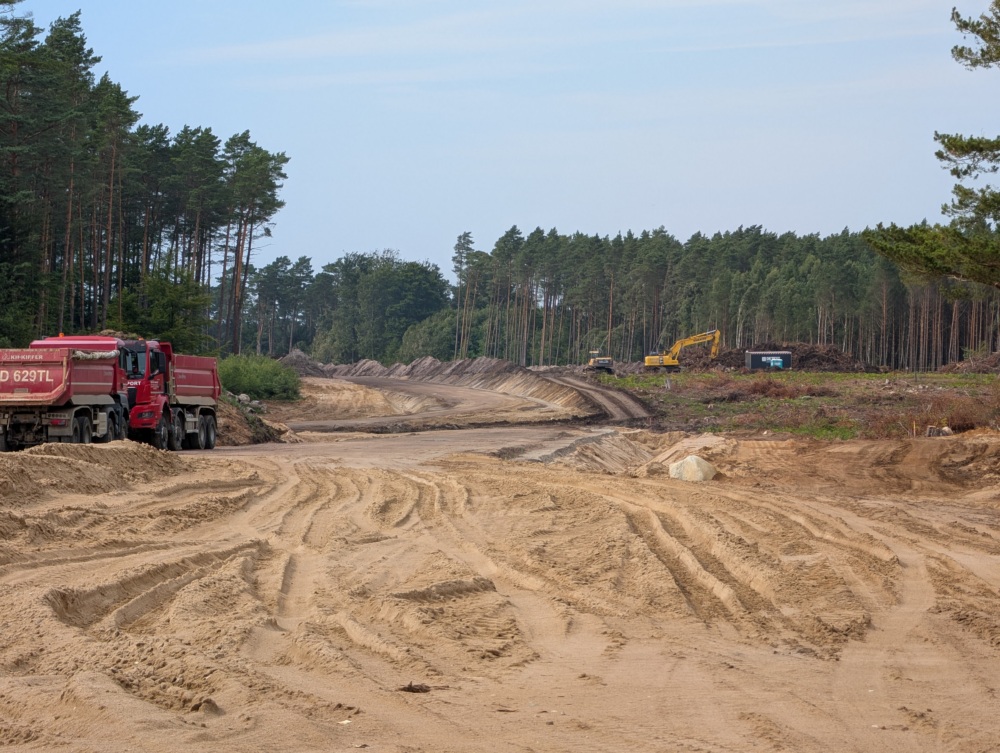
Photo: Forest clearing and heavy machinery used in construction of road and railway infrastructure for the Lubiatowo-Kopalino Nuclear Power Plant, construction between Kopalino and Biebrowo, Poland. Taken July 2026. Credit: Mfloryan, CC BY 4.0, via Wikimedia Commons.