

Industrial and commercial growth is critical to meeting the soaring demand for jobs across Africa. Yet, four out of ten firms in sub-Saharan Africa report unreliable power damages their equipment and holds them back from producing, earning, and hiring more. These figures reflect only the firms captured in available surveys. Many more businesses operate under unreliable power and at lower productivity without being measured, while countless more are never created because reliable electricity is unavailable in the first place.
The result of persistent unreliable power is a self reinforcing cycle: firms leave the grid for self-supply or remain grid-connected while investing in redundant backup systems — sacrificing revenue or paying more for everyday business activities. Utilities also lose revenue as high-consuming, reliably-paying customers leave the grid or reduce grid consumption. Yet they must continue to maintain and upgrade infrastructure for partially-connected firms and other customers. The result is massive utility debt, deteriorating grid quality, higher cost for businesses, poorer service for residential consumers, and a drag on the local economy and jobs.
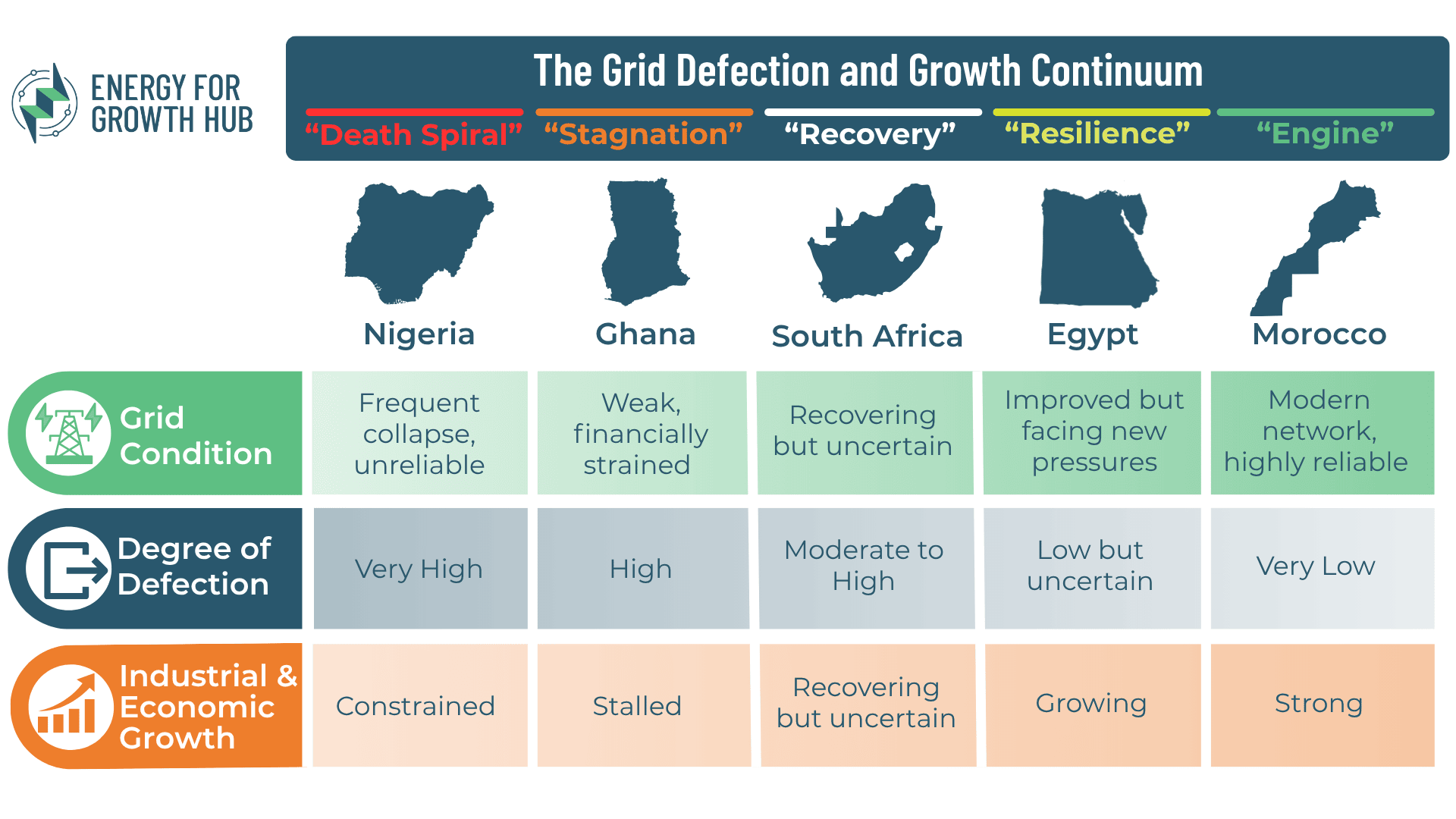
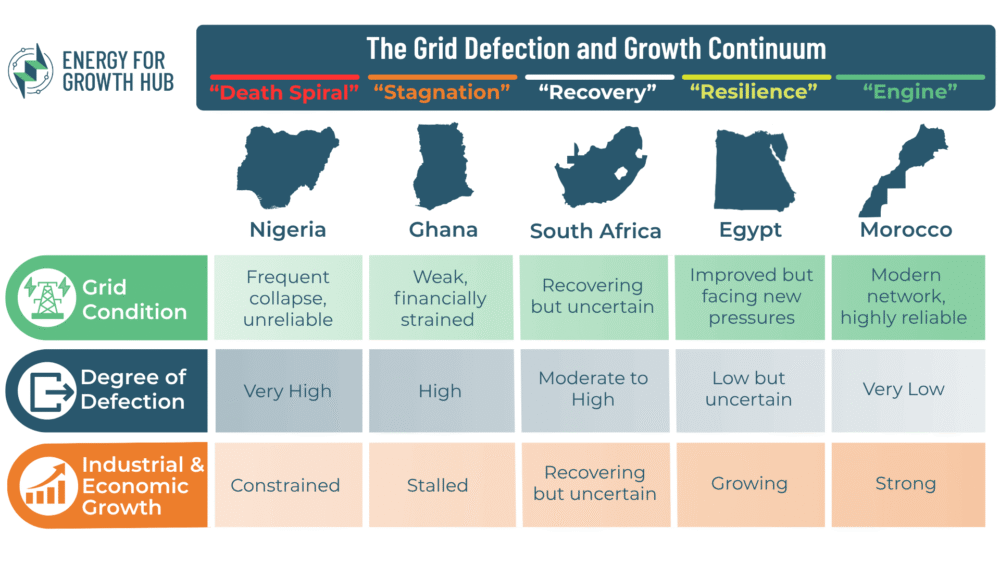
A closer look at five African countries reveals a continuum linking grid defection, utility health, and economic performance.
Nigeria is the starkest example: firms unserved by the grid deflect to self-supply at a scale that rivals the grid, worsening preexisting poor utility conditions, and imposing expensive penalties on industries that want to compete. Ghana follows, where growing grid defection is stagnating the economy. South Africa is navigating an unpredictable recovery. After a prolonged power crisis, South African firms turned to independent power providers, which also relieved pressure on the grid as it recovers. Egypt shows the benefits of improved reliability with new demand causing some uncertainty. And Morocco is the best example of reliable power-fueled economic competitiveness.
Egypt and Morocco are going beyond reliability investment and limiting isolated self-generation while self-generation is serving like a parallel grid and outpacing national grids in Nigeria and Ghana.
“Death Spiral”: Nigeria’s grid failure is causing mass firm defection, utility death spiral, and economic drag.
- Grid condition: Chronic system-wide grid failure. Between 2000-2022, Nigeria recorded 564 partial and complete electricity grid collapses. In April 2026, nearly 70% of installed power capacity was unusable, likely due to transmission bottlenecks.
- How firms respond: Firms leave and build a parallel grid at their own expense. In 2024, more than 250 large firms in Nigeria exited the grid for captive diesel generation paying well above grid tariff rates. Within the first three months of 2025, regulators issued captive power permits totaling nearly 1 gigawatt (GW). Firms disregard the grid entirely for self generation that surpasses national grid capacity.
- How utilities perform: Utilities keep prices low and service continues to decline. In 2025, Nigeria’s electricity subsidy bill was projected to be nearly US$2 billion(₦1.9 trillion). This strains revenue, defers maintenance, and worsens reliability as firms continue to exit.
- Impact on industry and economy: Raised cost of business and economic loss. Back-up electricity raised manufacturers’ total production costs to four-fold those in industrialized economies. The problem dates back more than a decade, when Nigerian businesses reported losing 17% of sales to power outages. Unreliable electricity is costing jobs and billions in economic value (with a whopping annual GDP loss of $29 billion thrown around with little evidence).
“Stagnation”: Ghana’s utility financial stress and firm defection are stagnating economic growth.
- Grid condition: Grid outages followed by financially unsustainable power deals. Between 2011 and 2016, Ghana’s “dumsor” crisis triggered prolonged blackouts. Rushed power contracts signed to close the supply gap later became a major fiscal burden, straining public finances and utility performance.
- How firms respond: Power challenges continue to drive businesses to backup power. Three out of four Ghanaian firms experienced outages in 2023, and nearly 70% owned or shared a generator. Energy-intensive firms such as Unilever and Kasapreko have shifted to dedicated solar or gas captive plants.
- How utilities perform: Utilities are still struggling to emerge from poor power contract debts. By the end of 2023, Ghana’s power sector carried $2.1 billion in independent power procurement legacy arrears (2.8% of GDP). In just 2025 alone, the government paid near US$400 million in legacy debt. The utility has been attempting to raise revenue through tariff updates with some improvements.
- Impact on industry and economy: Stalled industry results in a stalled economy. Ghana’s electricity crisis of 2012–2016 severely reduced firm output and productivity. The impact was acute for firms without generators, who were made even more vulnerable by outages. The crisis was estimated to reduce GDP by approximately 2% in 2014 alone. Consequently, the manufacturing sector has stalled since the 1970s at over 10% of GDP.
“Early Recovery”: South Africa’s grid is recovering, but the economic legacy of the power crisis remains and firms’ return to the grid is not guaranteed.
- Grid condition: After more than a decade-long crisis, the grid is recovering. Load shedding fell sharply in 2024 and 2025 following utility improvements and expanded private power procurement, a stark contrast to 2023, when outages occurred almost daily and 45% of generation capacity was offline.
- How firms respond: Firms and manufacturing abandoned the utility. In 2020, 92% of firms reported having experienced electricity outages. Self-generation surged to 1.2 GW in 2021, and to 6.1 GW by 2024, with business and commercial sectors driving more than 70% of installations.
- How utilities perform: Utility in debt and strained local government revenue. Despite nearly tenfold tariff increases since 2007, power quality deteriorated. Years of power sector failure left the utility in debt, requiring a $15 billion bailout in 2023. Recent reforms are improving performance, unlocking private investment, and giving the utility breathing room to improve power infrastructure.
- Impact on industry and economy: South Africa’s recovery is real, but the economic scars remain and the future is uncertain. At its peak in 2023, load shedding reduced GDP by an estimated 1.5 percentage points. Energy-intensive manufacturing sectors are estimated to have lost 3–7% of jobs during the power crisis. Improving power supply helped lift GDP growth from 0.7% to 1.3% in 2025, but much of the damage remains to be recovered. Additionally, the rapid transition of firms to independent power suppliers is creating a new economic landscape and competing with the utility’s role and long-term financial health.
“Strained Resilience”: Egypt’s reliability improvements kept firms connected, improved the utility, and powered industrial growth — but new challenges test the system.
- Grid condition: Successful decade-long improvement after crisis. Between 2008 to 2014, Egypt experienced severe power outages due to years of underinvestment, growing demand, aging infrastructure, fuel shortages, and subsidies that strained public financing. Since then, a $17 billion investment in modernization and transmission infrastructure, coupled with involvement of the private sector, have helped restore reliable power.
- How firms respond: Reliability improvements and self-generation policies have kept firms on-grid. A decade of reliability improvements have reduced both outage duration and the share of firms affected: the percentage of companies experiencing outages dropped from 80% in 2013 to 35% in 2023. Captive power in Egypt remains limited, about 300 megawatts (MW) in 2018 versus 55 GW of total capacity. Starting in 2023, self-generation above 500 kilowatts (kW) requires prior licensing and grid-integration approval. Industry electricity consumption has been growing overall since 2000, with a decline between 2011-2013.
- How utilities perform: Demonstrated success but facing new pressures and self generation risk. Since 2015, rapid investment in efficiency and power infrastructure, growing private sector involvement, and reduction of subsidies have improved utility conditions. However, recent gas supply constraints and annual 6-7% electricity demand growth is creating new pressure on the grid and utility, raising the risk of self-generation.
- Impact on industry and economy: Maintained industrial and GDP growth. So far, reliable power has helped support sustained economic growth, with Egypt achieving annual real GDP growth above 3% since 2015 (2.4% real GDP in 2024 being an exception due to gas supply constraints). Energy-intensive, non-oil manufacturing like motor vehicles, pharmaceuticals, and textiles and garments grew 14.7% in fiscal year 2024/25. Continued growth will require Egypt’s grid withstand new demand pressures that are causing blackouts in other countries in the region.
“Growth Engine”: Morocco’s high-reliability grid is an engine for sustained industrial expansion and economic growth.
- Grid condition: Highly reliable. Morocco’s National Energy Strategy, launched in 2009, combined renewable energy expansion with transmission modernization. These reforms helped achieve near EU-standard grid stability by 2024, supporting the country’s attractiveness to energy-intensive businesses.
- How firms respond: Grid stability has helped keep and attract new firms. Morocco has been significantly reducing firm outages, going from 35% of firms experiencing outages in 2013, to 11% in 2023. Industry has been steadily growing since 2001, and is the largest electricity consuming sector (35% in 2023). Grid reliability and clean power is also drawing new automotive firms to the country. Similar to Egypt, since 2023, Morocco has required approval for self-generation installations of 5 MW or more and recently created an option to sell excess power back to the grid — ensuring private generation supports rather than overtakes the grid.
- How utilities perform: Improved utility financial health ensured resilience investment. Sector restructuring, tariff reform, and global fuel cost easement drastically reduced the utility’s deficit by 2023. The government also injected EUR 465 million and a EUR 300 million loan from the European Bank for Reconstruction and Development to modernize, decarbonize, and increase resilience of grids.
- Impact on industry and economy: Morocco leads Africa’s industrialization. Morocco now ships more than 500,000 vehicles annually to the EU. Other sectors like aerospace and chemical derivatives have also shown significant growth. Morocco’s GDP growth reached 4.9% in 2025, above the regional average. The African Development Bank’s latest industrialization ranking just gave Morocco the top spot for this consistent industrial growth trajectory.
Conclusion
Manufacturers, miners, and agro-processors in many African economies are abandoning national grids, not out of ideology, but because utilities can no longer deliver the power industry needs to survive.
This blog compares Nigeria, Ghana, South Africa, Egypt, and Morocco and finds them on a spectrum of grid condition, utility health, and economic performance. Nigeria and Ghana both have a high number of firms operating outside the grid, but the economic consequences differ in severity. South Africa’s grid and economy are recovering, driven largely by independent generation and self-supply, though the long-term health of the utility remains uncertain. Egypt and Morocco show that sustained investment in reliability pays off. Egypt’s progress is being tested by new demand pressures, while Morocco just went to the top of Africa’s industrial leaderboard.
Power system health and economic performance move together on a continuum. Weak grids drive firms off the grid, constraining commerce, risking power infrastructure integrity, and ultimately slowing growth and job creation. Countries that invest in stronger, more reliable grids reap the opposite benefits: more grid-connected business, greater commercial activity, lower power costs, and stronger economic growth.